Ada Louise, Dean Catherine M, Lindley Richard, Lloyd Gemma
Discipline of Physiotherapy, Faculty of Health Sciences, The University of Sydney, Sydney, NSW, Australia.
BMC Neurol. 2009 Feb 11;9:8. doi: 10.1186/1471-2377-9-8.
It has been reported that following rehabilitation, only 7% of stroke survivors are able to walk at a level commensurate with community participation. Previous research indicates that treadmill and overground walking training can improve walking capacity in people living in the community after stroke. The main objectives of the AMBULATE trial are to determine (i) whether a 4-month treadmill walking program is more effective than a 2-month program, compared to control, in improving walking capacity, health and community participation and (ii) the "threshold" walking speed that results in sufficient walking capacity that makes walking self-sustaining.
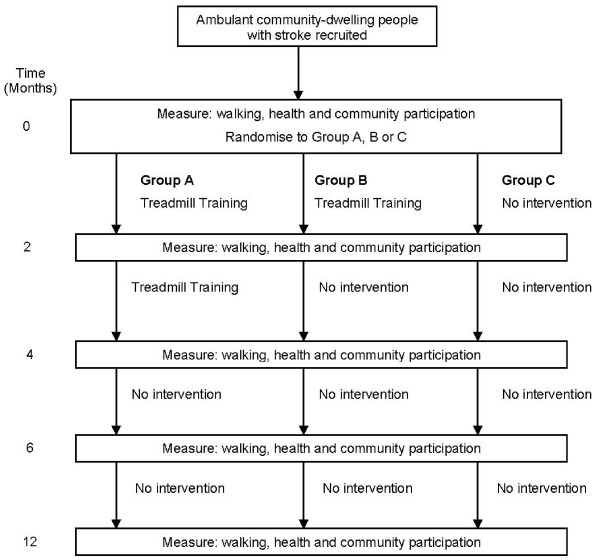
METHODS/DESIGN: A prospective randomised controlled trial of unsupported treadmill training with a 12 month follow-up with concealed allocation and blinded assessment will be conducted. 210 community-dwelling people after stroke who are able to walk independently but slowly will be recruited and randomly allocated to either a 4 month training group, 2 month training group or the control (no intervention) group. Intervention for the two training groups will occur 3 days per week for 30 minutes each session. Measurements of walking, health and community participation will be taken at baseline, 2 months, 4 months, 6 months and 12 months. This study has obtained ethical approval from the relevant Human Research Ethics Committees.
By improving stroke survivors' walking ability, it is likely also to improve their general wellbeing by promoting better health and greater community participation. Furthermore, if stroke survivors can reach a point where their walking and community participation is self-sustaining, this will reduce the burden of care on family and friends as well as the economic burden on the health system. Given the major demographic shift in developed nations involving significant growth in the aged population, this research will make an important evidence-based contribution to the promotion of healthy ageing.
This trial is registered with the Australian New Zealand Clinical Trials Registry, (ACTRN012607000227493).
据报道,康复治疗后,只有7%的中风幸存者能够达到与社区参与相适应的行走水平。先前的研究表明,跑步机行走训练和地面行走训练可以提高中风后社区居民的行走能力。AMBULATE试验的主要目标是确定:(i)与对照组相比,为期4个月的跑步机行走计划在改善行走能力、健康状况和社区参与方面是否比为期2个月的计划更有效;(ii)能产生足够行走能力以使行走能够自我维持的“临界”行走速度。
方法/设计:将进行一项前瞻性随机对照试验,对无支撑跑步机训练进行12个月的随访,采用隐蔽分组和盲法评估。将招募210名能够独立行走但速度较慢的社区中风患者,并随机分配到4个月训练组、2个月训练组或对照组(无干预)。两个训练组的干预将每周进行3天,每次30分钟。将在基线、2个月、4个月、6个月和12个月时测量行走、健康和社区参与情况。本研究已获得相关人类研究伦理委员会的伦理批准。
通过提高中风幸存者的行走能力,还可能通过促进更好的健康状况和更多的社区参与来改善他们的总体幸福感。此外,如果中风幸存者能够达到行走和社区参与能够自我维持的程度,这将减轻家人和朋友的护理负担以及卫生系统的经济负担。鉴于发达国家主要的人口结构转变,老年人口显著增长,这项研究将为促进健康老龄化做出重要的循证贡献。
本试验已在澳大利亚新西兰临床试验注册中心注册,(ACTRN012607000227493)。