Sutherland Andrew P R, Van Belle Tom, Wurster Andrea L, Suto Akira, Michaud Monia, Zhang Dorothy, Grusby Michael J, von Herrath Matthias
Department of Immunology and Infectious Diseases, Harvard School of Public Health, Boston, Massachusetts, USA.
Diabetes. 2009 May;58(5):1144-55. doi: 10.2337/db08-0882. Epub 2009 Feb 10.
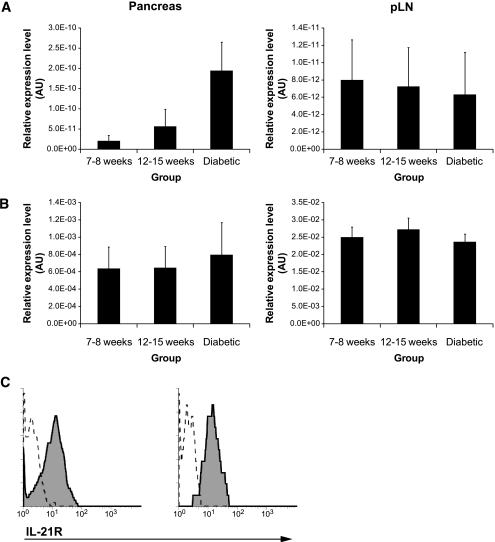
Interleukin (IL)-21 is a type 1 cytokine that has been implicated in the pathogenesis of type 1 diabetes via the unique biology of the nonobese diabetic (NOD) mouse strain. The aim of this study was to investigate a causal role for IL-21 in type 1 diabetes.
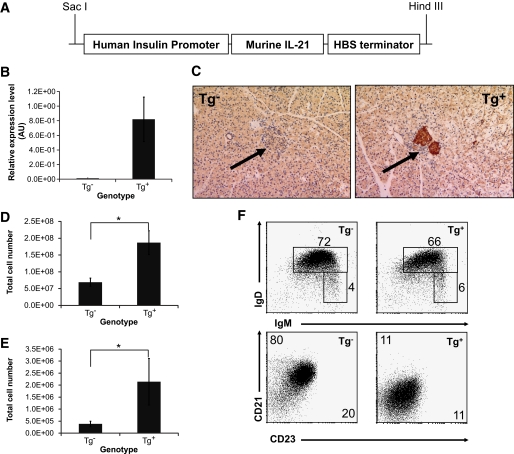
We generated IL-21R-deficient NOD mice and C57Bl/6 mice expressing IL-21 in pancreatic beta-cells, allowing the determination of the role of insufficient and excessive IL-21 signaling in type 1 diabetes.
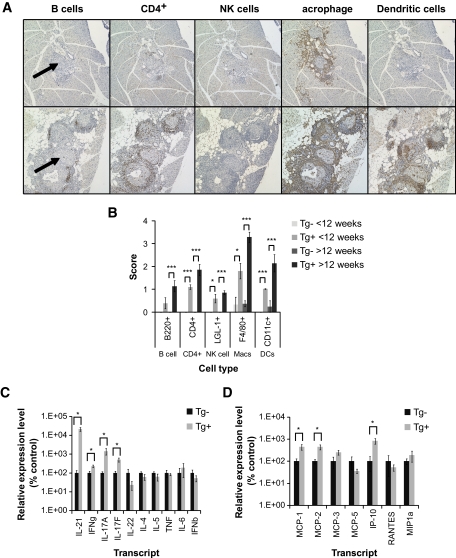
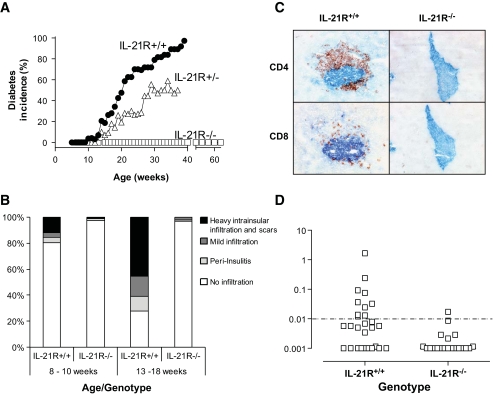
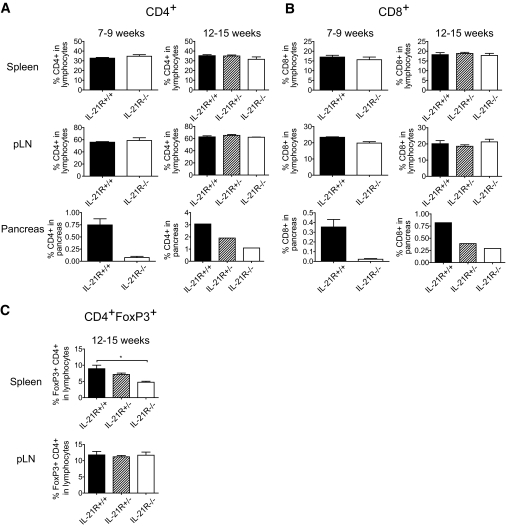
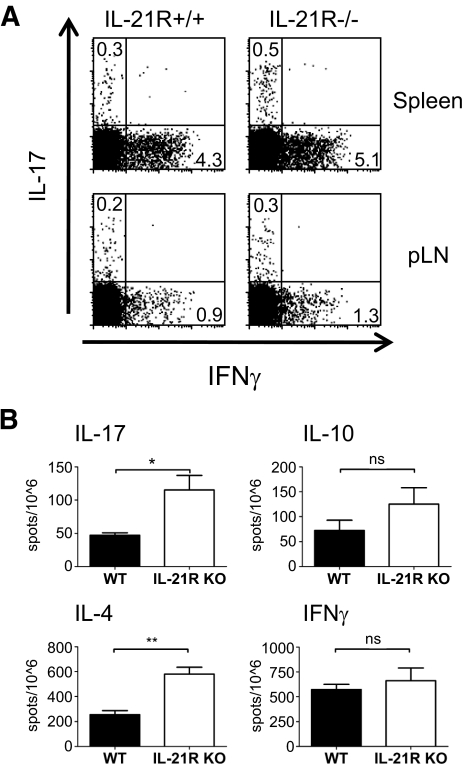
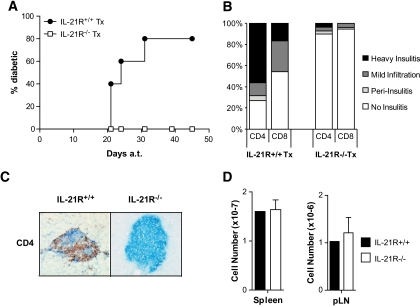
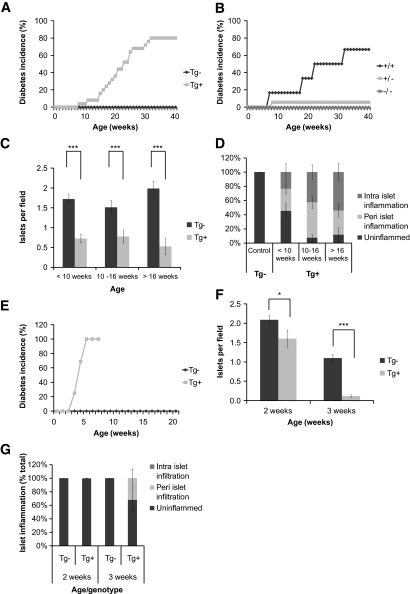
Deficiency in IL-21R expression renders NOD mice resistant to insulitis, production of insulin autoantibodies, and onset of type 1 diabetes. The lymphoid compartment in IL-21R-/- NOD is normal and does not contain an increased regulatory T-cell fraction or diminished effector cytokine responses. However, we observed a clear defect in autoreactive effector T-cells in IL-21R-/- NOD by transfer experiments. Conversely, overexpression of IL-21 in pancreatic beta-cells induced inflammatory cytokine and chemokines, including IL-17A, IL17F, IFN-gamma, monocyte chemoattractant protein (MCP)-1, MCP-2, and interferon-inducible protein-10 in the pancreas. The ensuing leukocytic infiltration in the islets resulted in destruction of beta-cells and spontaneous type 1 diabetes in the normally diabetes-resistant C57Bl/6 and NOD x C57Bl/6 backgrounds.
This work provides demonstration of the essential prodiabetogenic activities of IL-21 on diverse genetic backgrounds (NOD and C57BL/6) and indicates that IL-21 blockade could be a promising strategy for interventions in human type 1 diabetes.
白细胞介素(IL)-21是一种1型细胞因子,通过非肥胖糖尿病(NOD)小鼠品系的独特生物学特性参与1型糖尿病的发病机制。本研究旨在探讨IL-21在1型糖尿病中的因果作用。
我们构建了IL-21R缺陷的NOD小鼠以及在胰腺β细胞中表达IL-21的C57Bl/6小鼠,以确定IL-21信号不足和过量在1型糖尿病中的作用。
IL-21R表达缺陷使NOD小鼠对胰岛炎、胰岛素自身抗体产生及1型糖尿病发病具有抗性。IL-21R-/- NOD小鼠的淋巴细胞区室正常,调节性T细胞比例未增加,效应细胞因子反应也未减弱。然而,通过转移实验我们观察到IL-21R-/- NOD小鼠的自身反应性效应T细胞存在明显缺陷。相反,胰腺β细胞中IL-21的过表达诱导胰腺中炎性细胞因子和趋化因子产生,包括IL-17A、IL17F、IFN-γ、单核细胞趋化蛋白(MCP)-1、MCP-2和干扰素诱导蛋白-10。随后胰岛中的白细胞浸润导致β细胞破坏,并在通常对糖尿病有抗性的C57Bl/6和NOD×C57Bl/6背景下引发自发性1型糖尿病。
本研究证明了IL-21在不同遗传背景(NOD和C57BL/6)下具有促糖尿病的关键活性,并表明阻断IL-21可能是干预人类1型糖尿病的一种有前景的策略。