Special Care Department in Dentistry, Ohu University Dental Hospital, Koriyama city, Fukushima prefecture, Japan.
Ther Clin Risk Manag. 2008 Aug;4(4):721-6. doi: 10.2147/tcrm.s3227.
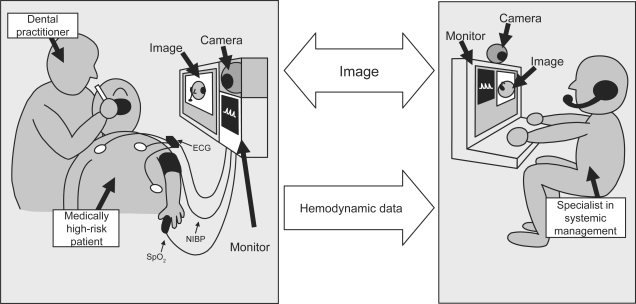
The importance of systemic management to prevent accidents is increasing in dentistry because co-morbid illnesses in an aging society and invasive surgical procedures are increasing. In this prefecture, a new medical system called the remote online hemodynamic monitoring system (ROHMs) was started in 2001. Eight private dental offices participated in this trial. When dental practitioners feel the risk of a dental procedure, they can contact via ROHMs to this hospital. Then, the hemodynamic data (blood pressure, heart rate, ECG, SpO₂, and RPP) of the patient in the clinic can be transmitted here via the internet, and the images and the voice can be transmitted as well. The availability of this system was assessed in 66 patients (98 cases). The most frequent complications were hypertension, heart disease, and diabetes mellitus. Systemic management included monitoring during the dental procedure (71.4%), checking vital signs after an interview (15.3%), and monitoring under sedation (13.3%). There were 35.7% of all cases where an unscheduled procedure was necessary for the systemic management. Based on a questionnaire, the majority of the patients felt relieved and safe. This system creates a situation where a specialist is almost present during the procedure. This system will provide significant assistance for future medical cooperation for risk management.
由于老龄化社会中合并症的增加和侵袭性手术的增加,系统管理对于预防牙科事故的重要性正在增加。在本地区,自 2001 年起开始使用一种名为远程在线血液动力学监测系统(ROHMs)的新医疗系统。有 8 家私人牙科诊所参与了这项试验。当牙科医生感到牙科手术有风险时,可以通过 ROHMs 与本医院联系。然后,可以通过互联网将诊所中患者的血液动力学数据(血压、心率、心电图、SpO₂和 RPP)传输到这里,并可以传输图像和声音。该系统在 66 名患者(98 例)中进行了评估。最常见的并发症是高血压、心脏病和糖尿病。系统管理包括在牙科手术期间进行监测(71.4%)、在访谈后检查生命体征(15.3%)和在镇静下监测(13.3%)。所有病例中有 35.7%需要进行系统性管理以安排手术。根据问卷调查,大多数患者感到放心和安全。该系统创造了一种专家几乎在手术过程中在场的情况。该系统将为未来的风险管理医疗合作提供重要帮助。