Valdimarsdóttir Unnur, Hultman Christina M, Harlow Bernard, Cnattingius Sven, Sparén Pär
Department of Medical Epidemiology and Biostatistics, Karolinska Institutet, Stockholm, Sweden.
PLoS Med. 2009 Feb 10;6(2):e13. doi: 10.1371/journal.pmed.1000013.
Psychotic illness following childbirth is a relatively rare but severe condition with unexplained etiology. The aim of this study was to investigate the impact of maternal background characteristics and obstetric factors on the risk of postpartum psychosis, specifically among mothers with no previous psychiatric hospitalizations.
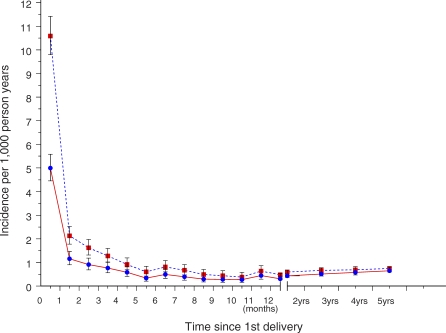
We investigated incidence rates and potential maternal and obstetric risk factors of psychoses after childbirth in a national cohort of women who were first-time mothers from 1983 through 2000 (n = 745,596). Proportional hazard regression models were used to estimate relative risks of psychoses during and after the first 90 d postpartum, among mothers without any previous psychiatric hospitalization and among all mothers. Within 90 d after delivery, 892 women (1.2 per 1,000 births; 4.84 per 1,000 person-years) were hospitalized due to psychoses and 436 of these (0.6 per 1,000 births; 2.38 per 1,000 person-years) had not previously been hospitalized for any psychiatric disorder. During follow-up after the 90 d postpartum period, the corresponding incidence rates per 1,000 person-years were reduced to 0.65 for all women and 0.49 for women not previously hospitalized. During (but not after) the first 90 d postpartum the risk of psychoses among women without any previous psychiatric hospitalization was independently affected by: maternal age (35 y or older versus 19 y or younger; hazard ratio 2.4, 95% confidence interval [CI] 1.2 to 4.7); high birth weight (> or = 4,500 g; hazard ratio 0.3, 95% CI 0.1 to 1.0); and diabetes (hazard ratio 0).
The incidence of psychotic illness peaks immediately following a first childbirth, and almost 50% of the cases are women without any previous psychiatric hospitalization. High maternal age increases the risk while diabetes and high birth weight are associated with reduced risk of first-onset psychoses, distinctly during the postpartum period.
产后精神病是一种相对罕见但严重的疾病,病因不明。本研究的目的是调查产妇背景特征和产科因素对产后精神病风险的影响,特别是在既往无精神科住院史的母亲中。
我们调查了1983年至2000年首次生育的全国队列女性产后精神病的发病率以及潜在的产妇和产科风险因素(n = 745,596)。使用比例风险回归模型估计产后前90天内及之后、既往无任何精神科住院史的母亲以及所有母亲中患精神病的相对风险。分娩后90天内,892名女性(每1000例分娩中有1.2例;每1000人年中有4.84例)因精神病住院,其中436例(每1000例分娩中有0.6例;每1000人年中有2.38例)既往无任何精神科疾病住院史。在产后90天随访期间,所有女性每1000人年的相应发病率降至0.65,既往未住院女性为0.49。在产后的前90天内(但不包括之后),既往无任何精神科住院史的女性患精神病的风险独立受到以下因素影响:产妇年龄(35岁及以上与19岁及以下相比;风险比2.4,95%置信区间[CI]1.2至4.7);高出生体重(≥4500克;风险比0.3,95%CI 0.1至1.0);以及糖尿病(风险比0)。
精神病性疾病的发病率在首次分娩后立即达到峰值,近50%的病例是既往无任何精神科住院史的女性。产妇年龄较大增加风险,而糖尿病和高出生体重与首次发作精神病的风险降低相关,在产后期尤为明显。