Vivancos Valérie, Chen Ping, Spassky Nathalie, Qian Dong, Dabdoub Alain, Kelley Matthew, Studer Michèle, Guthrie Sarah
MRC Centre for Developmental Neurobiology, King's College, Guy's Campus, London, SE1 1UL, UK.
Neural Dev. 2009 Feb 11;4:7. doi: 10.1186/1749-8104-4-7.
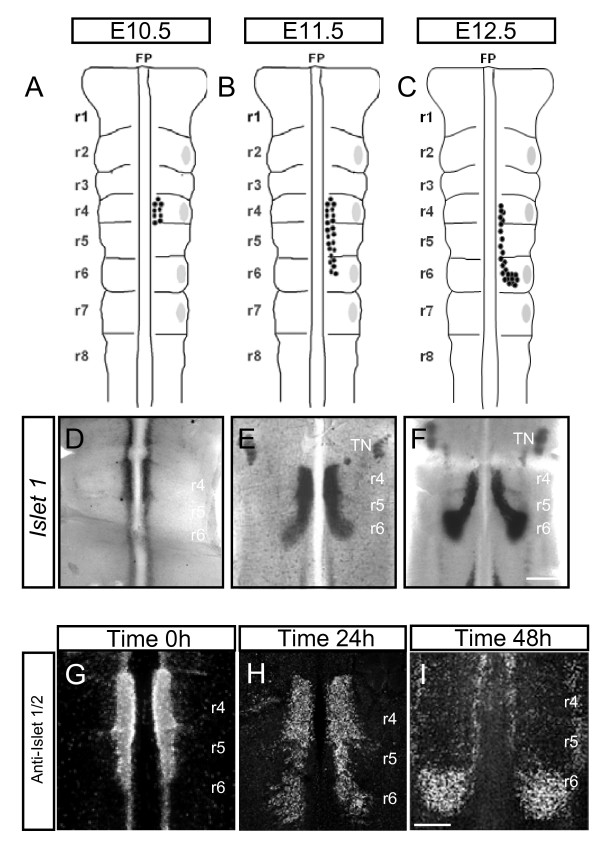
Wnt proteins play roles in many biological processes, including axon guidance and cell migration. In the mammalian hindbrain, facial branchiomotor (FBM) neurons undergo a striking rostral to caudal migration, yet little is known of the underlying molecular mechanisms. In this study, we investigated a possible role of Wnts and the planar cell polarity (PCP) pathway in this process.
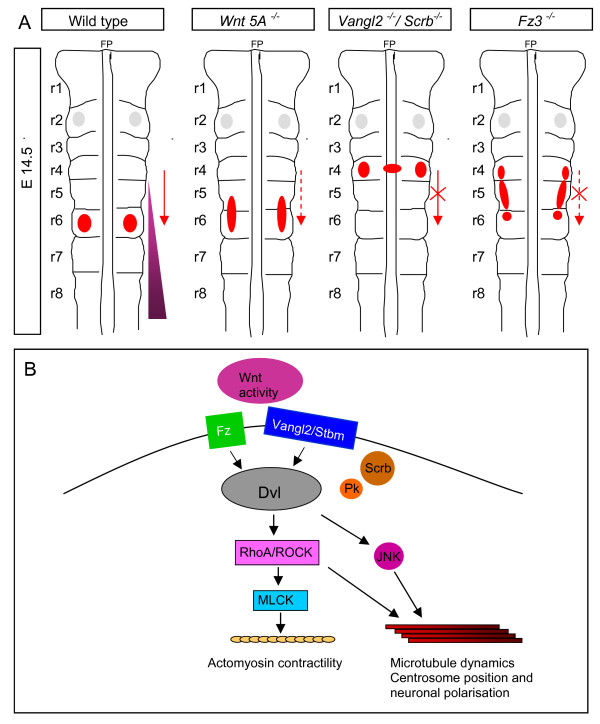
Here we demonstrate a novel role for Wnt proteins in guiding FBM neurons during their rostral to caudal migration in the hindbrain. We found that Wnt5a is expressed in a caudal high to rostral low gradient in the hindbrain. Wnt-coated beads chemoattracted FBM neurons to ectopic positions in an explant migration assay. The rostrocaudal FBM migration was moderately perturbed in Wnt5a mutant embryos and severely disrupted in Frizzled3 mutant mouse embryos, and was aberrant following inhibition of Wnt function by secreted Frizzled-related proteins. We also show the involvement of the Wnt/PCP pathway in mammalian FBM neuron migration. Thus, mutations in two PCP genes, Vangl2 and Scribble, caused severe defects in FBM migration. Inhibition of JNK and ROCK kinases strongly and specifically reduced the FBM migration, as well as blocked the chemoattractant effects of ectopic Wnt proteins.
These results provide in vivo evidence that Wnts chemoattract mammalian FBM neurons and that Wnt5a is a candidate to mediate this process. Molecules of the PCP pathway and the JNK and ROCK kinases also play a role in the FBM migration and are likely mediators of Wnt signalling.
Wnt蛋白在许多生物学过程中发挥作用,包括轴突导向和细胞迁移。在哺乳动物的后脑,面神经分支运动(FBM)神经元经历从吻侧向尾侧的显著迁移,但对其潜在分子机制知之甚少。在本研究中,我们调查了Wnt蛋白和平面细胞极性(PCP)信号通路在此过程中可能发挥的作用。
我们在此证明了Wnt蛋白在引导后脑FBM神经元从吻侧向尾侧迁移过程中具有新的作用。我们发现Wnt5a在后脑中以从尾侧高到吻侧低的梯度表达。在体外迁移试验中,包被Wnt的珠子将FBM神经元化学吸引到异位位置。在Wnt5a突变胚胎中,FBM神经元的吻尾迁移受到中度干扰,在卷曲蛋白3(Frizzled3)突变小鼠胚胎中则严重破坏,并且在分泌型卷曲相关蛋白抑制Wnt功能后出现异常。我们还表明Wnt/PCP信号通路参与了哺乳动物FBM神经元的迁移。因此,两个PCP基因Vangl2和Scribble的突变导致FBM迁移出现严重缺陷。抑制JNK和ROCK激酶强烈且特异性地减少了FBM迁移,同时也阻断了异位Wnt蛋白的化学吸引作用。
这些结果提供了体内证据,表明Wnt蛋白对哺乳动物FBM神经元具有化学吸引作用,并且Wnt5a是介导这一过程的候选分子。PCP信号通路的分子以及JNK和ROCK激酶也在FBM迁移中发挥作用,并且可能是Wnt信号的介质。