Kumar Kota Arun, Baxter Peter, Tarun Alice S, Kappe Stefan H I, Nussenzweig Victor
Department of Pathology, Micheal Hidelberg Division of Immunology, New York University School of Medicine, New York, New York, United States of America.
PLoS One. 2009;4(2):e4480. doi: 10.1371/journal.pone.0004480. Epub 2009 Feb 13.
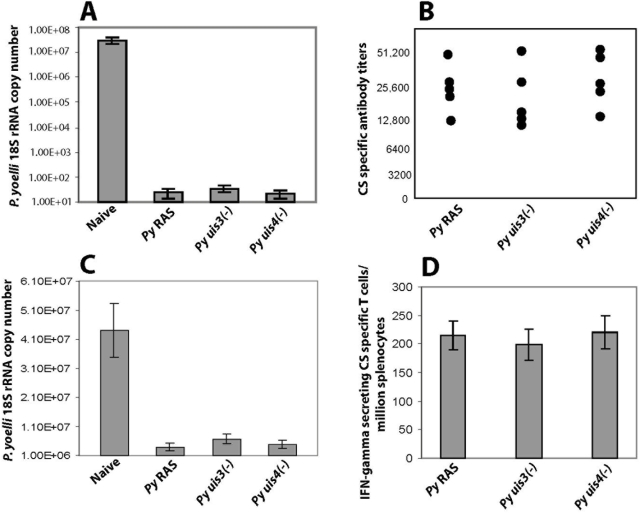
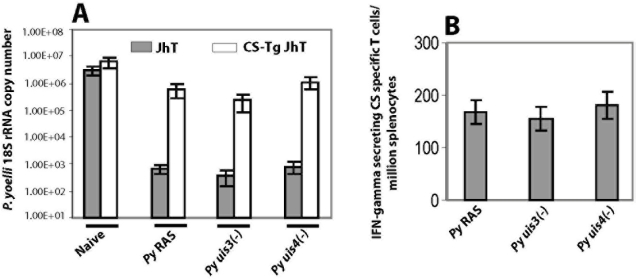
Immunization with radiation attenuated Plasmodium sporozoites (RAS) elicits sterile protective immunity against sporozoite challenge in murine models and in humans. Similarly to RAS, the genetically attenuated sporozoites (GAPs) named uis3(-), uis4(-) and P36p(-) have arrested growth during the liver stage development, and generate a powerful protective immune response in mice. We compared the protective mechanisms in P. yoelii RAS, uis3(-) and uis4(-) in BALB/c mice. In RAS and GAPs, sterile immunity is only achieved after one or more booster injections. There were no differences in the immune responses to the circumsporozoite protein (CSP) generated by RAS and GAPs. To evaluate the role of non-CSP T-cell antigens we immunized antibody deficient, CSP-transgenic BALB/c mice, that are T cell tolerant to CSP, with P. yoelii RAS or with uis3(-) or uis4(-) GAPs, and challenged them with wild type sporozoites. In every instance the parasite liver stage burden was approximately 3 logs higher in antibody deficient CSP transgenic mice as compared to antibody deficient mice alone. We conclude that CSP is a powerful protective antigen in both RAS and GAPs viz., uis3(-) and uis4(-) and that the protective mechanisms are similar independently of the method of sporozoite attenuation.
用辐射减毒疟原虫子孢子(RAS)进行免疫可在小鼠模型和人类中引发针对子孢子攻击的无菌保护性免疫。与RAS类似,名为uis3(-)、uis4(-)和P36p(-)的基因减毒子孢子(GAPs)在肝期发育过程中生长停滞,并在小鼠中产生强大的保护性免疫反应。我们比较了约氏疟原虫RAS、uis3(-)和uis4(-)在BALB/c小鼠中的保护机制。在RAS和GAPs中,只有在一次或多次加强注射后才能实现无菌免疫。RAS和GAPs产生的针对环子孢子蛋白(CSP)的免疫反应没有差异。为了评估非CSP T细胞抗原的作用,我们用约氏疟原虫RAS或uis3(-)或uis4(-) GAPs免疫对CSP具有T细胞耐受性的抗体缺陷型、CSP转基因BALB/c小鼠,并用野生型子孢子对它们进行攻击。在每种情况下,与单独的抗体缺陷小鼠相比,抗体缺陷型CSP转基因小鼠的寄生虫肝期负荷大约高3个对数。我们得出结论,CSP在RAS和GAPs即uis3(-)和uis4(-)中都是一种强大的保护性抗原,并且保护机制相似,与子孢子减毒方法无关。