Takeshima Eriko, Tomimori Koh, Kawakami Hirochika, Ishikawa Chie, Sawada Shigeki, Tomita Mariko, Senba Masachika, Kinjo Fukunori, Mimuro Hitomi, Sasakawa Chihiro, Fujita Jiro, Mori Naoki
Division of Molecular Virology and Oncology, Graduate School of Medicine, University of the Ryukyus, Nishihara, Okinawa, Japan.
BMC Microbiol. 2009 Feb 12;9:36. doi: 10.1186/1471-2180-9-36.
The inflammatory response in Helicobacter pylori-infected gastric tissue is mediated by cag pathogenicity island (PAI)-dependent activation of nuclear factor-kappaB (NF-kappaB). Phosphatidylinositol 3-kinase (PI3K)/Akt signaling is known to play a role in NF-kappaB activation, but little information is available on the relationship between H. pylori and PI3K/Akt signaling in gastric epithelial cells. We examined whether H. pylori activates Akt in gastric epithelial cells, the role of cag PAI in this process and the role of Akt in regulating H. pylori-induced NF-kappaB activation.
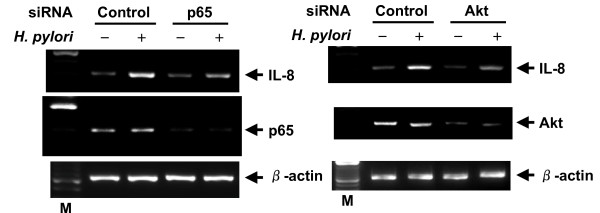
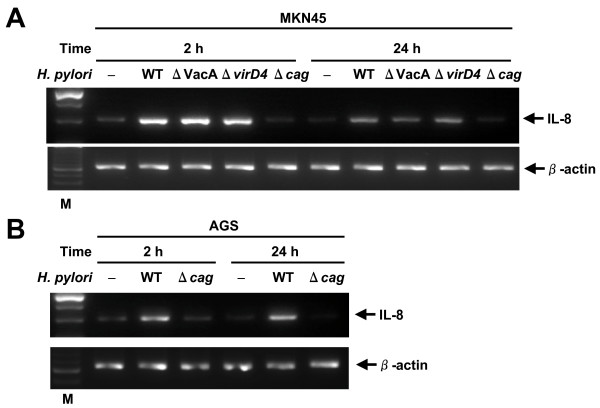
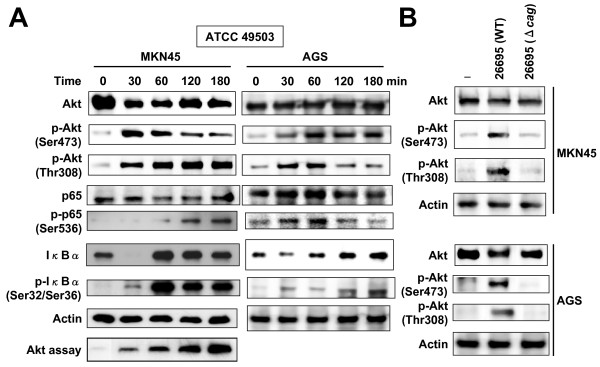
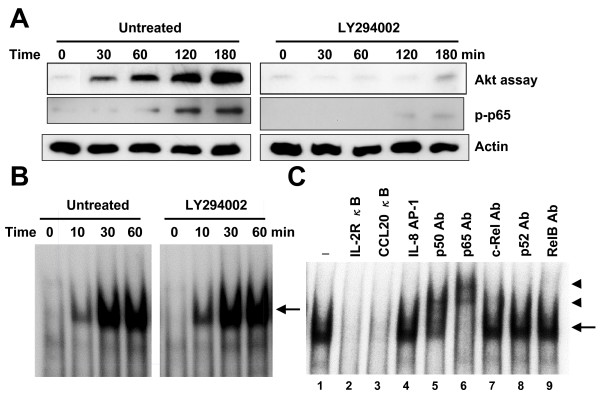
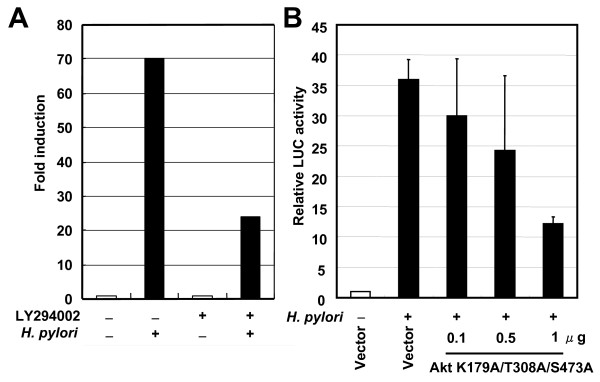
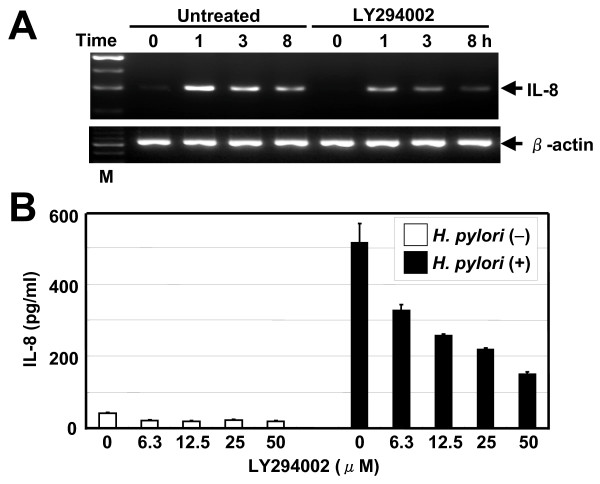
Phosphorylated Akt was detected in epithelial cells of H. pylori-positive gastric tissues. Although Akt was activated in MKN45 and AGS cells by coculture with cag PAI-positive H. pylori strains, a cag PAI-negative mutant showed no activation of Akt. H. pylori also induced p65 phosphorylation. PI3K inhibitor suppressed H. pylori-induced p65 phosphorylation and NF-kappaB transactivation, as well as interleukin-8 expression. Furthermore, transfection with a dominant-negative Akt inhibited H. pylori-induced NF-kappaB transactivation. Transfection with small interference RNAs for p65 and Akt also inhibited H. pylori-induced interleukin-8 expression.
The results suggest that cag PAI-positive H. pylori activates Akt in gastric epithelial cells and this may contribute to H. pylori-mediated NF-kappaB activation associated with mucosal inflammation and carcinogenesis.
幽门螺杆菌感染的胃组织中的炎症反应由细胞毒素相关基因致病性岛(cag PAI)依赖的核因子-κB(NF-κB)激活介导。已知磷脂酰肌醇3-激酶(PI3K)/Akt信号传导在NF-κB激活中起作用,但关于幽门螺杆菌与胃上皮细胞中PI3K/Akt信号传导之间关系的信息较少。我们研究了幽门螺杆菌是否激活胃上皮细胞中的Akt、cag PAI在此过程中的作用以及Akt在调节幽门螺杆菌诱导的NF-κB激活中的作用。
在幽门螺杆菌阳性胃组织的上皮细胞中检测到磷酸化Akt。虽然通过与cag PAI阳性幽门螺杆菌菌株共培养,Akt在MKN45和AGS细胞中被激活,但cag PAI阴性突变体未显示Akt激活。幽门螺杆菌还诱导p65磷酸化。PI3K抑制剂抑制幽门螺杆菌诱导的p65磷酸化和NF-κB反式激活,以及白细胞介素-8表达。此外,用显性负性Akt转染抑制幽门螺杆菌诱导的NF-κB反式激活。用针对p65和Akt的小干扰RNA转染也抑制幽门螺杆菌诱导的白细胞介素-8表达。
结果表明,cag PAI阳性幽门螺杆菌激活胃上皮细胞中的Akt,这可能有助于幽门螺杆菌介导的与黏膜炎症和致癌作用相关的NF-κB激活。