Zhan Wang, Zhang Yu, Mueller Susanne G, Lorenzen Peter, Hadjidemetriou Stathis, Schuff Norbert, Weiner Michael W
University of California San Francisco, VA Medical Center, Department of Radiology, Center of Imaging for Neurodegenerative Diseases, 4150 Clement Street, 114M, San Francisco, CA 94121, USA.
Neuroimage. 2009 Aug;47 Suppl 2:T58-65. doi: 10.1016/j.neuroimage.2009.02.004. Epub 2009 Feb 20.
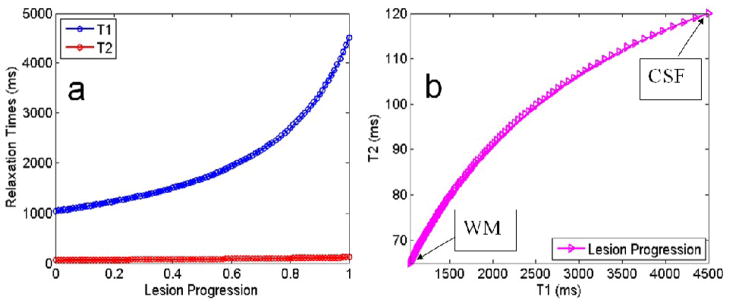
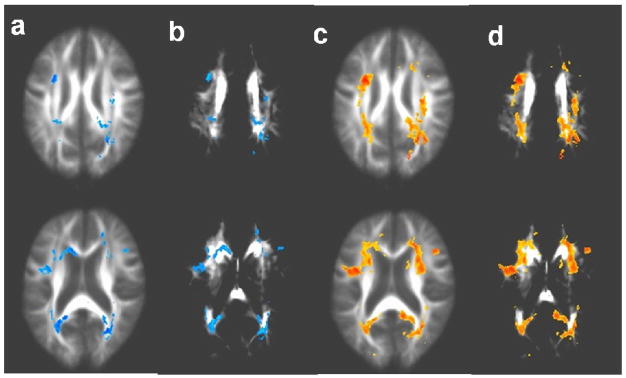
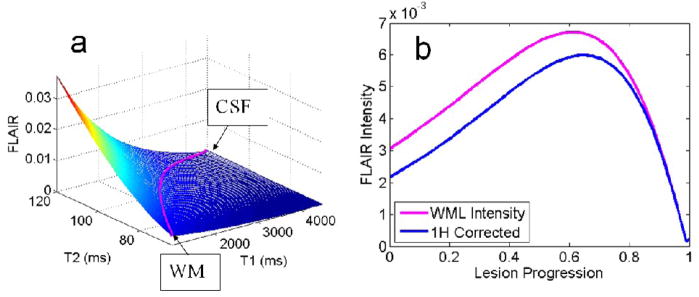
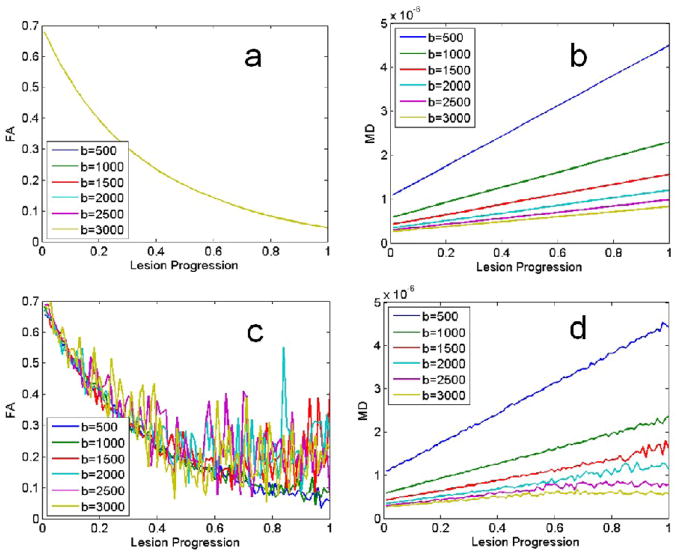
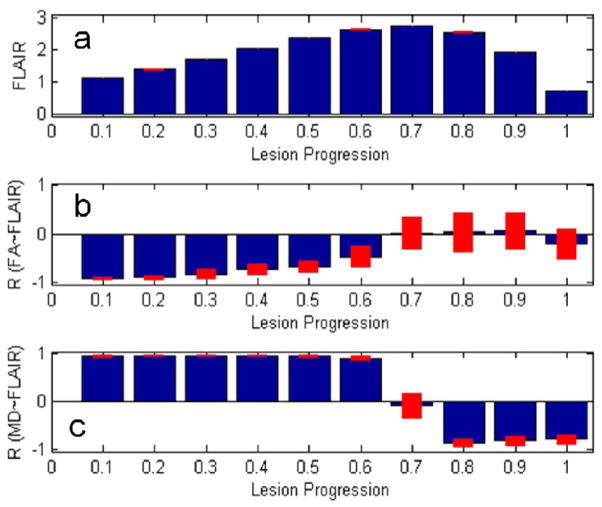
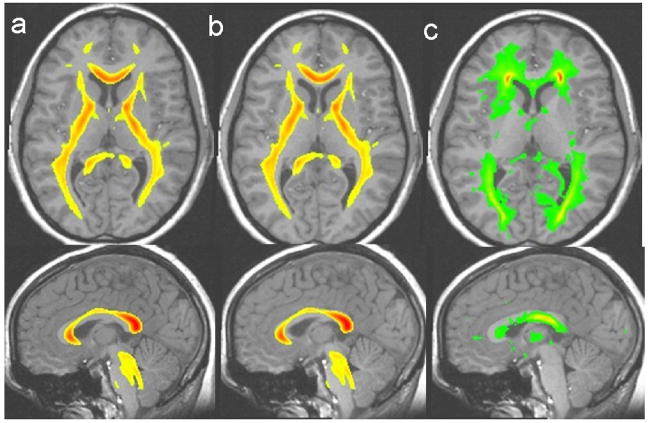
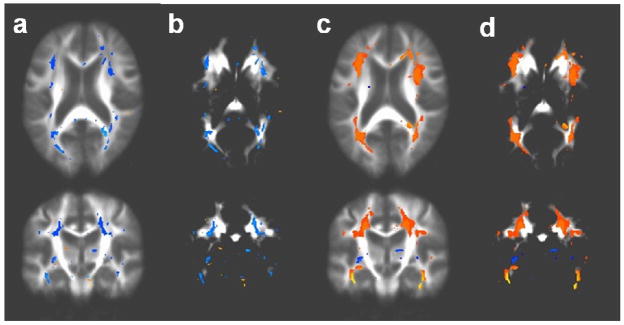
Fluid attenuated inversion recovery (FLAIR) and diffusion tensor imaging (DTI) techniques have been widely used to evaluate white matter (WM) alterations associated with aging, dementia and cerebral vascular disease. The relationship between FLAIR detected WM lesions (WML) and DTI detected WM integrity changes, however, remains unclear. To investigate this association, voxelwise correlations between 4 Tesla DTI and FLAIR images from elderly subjects were performed by relating WML volume and intensity in FLAIR to fractional anisotropy (FA) and mean diffusivity (MD) in DTI. Significant DTI-FLAIR correlations were found in regions overlapping with the WML of moderate intensities in FLAIR. No significant correlations were detected in periventricular regions where the FLAIR intensities are particularly high. The findings are consistent with a transitional model for WM degeneration from normal WM to cerebrospinal fluid (CSF). The results show that the correlation between DTI and FLAIR disappears when the FLAIR intensity of WML reaches its maximum at a certain lesion severity, and that the correlations may remerge with reversed signs when the lesion severity is further increased. These results suggest that the different stages of WM degeneration in elderly subjects can be better characterized by regional DTI-FLAIR correlations than single modality alone.
液体衰减反转恢复(FLAIR)和扩散张量成像(DTI)技术已被广泛用于评估与衰老、痴呆和脑血管疾病相关的白质(WM)改变。然而,FLAIR检测到的WM病变(WML)与DTI检测到的WM完整性变化之间的关系仍不清楚。为了研究这种关联,通过将FLAIR中的WML体积和强度与DTI中的分数各向异性(FA)和平均扩散率(MD)相关联,对老年受试者的4特斯拉DTI和FLAIR图像进行了体素级相关性分析。在与FLAIR中中等强度的WML重叠的区域发现了显著的DTI-FLAIR相关性。在FLAIR强度特别高的脑室周围区域未检测到显著相关性。这些发现与WM从正常WM到脑脊液(CSF)退变的过渡模型一致。结果表明,当WML的FLAIR强度在一定病变严重程度下达到最大值时,DTI与FLAIR之间的相关性消失,而当病变严重程度进一步增加时,相关性可能会以相反的符号重新出现。这些结果表明,与单独使用单一模态相比,通过区域DTI-FLAIR相关性可以更好地表征老年受试者WM退变的不同阶段。