Sureshan Kana M, Riley Andrew M, Rossi Ana M, Tovey Stephen C, Dedos Skarlatos G, Taylor Colin W, Potter Barry V L
Wolfson Laboratory of Medicinal Chemistry, Department of Pharmacy and Pharmacology, University of Bath, Claverton Down, UK Bath BA2 7AY.
Chem Commun (Camb). 2009 Mar 14(10):1204-6. doi: 10.1039/b819328b. Epub 2009 Feb 4.
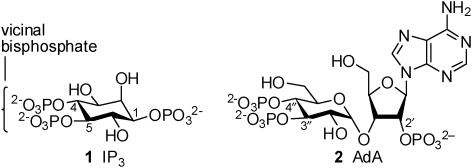
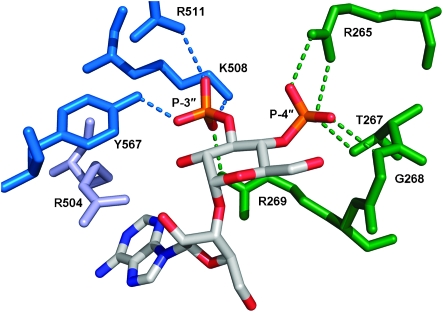
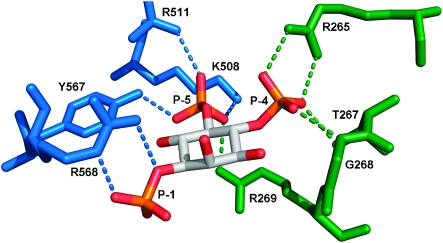
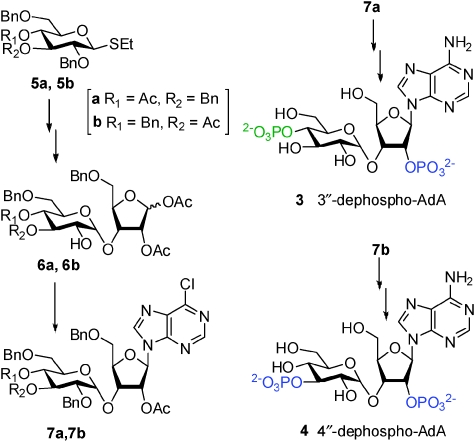
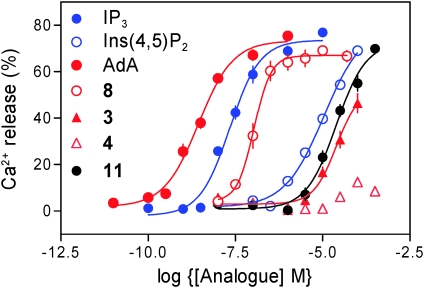
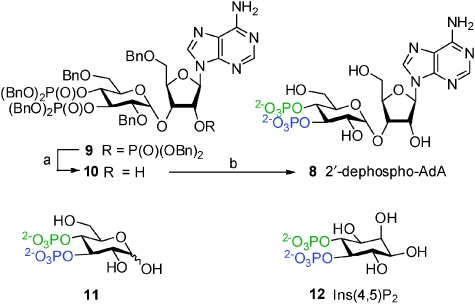
Ca(2+) release by d-myo-inositol 1,4,5-trisphosphate receptors (IP(3)Rs) is widely considered to require the vicinal 4,5-bisphosphate motif of IP(3), with P-5 and P-4 engaging the alpha and beta domains of the binding site; using synthesis and mutagenesis we show that the adenine of synthetic glyconucleotides, through an interaction with Arg504, can replace the interaction of either P-1 or P-5 with the alpha-domain producing, respectively, the most potent bisphosphate agonist yet synthesised and the first agonist of IP(3)R without a vicinal bisphosphate motif; this will stimulate new approaches to IP(3)R ligand design.
由d-肌醇1,4,5-三磷酸受体(IP(3)Rs)介导的Ca(2+)释放普遍被认为需要IP(3)的邻位4,5-二磷酸基序,其中P-5和P-4与结合位点的α和β结构域相互作用;通过合成和诱变,我们发现合成糖核苷酸的腺嘌呤通过与Arg504相互作用,可分别取代P-1或P-5与α结构域的相互作用,从而产生迄今合成的最有效的双磷酸激动剂以及首个没有邻位双磷酸基序的IP(3)R激动剂;这将推动IP(3)R配体设计的新方法。