Catania A, Arnold J, Macaluso A, Hiltz M E, Lipton J M
Department of Physiology, University of Texas Southwestern Medical Center, Dallas 75235-9040.
Proc Natl Acad Sci U S A. 1991 Oct 1;88(19):8544-7. doi: 10.1073/pnas.88.19.8544.
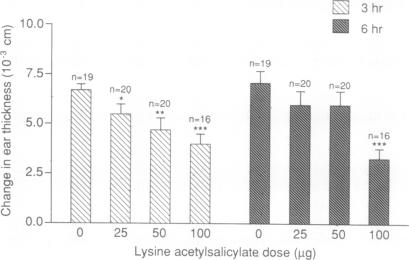
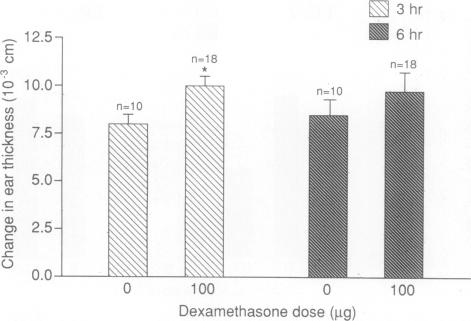
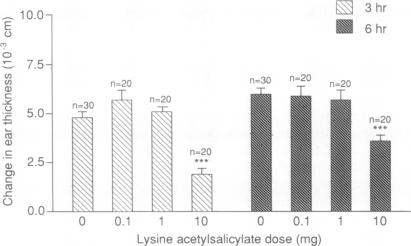
Understanding of the antiinflammatory actions of nonsteroidal drugs is incomplete, but these actions are believed to occur in the periphery, without any contribution from the central nervous system. Recent research on the antipyretic antiinflammatory neuropeptide alpha-melanocyte-stimulating hormone indicates that it can act centrally to inhibit peripheral inflammation; this raises the possibility that other agents, such as nonsteroidal antiinflammatory drugs, may have similar activity. In the present research both lysine acetylsalicylate and sodium salicylate inhibited edema, induced in the mouse ear by topical application of picryl chloride, when injected into the lateral cerebral ventricle. This inhibitory activity on a measure of acute inflammation was not due to escape of the drugs into the periphery, because systemic injection of doses that were effective centrally did not affect inflammation. In contrast, central administration of a dose of indomethacin that was antiinflammatory when given intraperitoneally did not inhibit peripheral inflammation. Thus indomethacin apparently lacks the central antiinflammatory action of the salicylates. This observation, plus our inability to demonstrate either an antiinflammatory effect of intracerebroventricular dexamethasone, a prostaglandin inhibitor, or a pro-inflammatory influence of prostaglandin E2, suggests that prostaglandins are not important to central modulation of inflammation. The results indicate that, in addition to having central influences on fever and pain, salicylates can act within the brain to inhibit acute inflammation in the periphery.
目前对非甾体类药物抗炎作用的理解尚不完整,但据信这些作用发生在外周,中枢神经系统未参与其中。近期关于解热抗炎神经肽α-黑素细胞刺激素的研究表明,它可在中枢发挥作用以抑制外周炎症;这增加了其他药物(如非甾体类抗炎药)可能具有类似活性的可能性。在本研究中,当将赖氨酸乙酰水杨酸酯和水杨酸钠注入小鼠侧脑室时,它们均可抑制因局部涂抹苦味酸氯而在小鼠耳部诱发的水肿。这种对急性炎症指标的抑制活性并非由于药物逸出至外周,因为全身注射有效剂量的药物并未影响炎症反应。相比之下,腹腔注射具有抗炎作用的吲哚美辛剂量进行中枢给药时,并未抑制外周炎症。因此,吲哚美辛显然缺乏水杨酸盐的中枢抗炎作用。这一观察结果,再加上我们无法证明脑室注射前列腺素抑制剂地塞米松具有抗炎作用,也无法证明前列腺素E2具有促炎作用,表明前列腺素对中枢炎症调节并不重要。结果表明,除了对发热和疼痛具有中枢作用外,水杨酸盐还可在脑内发挥作用以抑制外周的急性炎症。