Priviero Fernanda B M, Zemse Saiprasad M, Teixeira Cleber E, Webb R Clinton
Department of Physical Education, Institute of Biosciences, São Paulo State University, UNESP, São Paulo, Brazil.
Am J Hypertens. 2009 May;22(5):493-9. doi: 10.1038/ajh.2009.18. Epub 2009 Feb 26.
BAY 41-2272 (5-cyclopropyl-2-[1-(2-fluoro-benzyl)-1H-pyrazolo[3,4-b]pyridin-3-yl]-pyrimidin-4-ylamine) relaxes mesenteric arteries (MA) in a synergistic fashion with nitric oxide (NO). We hypothesized that the relaxation to BAY 41-2272 is decreased in spontaneously hypertensive rats (SHR) because of the reduced NO bioavailability in this strain and that relaxation would be improved by inhibiting the oxidative stress. We aimed to evaluate the influence of oxidative stress in BAY 41-2272-induced vasorelaxation in isolated MA from SHR.
MA function was evaluated by concentration-response curves to BAY 41-2272. We measured protein expression of endothelial NO synthase (eNOS), soluble guanylyl cyclase (sGC) and human-antigen R (HuR) (sGC mRNA-stabilizing protein), sGC activity and plasma levels of superoxide dismutase (SOD), and total antioxidant status (TAS).
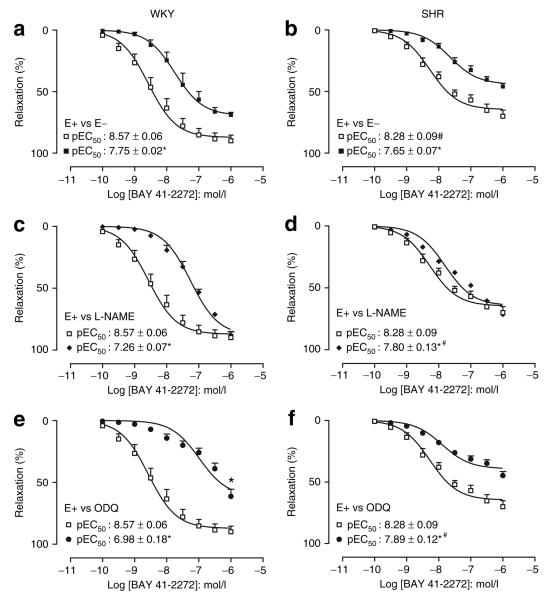
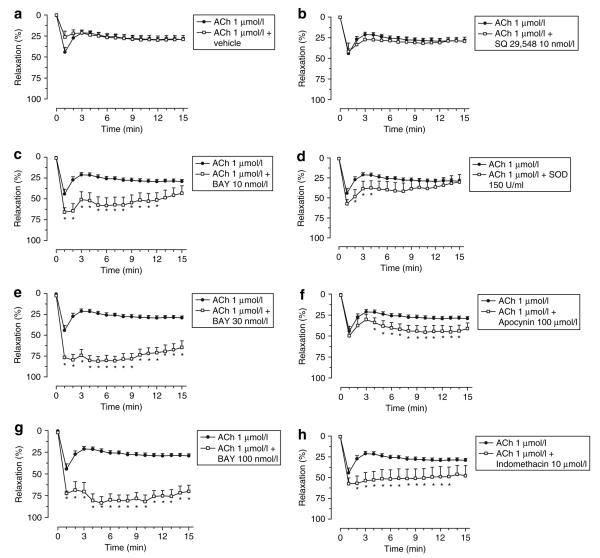
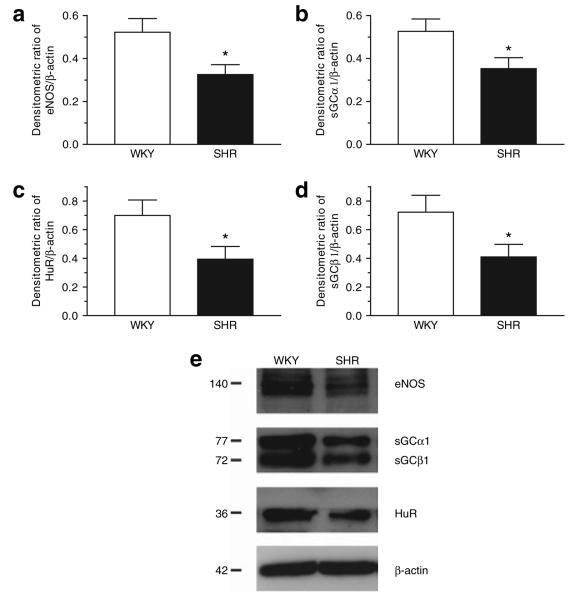
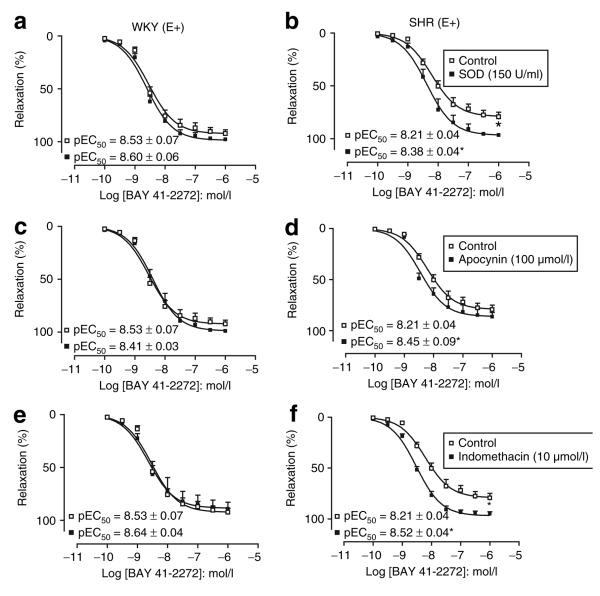
Cyclic guanosine monophosphate (cGMP)-dependent and -independent relaxation induced by BAY 41-2272 (0.0001-1 micromol/l) was impaired in SHR compared with Wistar-Kyoto (WKY). We observed reduced expression of eNOS, sGC and HuR, and decreased sGC activity in SHR. Plasma levels of SOD and TAS were also diminished in SHR. Incubation with SOD or indomethacin increased relaxation to BAY 41-2272 in SHR. Furthermore, acetylcholine (ACh)-induced relaxation was increased in the presence of BAY 41-2272 or SOD, apocynin, or indomethacin.
Augmented oxidative stress in SHR impaired cGMP-dependent and -independent relaxation induced by BAY 41-2272, by decreasing NO bioavailability and sGC expression and by increasing contractile activity. Inhibiton of oxidative stress improved the relaxation of BAY 41-2272 in SHR. BAY 41-2272 might be an alternative therapeutic tool for hypertension if administrated with antioxidant compounds.
BAY 41-2272(5-环丙基-2-[1-(2-氟苄基)-1H-吡唑并[3,4-b]吡啶-3-基]-嘧啶-4-胺)与一氧化氮(NO)协同作用使肠系膜动脉(MA)舒张。我们推测,由于自发性高血压大鼠(SHR)中NO生物利用度降低,其对BAY 41-2272的舒张反应减弱,且抑制氧化应激可改善舒张反应。我们旨在评估氧化应激对SHR离体MA中BAY 41-2272诱导的血管舒张的影响。
通过对BAY 41-2272的浓度-反应曲线评估MA功能。我们检测了内皮型一氧化氮合酶(eNOS)、可溶性鸟苷酸环化酶(sGC)和人抗原R(HuR)(sGC mRNA稳定蛋白)的蛋白表达、sGC活性以及超氧化物歧化酶(SOD)的血浆水平和总抗氧化状态(TAS)。
与Wistar-Kyoto(WKY)大鼠相比,SHR中BAY 41-2272(0.0001 - 1微摩尔/升)诱导的环磷酸鸟苷(cGMP)依赖性和非依赖性舒张受损。我们观察到SHR中eNOS、sGC和HuR的表达降低,sGC活性下降。SHR的血浆SOD水平和TAS也降低。用SOD或吲哚美辛孵育可增加SHR对BAY 41-2272的舒张反应。此外,在存在BAY 41-2272或SOD、阿朴吗啡或吲哚美辛的情况下,乙酰胆碱(ACh)诱导的舒张增强。
SHR中氧化应激增强通过降低NO生物利用度和sGC表达以及增加收缩活性,损害了BAY 41-2272诱导的cGMP依赖性和非依赖性舒张。抑制氧化应激可改善SHR中BAY 41-2272介导的舒张。如果与抗氧化化合物联合给药,BAY 41-2272可能是治疗高血压的一种替代治疗工具。