Koorstra Jan-Bart M, Karikari Collins A, Feldmann Georg, Bisht Savita, Rojas Pamela Leal, Offerhaus G Johan A, Alvarez Hector, Maitra Anirban
Department of Pathology, The Sol Goldman Pancreatic Cancer Research Center, Johns Hopkins University School of Medicine, Baltimore, MD, USA.
Cancer Biol Ther. 2009 Apr;8(7):618-26. doi: 10.4161/cbt.8.7.7923. Epub 2009 Apr 22.
Pancreatic cancer is a near uniformly lethal disease and a better understanding of the molecular basis of this malignancy may lead to improved therapeutics. The Axl receptor tyrosine kinase is implicated in cellular transformation and tumor progression, although its role in pancreatic cancer has not been previously documented.
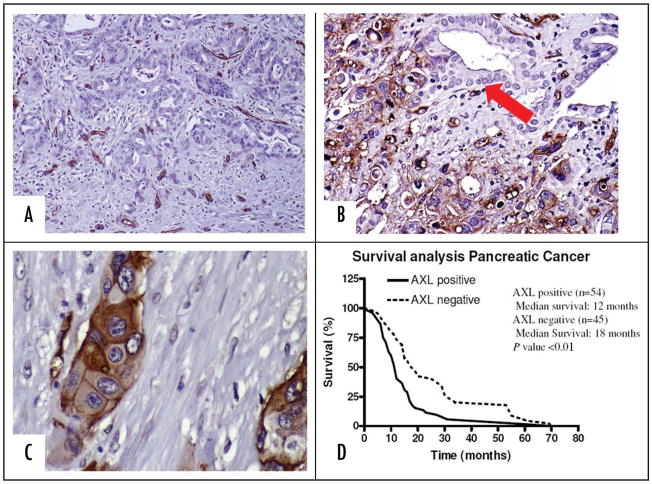
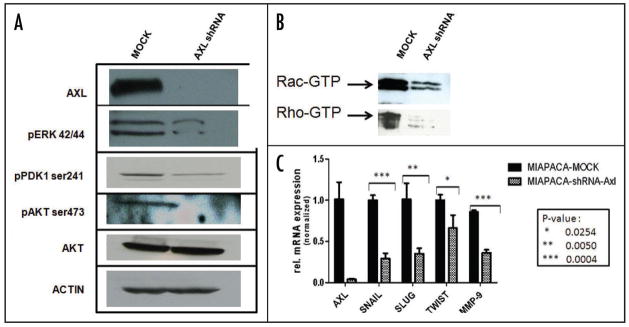
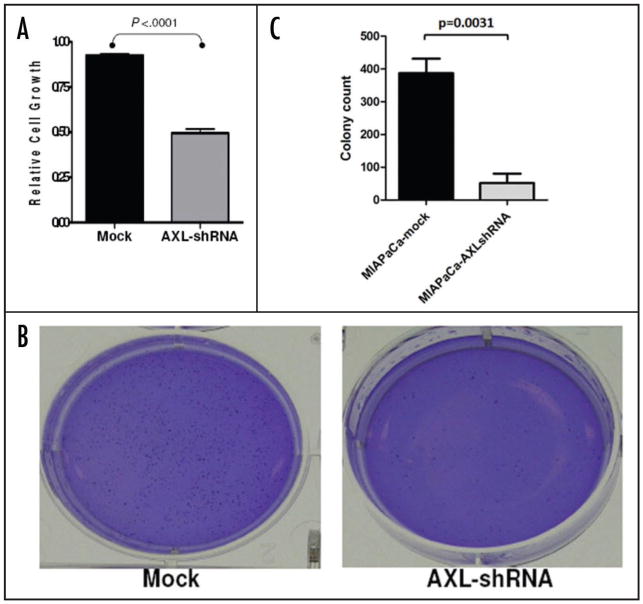
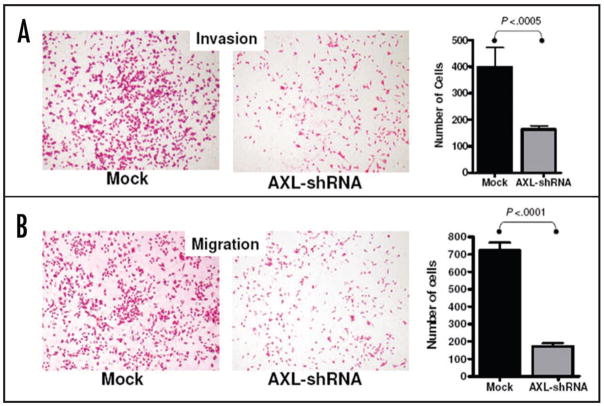
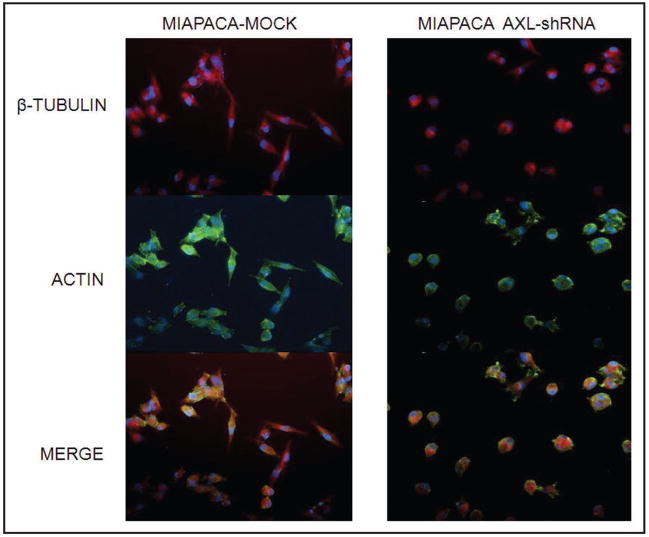
Axl labeling was present in 54 of 99 (55%), and was absent in 45 of 99 (45%) cases, respectively. Axl expression in pancreatic cancer was significantly associated with lymph node metastases (p < 0.01), and a shorter median survival (12 versus 18 months, p < 0.01), than in tumors with negative labeling. Stable knockdown of Axl resulted in significant reduction in cell viability (p < 0.001), anchorage independent growth (p = 0.0031), as well as attenuation of migratory (p < 0.001) and invasive properties (p < 0.005), compared to vector-transfected cells. Profound inhibition of p42/p44 MAP kinase and PI-3kinase/Akt effector pathways was observed in MIAPaCa-2 cells with loss of Axl function. The reduction in invasion and migration upon Axl knockdown was mirrored by a decrease in the amounts of activated (GTP-bound) GTPase proteins Rho and Rac, significant downregulation in transcript levels of the epithelial mesenchymal transition (EMT)-associated transcription factors slug, snail and twist, and significant decrease in matrix metalloproteinase MMP-9 mRNA levels.
The immunohistochemical expression of Axl protein was assessed in a panel of 99 archival pancreatic cancers. Endogenous Axl expression was stably downregulated by lentiviral short hairpin shRNA directed against AXL mRNA in MIAPaCa-2 cells, and the effects on cell viability, anchorage independent growth, invasion, migration and intracellular effector pathways was assessed, by comparing to lentiviral vector-transfected cells.
Expression of Axl tyrosine kinase in pancreatic cancers confers an adverse prognostic influence, and represents a new therapeutic target in this malignancy.
胰腺癌是一种几乎具有一致致死性的疾病,对这种恶性肿瘤分子基础的更好理解可能会带来更好的治疗方法。Axl受体酪氨酸激酶与细胞转化和肿瘤进展有关,尽管其在胰腺癌中的作用此前尚未有文献记载。
99例病例中,54例(55%)有Axl标记,45例(45%)无Axl标记。与无标记的肿瘤相比,胰腺癌中Axl表达与淋巴结转移显著相关(p < 0.01),且中位生存期较短(12个月对18个月,p < 0.01)。与载体转染细胞相比,Axl的稳定敲低导致细胞活力显著降低(p < 0.001)、非锚定依赖性生长(p = 0.0031)以及迁移能力(p < 0.001)和侵袭能力(p < 0.005)减弱。在Axl功能丧失的MIAPaCa - 2细胞中观察到p42/p44丝裂原活化蛋白激酶和PI - 3激酶/蛋白激酶B效应通路受到显著抑制。Axl敲低后侵袭和迁移能力的降低与活化(GTP结合)的GTP酶蛋白Rho和Rac数量减少、上皮 - 间质转化(EMT)相关转录因子slug、snail和twist转录水平显著下调以及基质金属蛋白酶MMP - 9 mRNA水平显著降低相对应。
在一组99例存档胰腺癌中评估Axl蛋白的免疫组化表达。通过针对AXL mRNA的慢病毒短发夹shRNA在MIAPaCa - 2细胞中稳定下调内源性Axl表达,并与慢病毒载体转染细胞相比,评估其对细胞活力、非锚定依赖性生长、侵袭、迁移和细胞内效应通路的影响。
胰腺癌中Axl酪氨酸激酶的表达具有不良预后影响,是这种恶性肿瘤的一个新治疗靶点。