Kaji Keisuke, Norrby Katherine, Paca Agnieszka, Mileikovsky Maria, Mohseni Paria, Woltjen Knut
MRC Centre for Regenerative Medicine, Institute for Stem Cell Research, University of Edinburgh, Edinburgh EH9 3JQ, UK.
Nature. 2009 Apr 9;458(7239):771-5. doi: 10.1038/nature07864. Epub 2009 Mar 1.
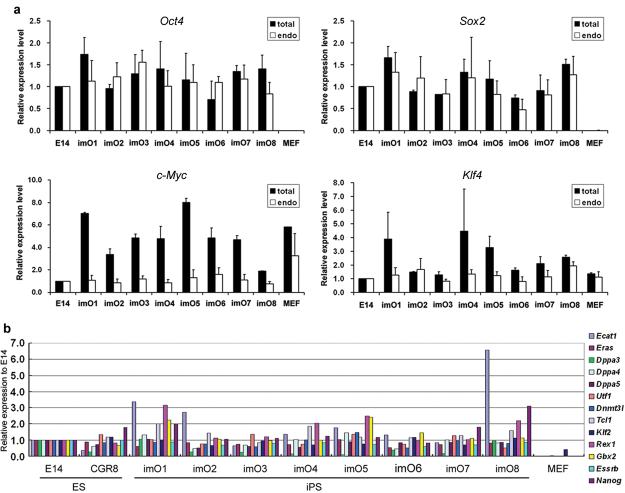
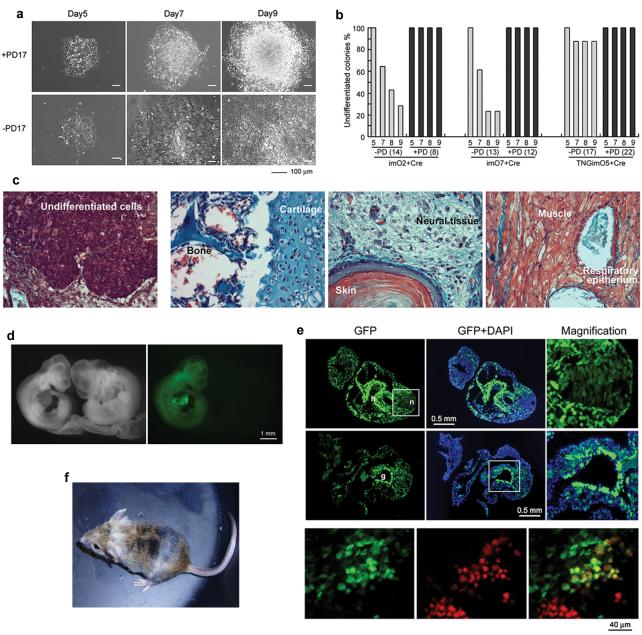
Reprogramming of somatic cells to pluripotency, thereby creating induced pluripotent stem (iPS) cells, promises to transform regenerative medicine. Most instances of direct reprogramming have been achieved by forced expression of defined factors using multiple viral vectors. However, such iPS cells contain a large number of viral vector integrations, any one of which could cause unpredictable genetic dysfunction. Whereas c-Myc is dispensable for reprogramming, complete elimination of the other exogenous factors is also desired because ectopic expression of either Oct4 (also known as Pou5f1) or Klf4 can induce dysplasia. Two transient transfection-reprogramming methods have been published to address this issue. However, the efficiency of both approaches is extremely low, and neither has been applied successfully to human cells so far. Here we show that non-viral transfection of a single multiprotein expression vector, which comprises the coding sequences of c-Myc, Klf4, Oct4 and Sox2 linked with 2A peptides, can reprogram both mouse and human fibroblasts. Moreover, the transgene can be removed once reprogramming has been achieved. iPS cells produced with this non-viral vector show robust expression of pluripotency markers, indicating a reprogrammed state confirmed functionally by in vitro differentiation assays and formation of adult chimaeric mice. When the single-vector reprogramming system was combined with a piggyBac transposon, we succeeded in establishing reprogrammed human cell lines from embryonic fibroblasts with robust expression of pluripotency markers. This system minimizes genome modification in iPS cells and enables complete elimination of exogenous reprogramming factors, efficiently providing iPS cells that are applicable to regenerative medicine, drug screening and the establishment of disease models.
将体细胞重编程为多能性,从而产生诱导多能干细胞(iPS细胞),有望变革再生医学。大多数直接重编程的实例是通过使用多种病毒载体强制表达特定因子来实现的。然而,此类iPS细胞含有大量病毒载体整合序列,其中任何一个都可能导致不可预测的基因功能障碍。虽然c-Myc对于重编程并非必需,但由于Oct4(也称为Pou5f1)或Klf4的异位表达均可诱导发育异常,因此也希望完全消除其他外源性因子。已发表了两种瞬时转染重编程方法来解决这一问题。然而,这两种方法的效率都极低,且迄今为止均未成功应用于人类细胞。在此我们表明,单个多蛋白表达载体的非病毒转染可重编程小鼠和人类成纤维细胞,该载体包含与2A肽相连的c-Myc、Klf4、Oct4和Sox2的编码序列。此外,一旦重编程完成,转基因即可去除。用这种非病毒载体产生的iPS细胞显示出多能性标志物的强劲表达,表明通过体外分化试验和成年嵌合小鼠的形成在功能上得到确认的重编程状态。当单载体重编程系统与piggyBac转座子结合时,我们成功地从胚胎成纤维细胞建立了具有多能性标志物强劲表达的重编程人类细胞系。该系统将iPS细胞中的基因组修饰降至最低,并能完全消除外源性重编程因子,有效地提供适用于再生医学、药物筛选和疾病模型建立的iPS细胞。