Huang Yu-Fen, Shangguan Dihua, Liu Haipeng, Phillips Joseph A, Zhang Xiaoling, Chen Yan, Tan Weihong
Department of Chemistry, Shands Cancer Center and Center for Research at Bio/Nano Interface, Genetics Institute and McKnight Brain Institute, University of Florida, Gainesville, FL 32611, USA.
Chembiochem. 2009 Mar 23;10(5):862-8. doi: 10.1002/cbic.200800805.
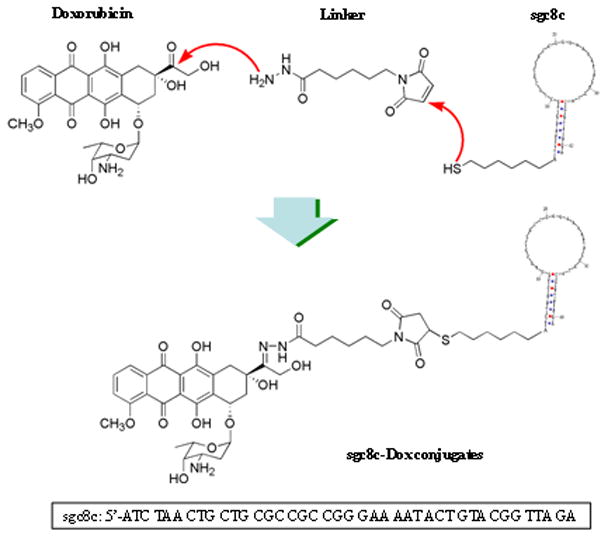
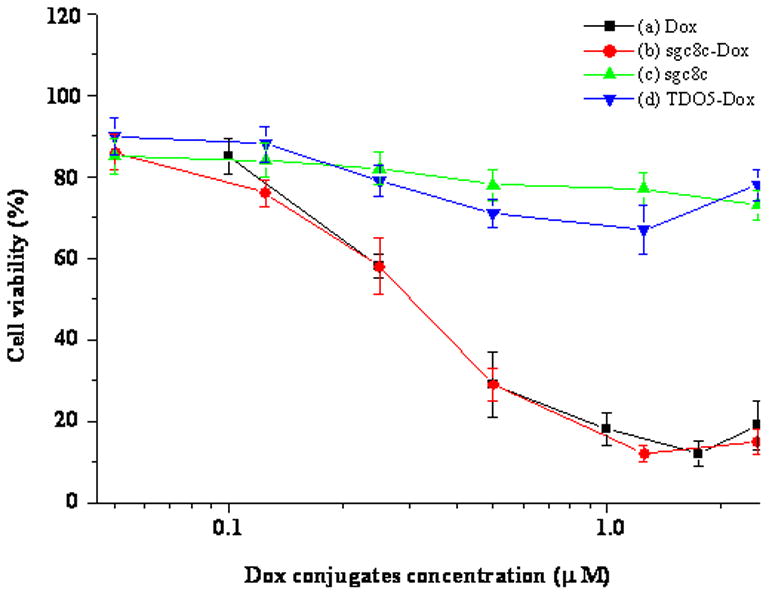
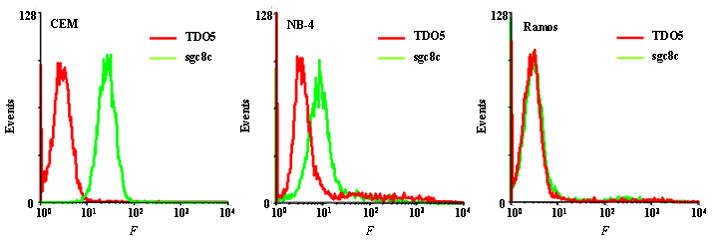
The conjugation of antitumor drugs to targeting reagents such as antibodies is a promising method that can increase the efficacy of chemotherapy and reduce the overall toxicity of the drugs. In this study, we covalently link the antitumor agent doxorubicin (Dox) to the DNA aptamer sgc8c, which was selected by the cell-SELEX method. In doing so, we expected that this sgc8c-Dox conjugate would specifically kill the target CCRF-CEM (T-cell acute lymphoblastic leukemia, T-cell ALL) cells, but with minimal toxicity towards nontarget cells. The results demonstrated that the sgc8c-Dox conjugate possesses many of the properties of the sgc8c aptamer, including high binding affinity (K(d)=2.0+/-0.2 nM) and the capability to be efficiently internalized by target cells. Moreover, due to the specific conjugation method, the acid-labile linkage connecting the sgc8c-Dox conjugate can be cleaved inside the acidic endosomal environment. Cell viability tests demonstrate that the sgc8c-Dox conjugates not only possess potency similar to unconjugated Dox, but also have the required molecular specificity that is lacking in most current targeted drug delivery strategies. Furthermore, we found that nonspecific uptake of membrane-permeable Dox to nontarget cell lines could also be inhibited by linking the drug with the aptamer; thus, the conjugates are selective for cells that express higher amounts of target proteins. Compared to the less effective Dox-immunoconjugates, these sgc8c-Dox conjugates make targeted chemotherapy more feasible with drugs having various potencies. When combined with the large number of recently created DNA aptamers that specifically target a wide variety of cancer cells, this drug-aptoconjugation method will have broad implications for targeted drug delivery.
将抗肿瘤药物与诸如抗体等靶向试剂偶联是一种很有前景的方法,它可以提高化疗效果并降低药物的总体毒性。在本研究中,我们将抗肿瘤药物阿霉素(Dox)与通过细胞指数富集的配体系统进化技术(cell-SELEX)筛选出的DNA适配体sgc8c共价连接。我们期望这种sgc8c-Dox偶联物能够特异性地杀死靶标CCRF-CEM(T细胞急性淋巴细胞白血病,T细胞ALL)细胞,但对非靶标细胞的毒性最小。结果表明,sgc8c-Dox偶联物具有sgc8c适配体的许多特性,包括高结合亲和力(K(d)=2.0±0.2 nM)以及被靶标细胞有效内化的能力。此外,由于特定的偶联方法,连接sgc8c-Dox偶联物的酸不稳定键可以在酸性内体环境中被裂解。细胞活力测试表明,sgc8c-Dox偶联物不仅具有与未偶联的Dox相似的效力,而且具有当前大多数靶向药物递送策略所缺乏的所需分子特异性。此外,我们发现通过将药物与适配体连接,也可以抑制膜通透性Dox对非靶标细胞系的非特异性摄取;因此,偶联物对表达较高量靶标蛋白的细胞具有选择性。与效果较差的Dox免疫偶联物相比,这些sgc8c-Dox偶联物使具有各种效力的药物进行靶向化疗变得更加可行。当与大量最近创建的特异性靶向多种癌细胞的DNA适配体相结合时,这种药物-适配体偶联方法将对靶向药物递送具有广泛的意义。