Green Kayla N, Brothers Scott M, Lee Boram, Darensbourg Marcetta Y, Rockcliffe David A
Department of Chemistry, Texas A&M University, College Station, Texas 77845, USA.
Inorg Chem. 2009 Apr 6;48(7):2780-92. doi: 10.1021/ic801628r.
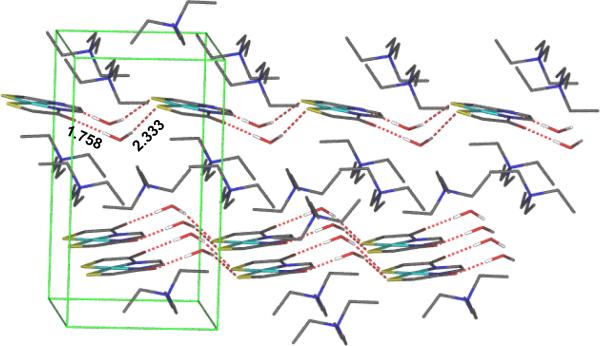
The discovery of the metallopeptide Ni(Cysteine-Glycine-Cysteine)(2-), Ni(CGC)(2-), in the A-cluster active site of Acetyl CoA Synthase has prompted the synthesis of many small molecule models which employ M(N(2)S(2)) complexes as metalloligands. In vitro studies have shown that nickel incorporates into the N(2)S(2) binding pocket even when copper is in the enzyme growth medium, while copper is preferentially taken up in the proximal site, displacing the catalytically active nickel. (Darnault, C.; Volbeda, A.; Kim, E.J.; Legrand, P.; Vernede, X.; Lindahl, P.A.; Fontecilla-Camps, J.C. Nat. Struct. Biol. 2003, 10, 271-279.) The work herein has been designed to address the chemical viability of copper(II) within the tripeptide N(2)S(2) ligand set. To this end, a series of CuN(2)S(2)(2-) complexes, the resin-bound, O-Cu(CGC)(2-) (A) and free Cu(CGC)(2-) (B) complexes, as well as Cu(ema)(2-) (C) and Cu(emi)(2-) (D) dianions, have been characterized by UV-vis, electron paramagnetic resonance (EPR), and electrospray ionization mass spectrometry (ESI-MS) spectroscopies, cyclic voltammetry (CV), and, where appropriate, X-ray diffraction studies, and compared to the Ni(II) congeners. EPR spectroscopic results have indicated that, in frozen N,N-dimethylformamide (DMF) solution, the copper complexes are distorted square planar structures with nitrogen and sulfur donors. This is consistent with X-ray diffraction measurements which also show copper(II) in a distorted square planar environment that is bereft of CuN(2)S(2)(2-) intermolecular interactions. Density-functional theory (DFT) calculations resulted in optimized structures that are consistent with crystallographic data and indicated highest occupied molecular orbital (HOMO)-singly occupied molecular orbital (SOMO) gaps of 5.01 and 4.68 eV for C and D, respectively. Optimized structures of Ni(ema)(2-) and Ni(emi)(2-) share the same basic characteristics as the copper(II) congeners. Electrochemical characterization of C and D resulted in a reversible Cu(III/II) couple at -1.20 V and - 1.40 V, respectively. Reactivity studies with Rh(CO)(2)(+) show similar donor capabilities for complexes A-D. Analysis of A shows that transmetalation does not occur. From competitive metal uptake studies on immobilized tripeptide it is concluded that the N(2)S(2)(4-) ligating unit has a slight preference for Cu(2+) over Ni(2+) and that the biosynthetic pathway responsible for constructing the distal site of ACS must be selective for nickel insertion or copper exclusion, or both.
在乙酰辅酶A合成酶的A簇活性位点发现金属肽Ni(半胱氨酸-甘氨酸-半胱氨酸)(2-),即Ni(CGC)(2-),促使人们合成了许多以M(N₂S₂)配合物作为金属配体的小分子模型。体外研究表明,即使铜存在于酶的生长培养基中,镍也会掺入N₂S₂结合口袋,而铜则优先占据近端位点,取代具有催化活性的镍。(达尔诺,C.;沃尔贝达,A.;金,E.J.;勒格朗,P.;韦尔内德,X.;林达尔,P.A.;丰特西拉-坎普斯,J.C.《自然结构生物学》,2003年,第10卷,第271 - 279页。)本文的工作旨在探讨铜(II)在三肽N₂S₂配体体系中的化学活性。为此,通过紫外可见光谱、电子顺磁共振(EPR)、电喷雾电离质谱(ESI-MS)光谱、循环伏安法(CV)以及在适当情况下的X射线衍射研究,对一系列CuN₂S₂(2-)配合物,即树脂结合的O-Cu(CGC)(2-)(A)和游离的Cu(CGC)(2-)(B)配合物,以及Cu(ema)(2-)(C)和Cu(emi)(2-)(D)二价阴离子进行了表征,并与镍(II)同类物进行了比较。EPR光谱结果表明,在冷冻的N,N-二甲基甲酰胺(DMF)溶液中,铜配合物为具有氮和硫供体的扭曲平面正方形结构。这与X射线衍射测量结果一致,该测量结果也表明铜(II)处于缺乏CuN₂S₂(2-)分子间相互作用的扭曲平面正方形环境中。密度泛函理论(DFT)计算得出的优化结构与晶体学数据一致,表明C和D的最高占据分子轨道(HOMO)-单占据分子轨道(SOMO)间隙分别为5.01和4.68 eV。Ni(ema)(2-)和Ni(emi)(2-)的优化结构与铜(II)同类物具有相同的基本特征。C和D的电化学表征分别在-1.20 V和-1.40 V处得到可逆的Cu(III/II)偶合。与Rh(CO)₂(+)的反应性研究表明配合物A - D具有相似的供体能力。对A的分析表明没有发生金属转移。通过对固定化三肽的竞争性金属摄取研究得出结论,N₂S₂(4-)连接单元对Cu(2+)的偏好略高于Ni(2+),并且负责构建乙酰辅酶A合成酶远端位点的生物合成途径必须对镍插入或铜排除或两者都具有选择性。