Tuzcu Volkan, Nas Selman, Ulusar Umit, Ugur Ahmet, Kaiser Jeffrey R
Arkansas Children's Hospital, Division of Cardiology, 1900 Maryland, Mail Slot 512-3, Little Rock, AR 72202, USA.
Pediatrics. 2009 Mar;123(3):810-5. doi: 10.1542/peds.2008-0253.
Intraventricular hemorrhage remains an important problem among very low birth weight infants and may result in long-term neurodevelopmental disabilities. Neonatologists have been unable to accurately predict impending intraventricular hemorrhage. Because alterations in the autonomic nervous system's control of heart rhythm have been associated with intraventricular hemorrhage after its development, we sought to determine if early subtle alterations of heart rhythm could be predictive of impending intraventricular hemorrhage in very low birth weight infants.
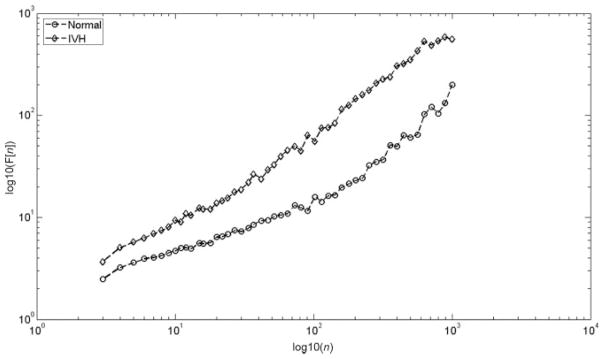
This case-control study included 10 newborn very low birth weight infants with intraventricular hemorrhage (5 grade IV, 4 grade III, and 1 grade II) and 14 control infants without intraventricular hemorrhage. Heart rhythm data from the first day of life before the development of intraventricular hemorrhage were evaluated. Detrended fluctuation analysis, a nonlinear fractal heart rate variability method, was used to assess the fractal dynamics of the heart rhythm. Fractal scaling exponents were calculated by using this analysis.
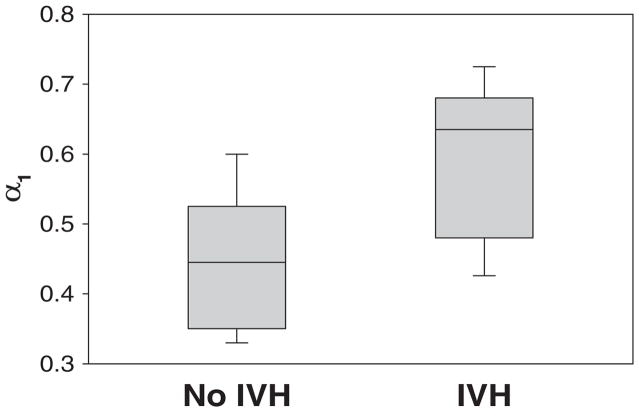
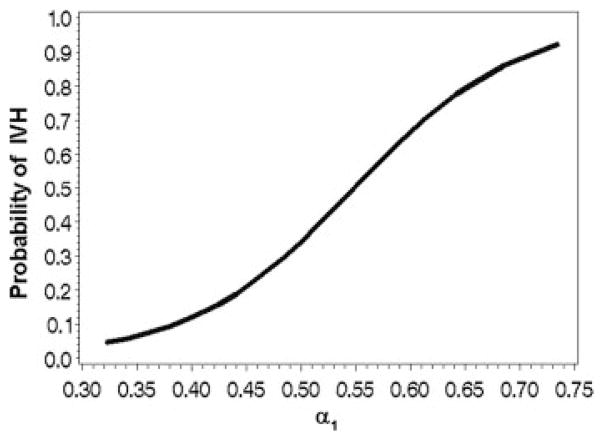
Twenty-four infants (mean +/- SD, birth weight: 845 +/- 213g: gestational age: 26.1 +/- 1.9 weeks) participated in the study. The short-term scaling exponent was significantly larger in infants who later developed intraventricular hemorrhage compared with those who did not (0.60 +/- 0.1 vs 0.45 +/- 0.1). A value of 0.52 resulted in 70% sensitivity and positive predictive value and 79% specificity and negative predictive value. The short-term scaling exponent was the only significant predictor of intraventricular hemorrhage.
Fractal dynamics of the heart rhythm is significantly altered in very low birth weight infants before developing intraventricular hemorrhage and may be predictive of impending intraventricular hemorrhage.
脑室内出血在极低出生体重儿中仍然是一个重要问题,可能导致长期神经发育残疾。新生儿科医生一直无法准确预测即将发生的脑室内出血。由于自主神经系统对心律的控制改变与脑室内出血发生后有关,我们试图确定心律的早期细微改变是否可预测极低出生体重儿即将发生的脑室内出血。
这项病例对照研究纳入了10例发生脑室内出血的极低出生体重新生儿(5例IV级、4例III级和1例II级)和14例无脑室内出血的对照婴儿。评估脑室内出血发生前出生第一天的心律数据。去趋势波动分析是一种非线性分形心率变异性方法,用于评估心律的分形动力学。通过该分析计算分形标度指数。
24例婴儿(平均±标准差,出生体重:845±213g;胎龄:26.1±1.9周)参与了研究。与未发生脑室内出血的婴儿相比,后来发生脑室内出血的婴儿短期标度指数显著更大(0.60±0.1对0.45±0.1)。0.52的值产生了70%的敏感性和阳性预测值以及79%的特异性和阴性预测值。短期标度指数是脑室内出血的唯一显著预测指标。
极低出生体重儿在发生脑室内出血之前,心律的分形动力学有显著改变,可能预测即将发生的脑室内出血。