McGeoch Duncan J
Medical Research Council Virology Unit, Institute of Virology, University of Glasgow, Church Street, Glasgow G11 5JR, UK.
J Gen Virol. 2009 Apr;90(Pt 4):963-969. doi: 10.1099/vir.0.007658-0. Epub 2009 Mar 4.
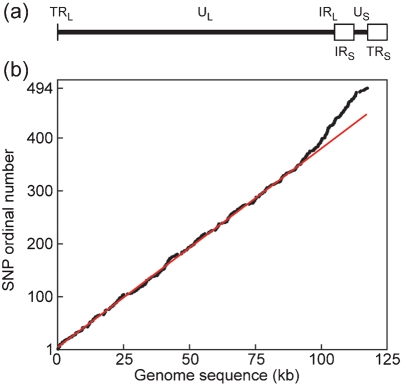
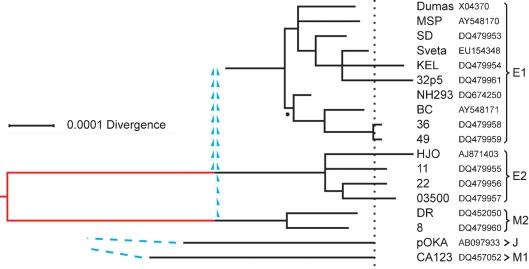
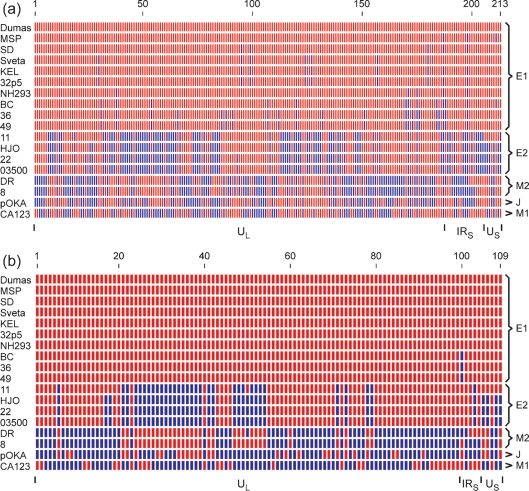
Relationships among varicella-zoster virus (VZV; Human herpesvirus 3) genome sequences were examined to evaluate descent of strains, structures of lineages and incidence of recombination events. Eighteen complete, published genome sequences were aligned and 494 single nucleotide polymorphisms (SNPs) extracted, each as two alleles. At 281 SNPs, a single sequence differed from all the others. Distributions of the remaining 213 SNPs indicated that the sequences fell into five groups, which coincided with previously recognized phylogenetic groupings, termed E1, E2, J, M1 and M2. The 213-SNP set was divisible into 104 SNPs that were specific to a single group, and 109 cross-group SNPs that defined relationships among groups. This last set was evaluated by criteria of continuities in relationships between groups and breaks in such patterns, to identify crossover points and ascribe them to lineages. For the 99 cross-group SNPs in the genome's long unique region, it was seen that the E2 and M2 groups were almost completely distinct in their SNP alleles, and the E1 group was derived from a recombinant of E2 and M2. A valid phylogenetic tree could thus be constructed for the four E2 and two M2 strains. There was no substantive evidence for recombination within the E2 group or the E1 group (ten strains). The J and M1 groups each contained only one strain, and both were interpreted as having substantial distinct histories plus possible recombinant elements from the E2 and M2 lineages. The view of VZV recombination and phylogeny reached represents a major clarification of deep relationships among VZV lineages.
研究了水痘带状疱疹病毒(VZV;人类疱疹病毒3型)基因组序列之间的关系,以评估毒株的谱系、谱系结构和重组事件的发生率。对18条已发表的完整基因组序列进行比对,并提取了494个单核苷酸多态性(SNP),每个SNP有两个等位基因。在281个SNP位点上,有一条序列与其他所有序列不同。其余213个SNP的分布表明,这些序列可分为五组,这与之前公认的系统发育分组一致,分别称为E1、E2、J、M1和M2。这213个SNP集合可分为104个特定于单个组的SNP和109个定义组间关系的跨组SNP。通过组间关系的连续性和此类模式中的断点标准来评估最后一组SNP,以识别交叉点并将其归因于谱系。对于基因组长独特区域中的99个跨组SNP,发现E2和M2组在SNP等位基因上几乎完全不同,E1组源自E2和M2的重组体。因此,可以为四个E2株和两个M2株构建有效的系统发育树。在E2组或E1组(十个毒株)内没有实质性的重组证据。J组和M1组各仅包含一个毒株,并且两者都被解释为具有显著不同的历史以及可能来自E2和M2谱系的重组元件。所达成的关于VZV重组和系统发育的观点代表了对VZV谱系之间深层关系的重大澄清。