
使用随机抽样、主成分分析和基旋转分解复杂反应网络
Decomposing complex reaction networks using random sampling, principal component analysis and basis rotation.
作者信息
Barrett Christian L, Herrgard Markus J, Palsson Bernhard
机构信息
Department of Bioengineering, University of California at San Diego, La Jolla, CA, 92093-0412, USA.
出版信息
BMC Syst Biol. 2009 Mar 6;3:30. doi: 10.1186/1752-0509-3-30.
BACKGROUND
Metabolism and its regulation constitute a large fraction of the molecular activity within cells. The control of cellular metabolic state is mediated by numerous molecular mechanisms, which in effect position the metabolic network flux state at specific locations within a mathematically-definable steady-state flux space. Post-translational regulation constitutes a large class of these mechanisms, and decades of research indicate that achieving a network flux state through post-translational metabolic regulation is both a complex and complicated regulatory problem. No analysis method for the objective, top-down assessment of such regulation problems in large biochemical networks has been presented and demonstrated.
RESULTS
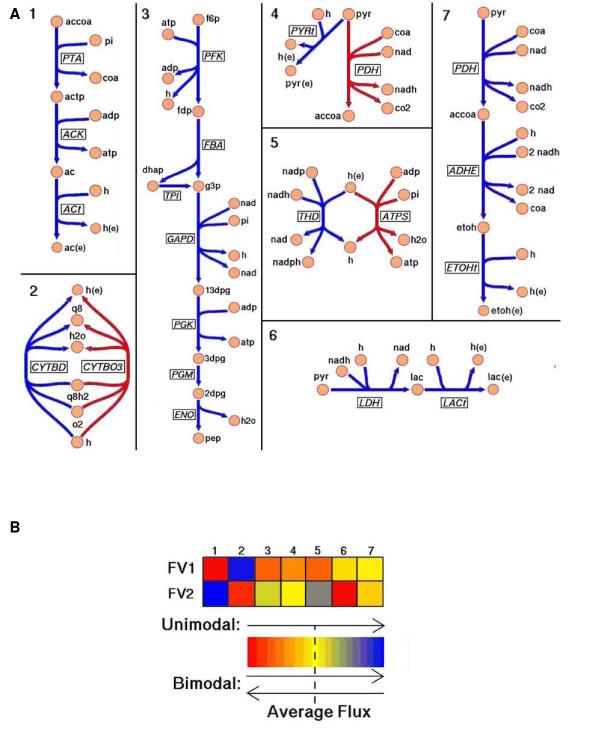
We show that the use of Monte Carlo sampling of the steady-state flux space of a cell-scale metabolic system in conjunction with Principal Component Analysis and eigenvector rotation results in a low-dimensional and biochemically interpretable decomposition of the steady flux states of the system. This decomposition comes in the form of a low number of small reaction sets whose flux variability accounts for nearly all of the flux variability in the entire system. This result indicates an underlying simplicity and implies that the regulation of a relatively low number of reaction sets can essentially determine the flux state of the entire network in the given growth environment.
CONCLUSION
We demonstrate how our top-down analysis of networks can be used to determine key regulatory requirements independent of specific parameters and mechanisms. Our approach complements the reductionist approach to elucidation of regulatory mechanisms and facilitates the development of our understanding of global regulatory strategies in biological networks.
背景
新陈代谢及其调节构成了细胞内分子活动的很大一部分。细胞代谢状态的控制由众多分子机制介导,这些机制实际上将代谢网络通量状态定位在数学上可定义的稳态通量空间内的特定位置。翻译后调节构成了这类机制中的一大类,数十年的研究表明,通过翻译后代谢调节实现网络通量状态是一个复杂且棘手的调节问题。目前尚未提出并证明用于对大型生化网络中此类调节问题进行客观、自上而下评估的分析方法。
结果
我们表明,结合主成分分析和特征向量旋转对细胞尺度代谢系统的稳态通量空间进行蒙特卡罗采样,会导致系统稳态通量状态的低维且具有生化可解释性的分解。这种分解以少量小反应集的形式出现,其通量变异性几乎占整个系统通量变异性的全部。这一结果表明存在潜在的简单性,并意味着在给定的生长环境中,对相对少量反应集的调节基本上可以决定整个网络的通量状态。
结论
我们展示了如何利用我们对网络的自上而下分析来确定独立于特定参数和机制的关键调节要求。我们的方法补充了用于阐明调节机制的还原论方法,并有助于加深我们对生物网络中全局调节策略的理解。


 Zotero 插件