Kenefic Leo J, Pearson Talima, Okinaka Richard T, Schupp James M, Wagner David M, Hoffmaster Alex R, Trim Carla B, Chung Wai-Kwan, Beaudry Jodi A, Jiang Lingxia, Gajer Pawel, Foster Jeffrey T, Mead James I, Ravel Jacques, Keim Paul
Department of Biological Sciences, Northern Arizona University, Flagstaff, Arizona, United States of America.
PLoS One. 2009;4(3):e4813. doi: 10.1371/journal.pone.0004813. Epub 2009 Mar 13.
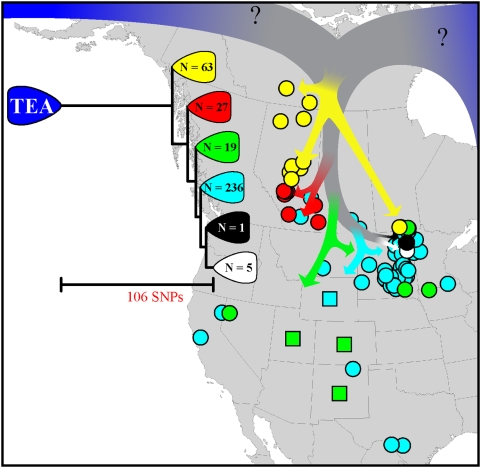
Disease introduction into the New World during colonial expansion is well documented and had a major impact on indigenous populations; however, few diseases have been associated with early human migrations into North America. During the late Pleistocene epoch, Asia and North America were joined by the Beringian Steppe ecosystem which allowed animals and humans to freely cross what would become a water barrier in the Holocene. Anthrax has clearly been shown to be dispersed by human commerce and trade in animal products contaminated with Bacillus anthracis spores. Humans appear to have brought B. anthracis to this area from Asia and then moved it further south as an ice-free corridor opened in central Canada approximately 13,000 ybp. In this study, we have defined the evolutionary history of Western North American (WNA) anthrax using 2,850 single nucleotide polymorphisms (SNPs) and 285 geographically diverse B. anthracis isolates. Phylogeography of the major WNA B. anthracis clone reveals ancestral populations in northern Canada with progressively derived populations to the south; the most recent ancestor of this clonal lineage is in Eurasia. Our phylogeographic patterns are consistent with B. anthracis arriving with humans via the Bering Land Bridge. This northern-origin hypothesis is highly consistent with our phylogeographic patterns and rates of SNP accumulation observed in current day B. anthracis isolates. Continent-wide dispersal of WNA B. anthracis likely required movement by later European colonizers, but the continent's first inhabitants may have seeded the initial North American populations.
在殖民扩张期间,疾病传入新大陆有充分的文献记载,并且对当地土著居民产生了重大影响;然而,与早期人类迁入北美相关的疾病却很少。在更新世晚期,亚洲和北美通过白令草原生态系统相连,这使得动物和人类能够自由穿越在全新世将成为水域屏障的区域。炭疽杆菌已被明确证明可通过人类对受炭疽芽孢杆菌孢子污染的动物产品的商业贸易进行传播。人类似乎从亚洲将炭疽芽孢杆菌带到了这个地区,然后随着大约13000年前加拿大中部一条无冰走廊的开通,将其进一步向南转移。在这项研究中,我们利用2850个单核苷酸多态性(SNP)和285株地理分布多样的炭疽芽孢杆菌分离株,确定了北美西部(WNA)炭疽的进化史。WNA主要炭疽芽孢杆菌克隆的系统地理学揭示了加拿大北部的祖先种群以及向南逐渐衍生的种群;这个克隆谱系的最近祖先在欧亚大陆。我们的系统地理模式与炭疽芽孢杆菌通过白令陆桥随人类抵达的情况一致。这种北方起源假说与我们在当今炭疽芽孢杆菌分离株中观察到的系统地理模式和SNP积累速率高度一致。WNA炭疽杆菌在整个大陆的传播可能需要后来的欧洲殖民者的活动,但该大陆的第一批居民可能播下了北美最初的炭疽杆菌种群。