
一氧化氮激活哺乳动物感觉神经元中的ATP敏感性钾通道:通过直接S-亚硝基化起作用。
Nitric oxide activates ATP-sensitive potassium channels in mammalian sensory neurons: action by direct S-nitrosylation.
作者信息
Kawano Takashi, Zoga Vasiliki, Kimura Masakazu, Liang Mei-Ying, Wu Hsiang-En, Gemes Geza, McCallum J Bruce, Kwok Wai-Meng, Hogan Quinn H, Sarantopoulos Constantine D
机构信息
Department of Anesthesiology, Medical College of Wisconsin, 8701 Watertown Plank Road, Milwaukee, WI 53226, USA.
出版信息
Mol Pain. 2009 Mar 14;5:12. doi: 10.1186/1744-8069-5-12.
BACKGROUND
ATP-sensitive potassium (KATP) channels in neurons regulate excitability, neurotransmitter release and mediate protection from cell-death. Furthermore, activation of KATP channels is suppressed in DRG neurons after painful-like nerve injury. NO-dependent mechanisms modulate both KATP channels and participate in the pathophysiology and pharmacology of neuropathic pain. Therefore, we investigated NO modulation of KATP channels in control and axotomized DRG neurons.
RESULTS
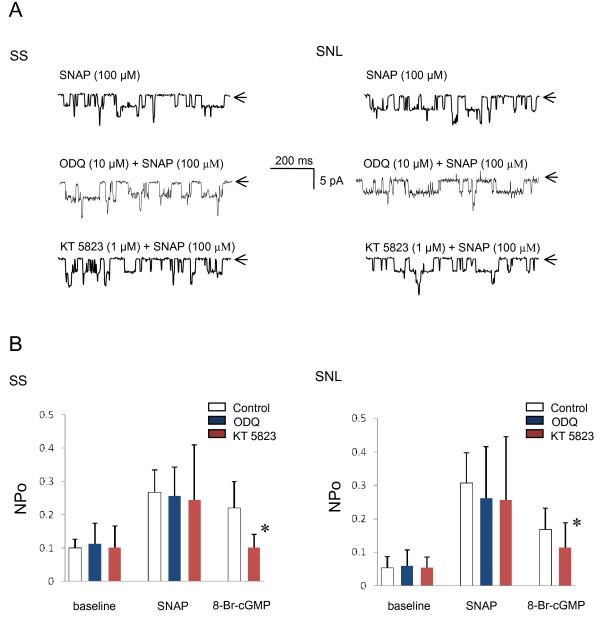
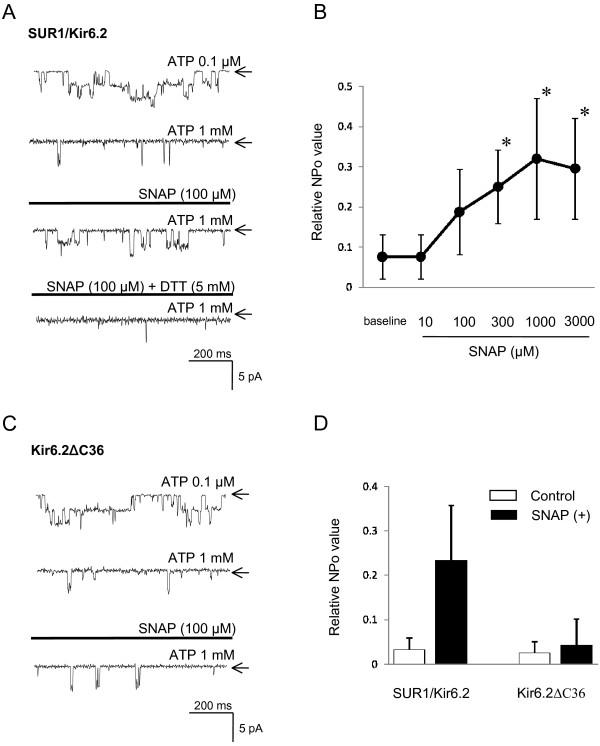
Cell-attached and cell-free recordings of KATP currents in large DRG neurons from control rats (sham surgery, SS) revealed activation of KATP channels by NO exogenously released by the NO donor SNAP, through decreased sensitivity to [ATP]i. This NO-induced KATP channel activation was not altered in ganglia from animals that demonstrated sustained hyperalgesia-type response to nociceptive stimulation following spinal nerve ligation. However, baseline opening of KATP channels and their activation induced by metabolic inhibition was suppressed by axotomy. Failure to block the NO-mediated amplification of KATP currents with specific inhibitors of sGC and PKG indicated that the classical sGC/cGMP/PKG signaling pathway was not involved in the activation by SNAP. NO-induced activation of KATP channels remained intact in cell-free patches, was reversed by DTT, a thiol-reducing agent, and prevented by NEM, a thiol-alkylating agent. Other findings indicated that the mechanisms by which NO activates KATP channels involve direct S-nitrosylation of cysteine residues in the SUR1 subunit. Specifically, current through recombinant wild-type SUR1/Kir6.2 channels expressed in COS7 cells was activated by NO, but channels formed only from truncated isoform Kir6.2 subunits without SUR1 subunits were insensitive to NO. Further, mutagenesis of SUR1 indicated that NO-induced KATP channel activation involves interaction of NO with residues in the NBD1 of the SUR1 subunit.
CONCLUSION
NO activates KATP channels in large DRG neurons via direct S-nitrosylation of cysteine residues in the SUR1 subunit. The capacity of NO to activate KATP channels via this mechanism remains intact even after spinal nerve ligation, thus providing opportunities for selective pharmacological enhancement of KATP current even after decrease of this current by painful-like nerve injury.
背景
神经元中的ATP敏感性钾(KATP)通道调节兴奋性、神经递质释放并介导细胞死亡保护。此外,在类疼痛性神经损伤后,背根神经节(DRG)神经元中KATP通道的激活受到抑制。一氧化氮(NO)依赖性机制调节KATP通道,并参与神经性疼痛的病理生理学和药理学过程。因此,我们研究了对照和轴突切断的DRG神经元中NO对KATP通道的调节作用。
结果
对来自对照大鼠(假手术,SS)的大型DRG神经元进行KATP电流的细胞贴附式和无细胞记录,结果显示,由NO供体S-亚硝基-N-乙酰青霉胺(SNAP)外源性释放的NO通过降低对细胞内ATP([ATP]i)的敏感性激活了KATP通道。在对脊神经结扎后对伤害性刺激表现出持续性痛觉过敏型反应的动物的神经节中,这种由NO诱导的KATP通道激活没有改变。然而,轴突切断抑制了KATP通道的基线开放及其由代谢抑制诱导的激活。用可溶性鸟苷酸环化酶(sGC)和蛋白激酶G(PKG)的特异性抑制剂未能阻断NO介导的KATP电流放大,表明经典的sGC/环磷酸鸟苷(cGMP)/PKG信号通路不参与SNAP的激活作用。在无细胞片中NO诱导的KATP通道激活仍然存在,可被硫醇还原剂二硫苏糖醇(DTT)逆转,并被硫醇烷基化剂N-乙基马来酰亚胺(NEM)阻止。其他研究结果表明,NO激活KATP通道的机制涉及SUR1亚基中半胱氨酸残基的直接S-亚硝基化。具体而言,在COS7细胞中表达的重组野生型SUR1/Kir6.2通道的电流可被NO激活,但仅由无SUR1亚基的截短型Kir6.2亚基形成的通道对NO不敏感。此外,SUR1的诱变表明,NO诱导的KATP通道激活涉及NO与SUR1亚基核苷酸结合结构域1(NBD1)中的残基相互作用。
结论
NO通过直接对SUR1亚基中的半胱氨酸残基进行S-亚硝基化来激活大型DRG神经元中的KATP通道。即使在脊神经结扎后,NO通过这种机制激活KATP通道的能力仍然存在,因此即使在类疼痛性神经损伤导致该电流降低后,仍为选择性药理增强KATP电流提供了机会。





 Zotero 插件