Dumville Jo C, Worthy Gill, Bland J Martin, Cullum Nicky, Dowson Christopher, Iglesias Cynthia, Mitchell Joanne L, Nelson E Andrea, Soares Marta O, Torgerson David J
Department of Health Sciences, University of York, York YO10 5DD, UK.
BMJ. 2009 Mar 19;338:b773. doi: 10.1136/bmj.b773.
To compare the clinical effectiveness of larval therapy with a standard debridement technique (hydrogel) for sloughy or necrotic leg ulcers.
Pragmatic, three armed randomised controlled trial.
Community nurse led services, hospital wards, and hospital outpatient leg ulcer clinics in urban and rural settings, United Kingdom.
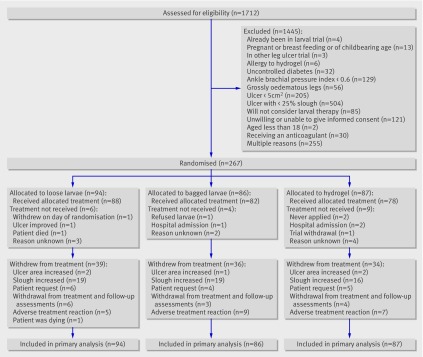
267 patients with at least one venous or mixed venous and arterial ulcer with at least 25% coverage of slough or necrotic tissue, and an ankle brachial pressure index of 0.6 or more.
Loose larvae, bagged larvae, and hydrogel.
The primary outcome was time to healing of the largest eligible ulcer. Secondary outcomes were time to debridement, health related quality of life (SF-12), bacterial load, presence of meticillin resistant Staphylococcus aureus, adverse events, and ulcer related pain (visual analogue scale, from 0 mm for no pain to 150 mm for worst pain imaginable).
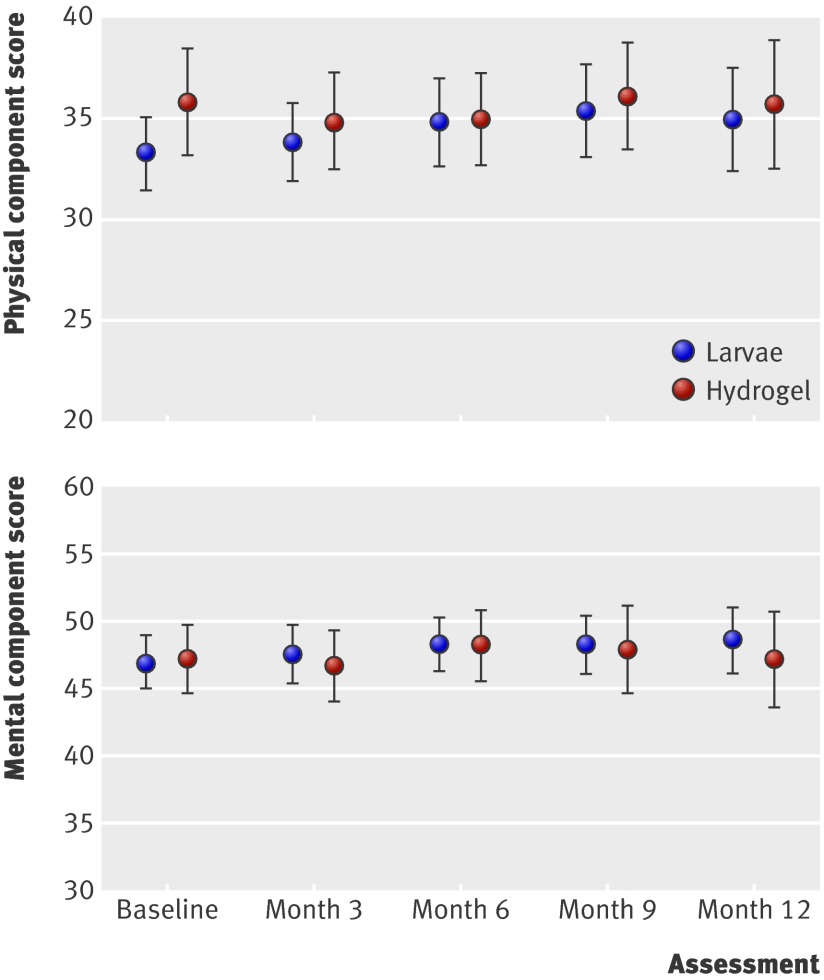
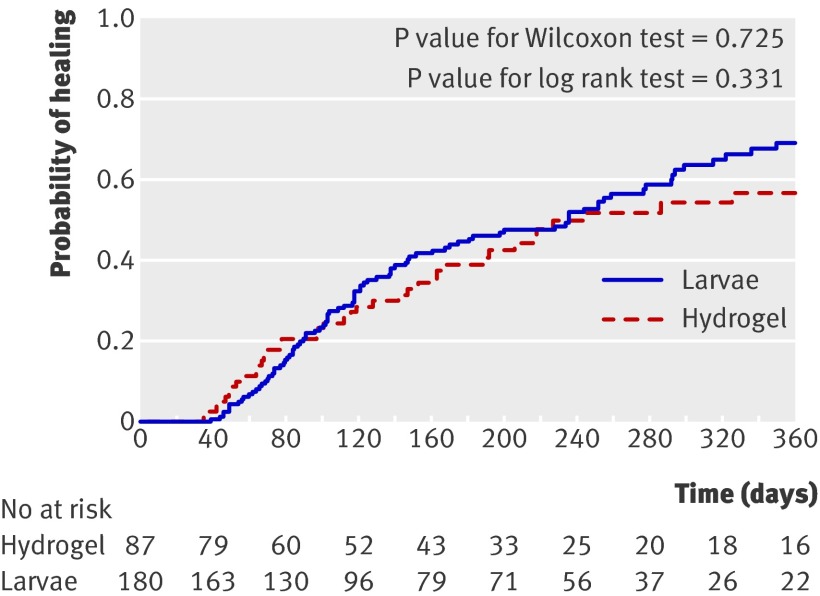
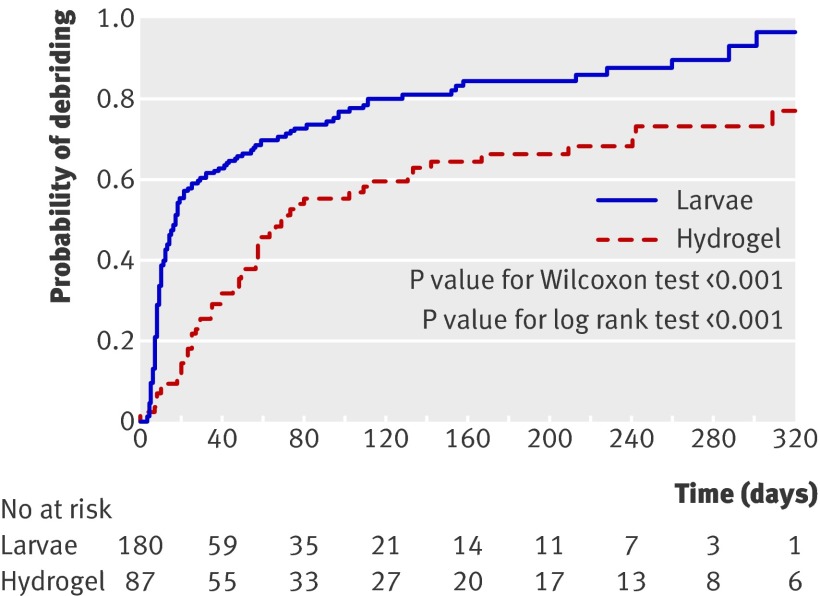
Time to healing was not significantly different between the loose or bagged larvae group and the hydrogel group (hazard ratio for healing using larvae v hydrogel 1.13, 95% confidence interval 0.76 to 1.68; P=0.54). Larval therapy significantly reduced the time to debridement (2.31, 1.65 to 3.2; P<0.001). Health related quality of life and change in bacterial load over time were not significantly different between the groups. 6.7% of participants had MRSA at baseline. No difference was found between larval therapy and hydrogel in their ability to eradicate MRSA by the end of the debridement phase (75% (9/12) v 50% (3/6); P=0.34), although this comparison was underpowered. Mean ulcer related pain scores were higher in either larvae group compared with hydrogel (mean difference in pain score: loose larvae v hydrogel 46.74 (95% confidence interval 32.44 to 61.04), P<0.001; bagged larvae v hydrogel 38.58 (23.46 to 53.70), P<0.001).
Larval therapy did not improve the rate of healing of sloughy or necrotic leg ulcers or reduce bacterial load compared with hydrogel but did significantly reduce the time to debridement and increase ulcer pain.
Current Controlled Trials ISRCTN55114812 and National Research Register N0484123692.
比较幼虫疗法与标准清创技术(水凝胶)治疗腿部溃疡伴坏死组织或腐肉的临床疗效。
实用的三臂随机对照试验。
英国城乡社区护士主导服务、医院病房及医院门诊腿部溃疡诊所。
267例患者,至少有一处静脉性溃疡或动静脉混合性溃疡,腐肉或坏死组织覆盖面积至少达25%,踝肱压力指数为0.6或更高。
松散幼虫、袋装幼虫和水凝胶。
主要观察指标为最大符合条件溃疡的愈合时间。次要观察指标包括清创时间、健康相关生活质量(SF-12)、细菌载量、耐甲氧西林金黄色葡萄球菌的存在情况、不良事件以及溃疡相关疼痛(视觉模拟评分,无痛为0 mm,可想象的最剧烈疼痛为150 mm)。
松散或袋装幼虫组与水凝胶组的愈合时间无显著差异(使用幼虫与水凝胶愈合的风险比为1.13,95%置信区间为0.76至1.68;P = 0.54)。幼虫疗法显著缩短了清创时间(2.31,1.65至3.2;P < 0.001)。两组之间健康相关生活质量及随时间变化的细菌载量无显著差异。6.7%的参与者在基线时携带耐甲氧西林金黄色葡萄球菌。在清创阶段结束时,幼虫疗法与水凝胶在根除耐甲氧西林金黄色葡萄球菌的能力上无差异(75%(9/12)对50%(3/6);P = 0.34),尽管该比较的检验效能不足。与水凝胶相比,幼虫组的平均溃疡相关疼痛评分更高(疼痛评分的平均差异:松散幼虫与水凝胶为46.74(95%置信区间32.44至61.04),P < 0.001;袋装幼虫与水凝胶为38.58(23.46至53.70),P < 0.001)。
与水凝胶相比,幼虫疗法未提高腿部溃疡伴坏死组织或腐肉伤口的愈合率,也未降低细菌载量,但显著缩短了清创时间并增加了溃疡疼痛。
当前对照试验ISRCTN55114812及国家研究注册N0484123692。