Locci Michela, Draghici Elena, Marangoni Francesco, Bosticardo Marita, Catucci Marco, Aiuti Alessandro, Cancrini Caterina, Marodi Laszlo, Espanol Teresa, Bredius Robbert G M, Thrasher Adrian J, Schulz Ansgar, Litzman Jiri, Roncarolo Maria Grazia, Casorati Giulia, Dellabona Paolo, Villa Anna
Vita-Salute San Raffaele University, Milan, Italy.
J Exp Med. 2009 Apr 13;206(4):735-42. doi: 10.1084/jem.20081773. Epub 2009 Mar 23.
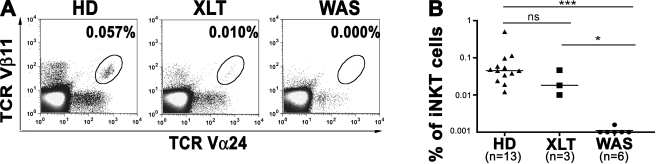
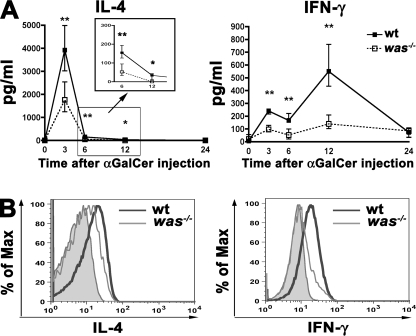
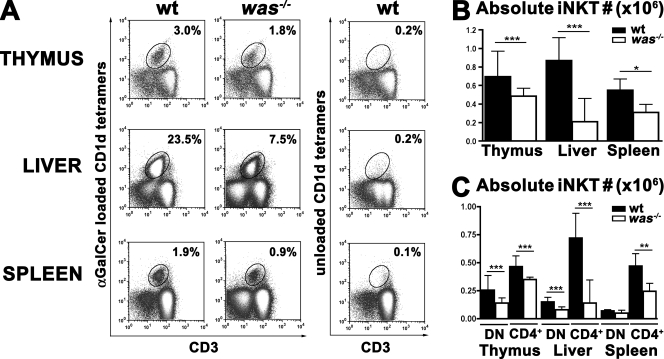
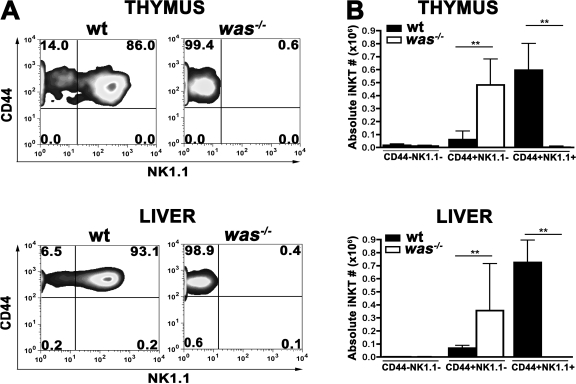
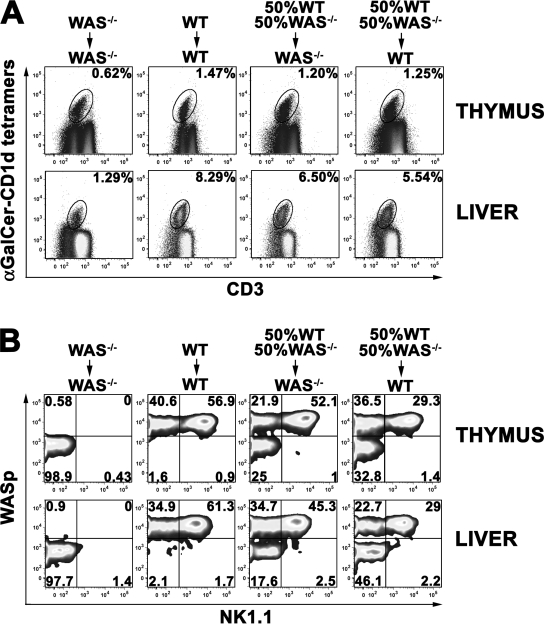
The Wiskott-Aldrich syndrome (WAS) protein (WASp) is a regulator of actin cytoskeleton in hematopoietic cells. Mutations of the WASp gene cause WAS. Although WASp is involved in various immune cell functions, its role in invariant natural killer T (iNKT) cells has never been investigated. Defects of iNKT cells could indeed contribute to several WAS features, such as recurrent infections and high tumor incidence. We found a profound reduction of circulating iNKT cells in WAS patients, directly correlating with the severity of clinical phenotype. To better characterize iNKT cell defect in the absence of WASp, we analyzed was(-/-) mice. iNKT cell numbers were significantly reduced in the thymus and periphery of was(-/-) mice as compared with wild-type controls. Moreover analysis of was(-/-) iNKT cell maturation revealed a complete arrest at the CD44(+) NK1.1(-) intermediate stage. Notably, generation of BM chimeras demonstrated a was(-/-) iNKT cell-autonomous developmental defect. was(-/-) iNKT cells were also functionally impaired, as suggested by the reduced secretion of interleukin 4 and interferon gamma upon in vivo activation. Altogether, these results demonstrate the relevance of WASp in integrating signals critical for development and functional differentiation of iNKT cells and suggest that defects in these cells may play a role in WAS pathology.
威斯科特-奥尔德里奇综合征(WAS)蛋白(WASp)是造血细胞中肌动蛋白细胞骨架的调节因子。WASp基因突变会导致WAS。尽管WASp参与多种免疫细胞功能,但其在不变自然杀伤T(iNKT)细胞中的作用从未被研究过。iNKT细胞缺陷确实可能导致WAS的一些特征,如反复感染和高肿瘤发生率。我们发现WAS患者循环中的iNKT细胞显著减少,这与临床表型的严重程度直接相关。为了更好地描述在缺乏WASp的情况下iNKT细胞的缺陷,我们分析了WAS基因敲除(was(-/-))小鼠。与野生型对照相比,was(-/-)小鼠胸腺和外周的iNKT细胞数量显著减少。此外,对was(-/-) iNKT细胞成熟的分析显示,其在CD44(+) NK1.1(-)中间阶段完全停滞。值得注意的是,骨髓嵌合体的生成证明了was(-/-) iNKT细胞存在自主发育缺陷。体内激活后白细胞介素4和干扰素γ分泌减少表明,was(-/-) iNKT细胞功能也受损。总之,这些结果证明了WASp在整合对iNKT细胞发育和功能分化至关重要的信号方面的相关性,并表明这些细胞的缺陷可能在WAS病理过程中起作用。