Mishra Paras Kumar, Tyagi Neetu, Kumar Munish, Tyagi Suresh C
Department of Physiology & Biophysics, University of Louisville School of Medicine, KY, USA.
J Cell Mol Med. 2009 Apr;13(4):778-89. doi: 10.1111/j.1582-4934.2009.00744.x. Epub 2009 Mar 13.
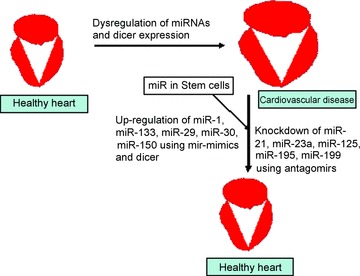
MicroRNAs (miRNAs) are tiny, endogenous, conserved, non-coding RNAs that negatively modulate gene expression by either promoting the degradation of mRNA or down-regulating the protein production by translational repression. They maintain optimal dose of cellular proteins and thus play a crucial role in the regulation of biological functions. Recent discovery of miRNAs in the heart and their differential expressions in pathological conditions provide glimpses of undiscovered regulatory mechanisms underlying cardiovascular diseases. Nearly 50 miRNAs are overexpressed in mouse heart. The implication of several miRNAs in cardiovascular diseases has been well documented such as miRNA-1 in arrhythmia, miRNA-29 in cardiac fibrosis, miRNA-126 in angiogenesis and miRNA-133 in cardiac hypertrophy. Aberrant expression of Dicer (an enzyme required for maturation of all miRNAs) during heart failure indicates its direct involvement in the regulation of cardiac diseases. MiRNAs and Dicer provide a particular layer of network of precise gene regulation in heart and vascular tissues in a spatiotemporal manner suggesting their implications as a powerful intervention tool for therapy. The combined strategy of manipulating miRNAs in stem cells for their target directed differentiation and optimizing the mode of delivery of miRNAs to the desired cells would determine the future potential of miRNAs to treat a disease. This review embodies the recent progress made in microRNomics of cardiovascular diseases and the future of miRNAs as a potential therapeutic target - the putative challenges and the approaches to deal with it.
微小RNA(miRNA)是微小的、内源性的、保守的非编码RNA,它们通过促进mRNA降解或通过翻译抑制下调蛋白质产生来负向调节基因表达。它们维持细胞蛋白质的最佳剂量,因此在生物功能调节中起关键作用。最近在心脏中发现的miRNA及其在病理条件下的差异表达为心血管疾病潜在的未被发现的调节机制提供了线索。近50种miRNA在小鼠心脏中过表达。几种miRNA在心血管疾病中的作用已有充分记录,如miRNA-1与心律失常、miRNA-29与心脏纤维化、miRNA-126与血管生成以及miRNA-133与心肌肥大有关。心力衰竭期间Dicer(所有miRNA成熟所需的一种酶)的异常表达表明其直接参与心脏疾病的调节。miRNA和Dicer以时空方式在心脏和血管组织中提供了一层特定的精确基因调控网络,表明它们作为一种强大的治疗干预工具的意义。在干细胞中操纵miRNA以实现其靶向定向分化并优化将miRNA递送至所需细胞的方式的联合策略将决定miRNA治疗疾病的未来潜力。本综述体现了心血管疾病微小RNA组学的最新进展以及miRNA作为潜在治疗靶点的未来——假定的挑战和应对方法。