Granville Courtney A, Memmott Regan M, Balogh Andria, Mariotti Jacopo, Kawabata Shigeru, Han Wei, Lopiccolo Jaclyn, Foley Jason, Liewehr David J, Steinberg Seth M, Fowler Daniel H, Hollander M Christine, Dennis Phillip A
Medical Oncology Branch, Center for Cancer Research, National Cancer Institute, Bethesda, Maryland, USA.
PLoS One. 2009;4(3):e5061. doi: 10.1371/journal.pone.0005061. Epub 2009 Mar 30.
K-Ras mutations are characteristic of human lung adenocarcinomas and occur almost exclusively in smokers. In preclinical models, K-Ras mutations are necessary for tobacco carcinogen-driven lung tumorigenesis and are sufficient to cause lung adenocarcinomas in transgenic mice. Because these mutations confer resistance to commonly used cytotoxic chemotherapies and targeted agents, effective therapies that target K-Ras are needed. Inhibitors of mTOR such as rapamycin can prevent K-Ras-driven lung tumorigenesis and alter the proportion of cytotoxic and Foxp3+ regulatory T cells, suggesting that lung-associated T cells might be important for tumorigenesis.
Lung tumorigenesis was studied in three murine models that depend on mutant K-Ras; a tobacco carcinogen-driven model, a syngeneic inoculation model, and a transgenic model. Splenic and lung-associated T cells were studied using flow cytometry and immunohistochemistry. Foxp3+ cells were depleted using rapamycin, an antibody, or genetic ablation.
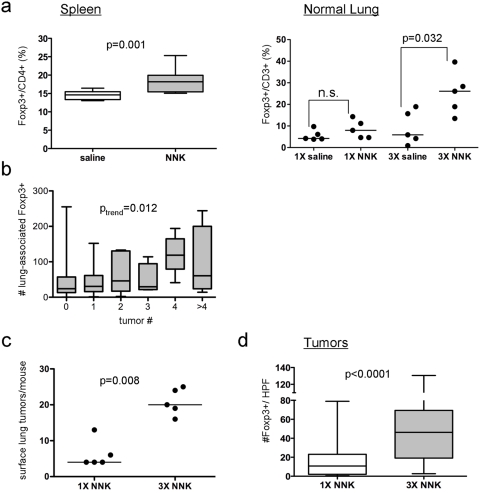
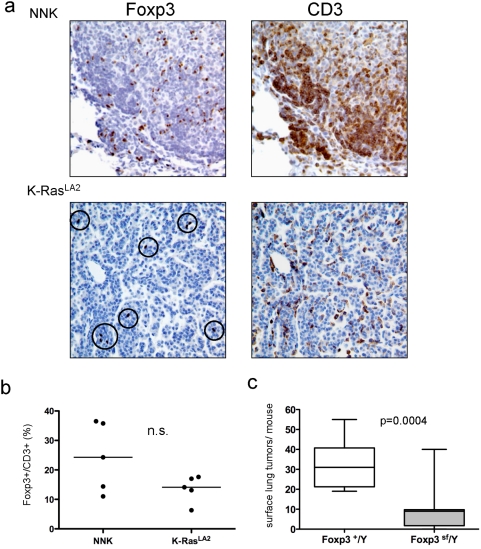
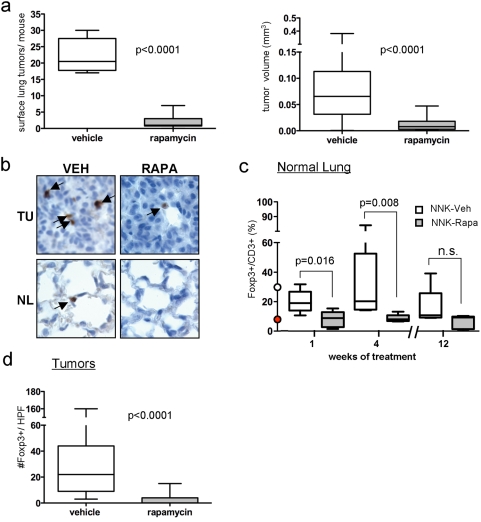
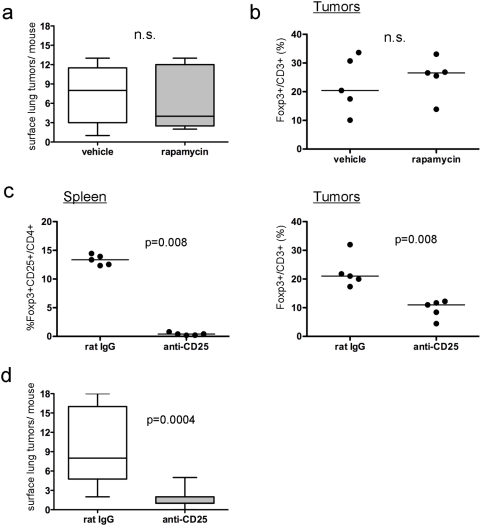
Exposure of A/J mice to a tobacco carcinogen tripled lung-associated Foxp3+ cells prior to tumor development. At clinically relevant concentrations, rapamycin prevented this induction and reduced lung tumors by 90%. In A/J mice inoculated with lung adenocarcinoma cells resistant to rapamycin, antibody-mediated depletion of Foxp3+ cells reduced lung tumorigenesis by 80%. Likewise, mutant K-Ras transgenic mice lacking Foxp3+ cells developed 75% fewer lung tumors than littermates with Foxp3+ cells.
Foxp3+ regulatory T cells are required for K-Ras-mediated lung tumorigenesis in mice. These studies support clinical testing of rapamycin or other agents that target Treg in K-Ras driven human lung cancer.
K-Ras突变是人类肺腺癌的特征,几乎仅发生于吸烟者中。在临床前模型中,K-Ras突变是烟草致癌物驱动的肺肿瘤发生所必需的,并且足以在转基因小鼠中引发肺腺癌。由于这些突变赋予对常用细胞毒性化疗和靶向药物的抗性,因此需要针对K-Ras的有效疗法。mTOR抑制剂如雷帕霉素可预防K-Ras驱动的肺肿瘤发生,并改变细胞毒性和Foxp3 +调节性T细胞的比例,这表明肺相关T细胞可能对肿瘤发生很重要。
在三种依赖突变K-Ras的小鼠模型中研究肺肿瘤发生;一种烟草致癌物驱动的模型、一种同基因接种模型和一种转基因模型。使用流式细胞术和免疫组织化学研究脾和肺相关T细胞。使用雷帕霉素、抗体或基因消融去除Foxp3 +细胞。
在肿瘤发生之前,将A/J小鼠暴露于烟草致癌物会使肺相关Foxp3 +细胞增加两倍。在临床相关浓度下,雷帕霉素可阻止这种诱导并使肺肿瘤减少90%。在接种对雷帕霉素耐药的肺腺癌细胞的A/J小鼠中,抗体介导的Foxp3 +细胞去除使肺肿瘤发生减少80%。同样,缺乏Foxp3 +细胞的突变K-Ras转基因小鼠比具有Foxp3 +细胞的同窝小鼠发生的肺肿瘤少75%。
Foxp3 +调节性T细胞是小鼠中K-Ras介导的肺肿瘤发生所必需的。这些研究支持对雷帕霉素或其他靶向K-Ras驱动的人类肺癌中Treg的药物进行临床试验。