Department of Thoracic Surgery, Zhongshan Hospital, Fudan University, Shanghai 200032, China.
J Immunol Res. 2022 Apr 22;2022:4355386. doi: 10.1155/2022/4355386. eCollection 2022.
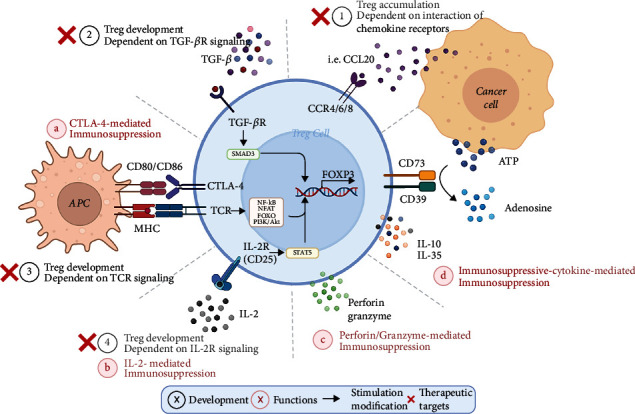
Non-small-cell lung cancer (NSCLC) is one of the most threatening malignant tumors to human health, with the overall 5-year survival rate being less than 30%. Regulatory T cells (Tregs), a functional subset of T cells, maintain immunologic immunological self-tolerance and homeostasis. Accumulating evidence has uncovered their implicated roles in various cancers in recent years. In NSCLC, they are associated with staging, therapeutic efficacy, and prognosis by infiltrating in tissues and thereby attenuating immunologic anticancer effects in patients. Tumor-associated Tregs display distinct immune signatures in NSCLC compared to thymus-derived Tregs, playing an important role in remodeling the tumor microenvironment (TME). Targeting Tregs has become a novel direction for NSCLC patients, such as disrupting their immune-suppressive functions, blocking their trafficking into tumors, and inhibiting their development and/or activation. This review is aimed at elucidating the molecular mechanisms of tumor-associated Tregs in NSCLC and providing therapeutic targets relevant to Tregs.
非小细胞肺癌(NSCLC)是对人类健康威胁最大的恶性肿瘤之一,整体 5 年生存率不足 30%。调节性 T 细胞(Tregs)是 T 细胞的一个功能亚群,可维持免疫免疫自身耐受和体内平衡。近年来,越来越多的证据揭示了它们在各种癌症中的作用。在 NSCLC 中,它们通过浸润组织与分期、治疗效果和预后相关,从而削弱了患者的免疫抗癌作用。与胸腺来源的 Tregs 相比,肿瘤相关的 Tregs 在 NSCLC 中具有独特的免疫特征,在重塑肿瘤微环境(TME)方面发挥着重要作用。针对 Tregs 已成为 NSCLC 患者的一个新方向,例如破坏其免疫抑制功能、阻止其向肿瘤转移,以及抑制其发育和/或激活。本综述旨在阐明 NSCLC 中肿瘤相关 Tregs 的分子机制,并提供与 Tregs 相关的治疗靶点。