Zhu Junfeng, Zhang Xiaoling, Wang Chengtao, Peng Xiaochun, Zhang Xianlong
Department of Orthopaedics, Shanghai the 6th People's Hospital, Jiaotong University, Shanghai, 200233, China.
Institute of Health Science, Shanghai Institute for Biological Sciences, Chinese Academy of Sciences, Shanghai, 200025, China.
Int J Mol Sci. 2008 Dec;9(12):2322-2332. doi: 10.3390/ijms9122322. Epub 2008 Nov 26.
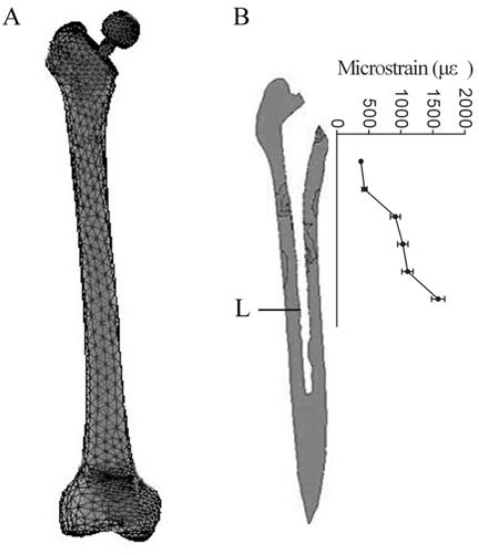
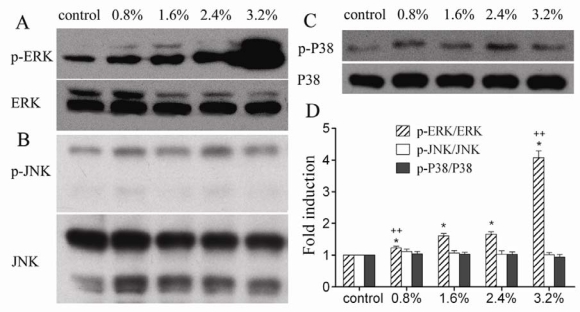
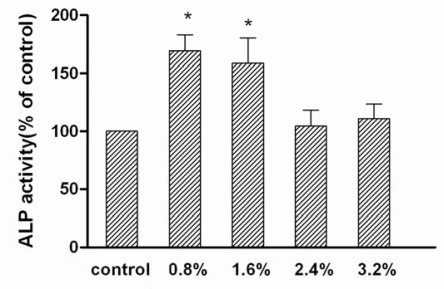
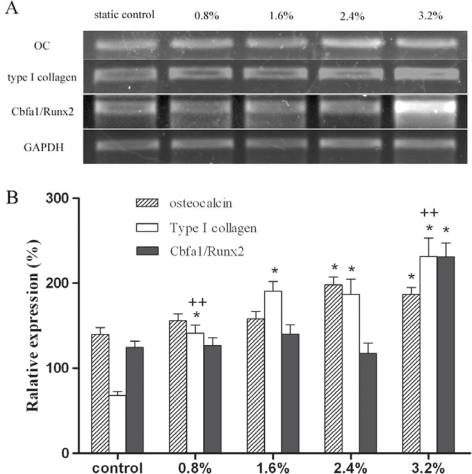
Mechanical factors are related to periprosthetic osseointegration following total hip arthroplasty. However, osteoblast response to strain in implanted femurs is unclear because of the absence of accurate stress-measuring methods. In our study, finite element analysis was performed to calculate strain distribution in implanted femurs. 0.8-3.2% tensile strain was then applied to human osteoblasts. Higher magnitudes of strain enhanced the expression of osteocalcin, type I collagen, and Cbfa1/Runx2. Lower magnitudes significantly increased ALP activity. Among these, type I collagen expression increased with the activation of ERK1/2 phosphorylation in a strain-magnitude-dependent manner. Our study marks the first investigation of osteoblast response at different magnitudes of periprosthetic strain. The results indicate that the functional status of human osteoblasts is determined by strain magnitude. The strain distribution in the proximal region of implanted femur should be improved for osseointegration.
机械因素与全髋关节置换术后假体周围骨整合有关。然而,由于缺乏精确的应力测量方法,植入股骨中骨细胞对应力的反应尚不清楚。在我们的研究中,进行了有限元分析以计算植入股骨中的应变分布。然后将0.8-3.2%的拉伸应变施加于人类成骨细胞。较高幅度的应变增强了骨钙素、I型胶原蛋白和Cbfa1/Runx2的表达。较低幅度的应变显著增加了碱性磷酸酶(ALP)活性。其中,I型胶原蛋白的表达随着ERK1/2磷酸化的激活而以应变幅度依赖的方式增加。我们的研究首次调查了不同幅度假体周围应变下成骨细胞的反应。结果表明,人类成骨细胞的功能状态由应变幅度决定。为了实现骨整合,应改善植入股骨近端区域的应变分布。