Sabet Razieh, Fassihi Afshin
Department of Medicinal Chemistry, Faculty of Pharmacy, Isfahan University of Medical Sciences, 81746-73461, Isfahan, Iran.
Int J Mol Sci. 2008 Dec;9(12):2407-2423. doi: 10.3390/ijms9122407. Epub 2008 Dec 2.
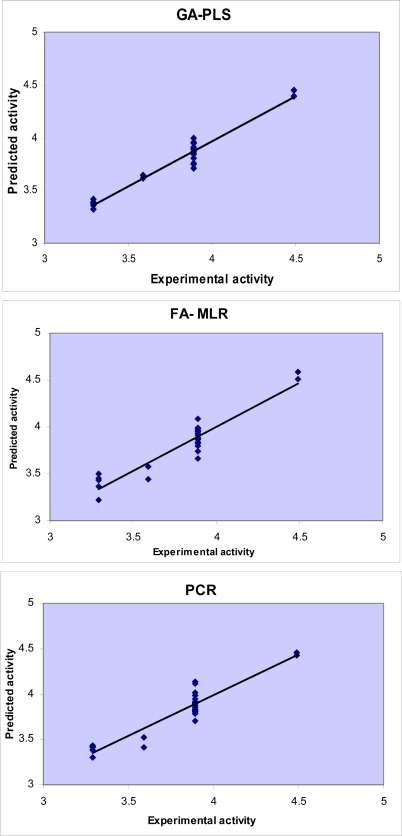
A series of 3-hydroxypyridine-4-one and 3-hydroxypyran-4-one derivatives were subjected to quantitative structure-antimicrobial activity relationships (QSAR) analysis. A collection of chemometrics methods, including factor analysis-based multiple linear regression (FA-MLR), principal component regression (PCR) and partial least squares combined with genetic algorithm for variable selection (GA-PLS) were employed to make connections between structural parameters and antimicrobial activity. The results revealed the significant role of topological parameters in the antimicrobial activity of the studied compounds against S. aureus and C. albicans. The most significant QSAR model, obtained by GA-PLS, could explain and predict 96% and 91% of variances in the pIC(50) data (compounds tested against S. aureus) and predict 91% and 87% of variances in the pIC(50) data (compounds tested against C. albicans), respectively.
对一系列3-羟基吡啶-4-酮和3-羟基吡喃-4-酮衍生物进行了定量构效关系(QSAR)分析。采用了一系列化学计量学方法,包括基于因子分析的多元线性回归(FA-MLR)、主成分回归(PCR)以及结合遗传算法进行变量选择的偏最小二乘法(GA-PLS),以建立结构参数与抗菌活性之间的联系。结果表明,拓扑参数在所研究化合物对金黄色葡萄球菌和白色念珠菌的抗菌活性中起着重要作用。通过GA-PLS获得的最显著的QSAR模型,分别可以解释和预测pIC(50)数据(针对金黄色葡萄球菌测试的化合物)中96%和91%的方差,以及预测pIC(50)数据(针对白色念珠菌测试的化合物)中91%和87%的方差。