Syversen Unni, Stunes Astrid K, Gustafsson Björn I, Obrant Karl J, Nordsletten Lars, Berge Rolf, Thommesen Liv, Reseland Janne E
Department of Cancer Research and Molecular Medicine, Norwegian University of Science and Technology, Trondheim, Norway.
BMC Endocr Disord. 2009 Mar 30;9:10. doi: 10.1186/1472-6823-9-10.
All the peroxisome proliferator activated receptors (PPARs) are found to be expressed in bone cells. The PPARgamma agonist rosiglitazone has been shown to decrease bone mass in mice and thiazolidinediones (TZDs) have recently been found to increase bone loss and fracture risk in humans treated for type 2 diabetes mellitus. The aim of the study was to examine the effect of the PPARalpha agonist fenofibrate (FENO) and the PPARgamma agonist pioglitazone (PIO) on bone in intact female rats.
Rats were given methylcellulose (vehicle), fenofibrate or pioglitazone (35 mg/kg body weight/day) by gavage for 4 months. BMC, BMD, and body composition were measured by DXA. Histomorphometry and biomechanical testing of excised femurs were performed. Effects of the compounds on bone cells were studied.
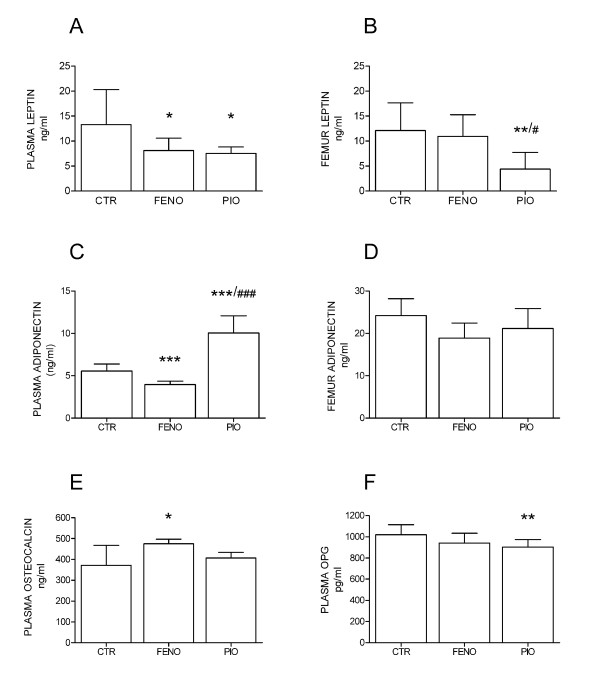
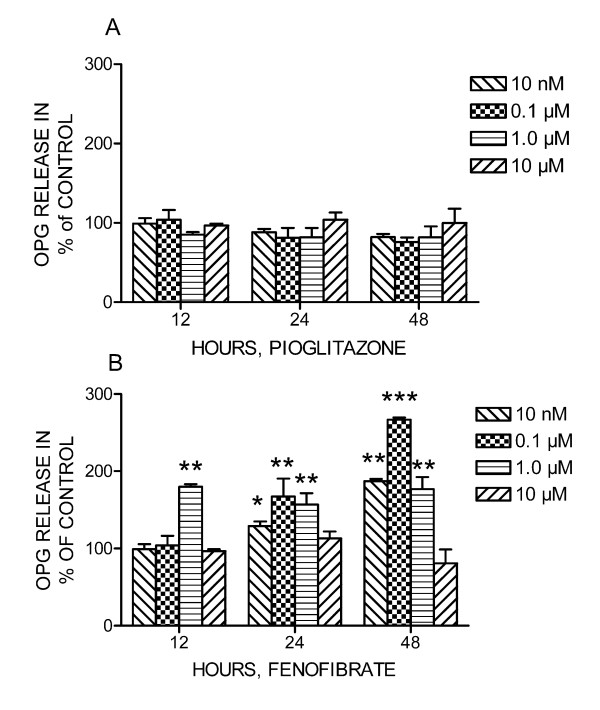
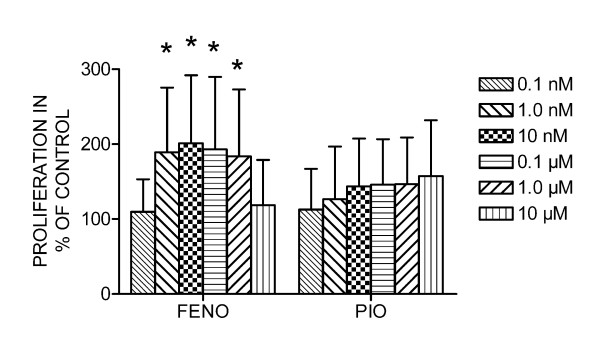
The FENO group had higher femoral BMD and smaller medullary area at the distal femur; while trabecular bone volume was similar to controls. Whole body BMD, BMC, and trabecular bone volume were lower, while medullary area was increased in PIO rats compared to controls. Ultimate bending moment and energy absorption of the femoral shafts were reduced in the PIO group, while similar to controls in the FENO group. Plasma osteocalcin was higher in the FENO group than in the other groups. FENO stimulated proliferation and differentiation of, and OPG release from, the preosteoblast cell line MC3T3-E1.
We show opposite skeletal effects of PPARalpha and gamma agonists in intact female rats. FENO resulted in significantly higher femoral BMD and lower medullary area, while PIO induced bone loss and impairment of the mechanical strength. This represents a novel effect of PPARalpha activation.
所有过氧化物酶体增殖物激活受体(PPARs)均在骨细胞中表达。已证实PPARγ激动剂罗格列酮可降低小鼠骨量,且最近发现噻唑烷二酮类药物(TZDs)会增加2型糖尿病患者的骨质流失和骨折风险。本研究旨在探讨PPARα激动剂非诺贝特(FENO)和PPARγ激动剂吡格列酮(PIO)对完整雌性大鼠骨骼的影响。
通过灌胃给予大鼠甲基纤维素(赋形剂)、非诺贝特或吡格列酮(35mg/kg体重/天),持续4个月。采用双能X线吸收法(DXA)测量骨矿含量(BMC)、骨密度(BMD)和身体成分。对切除的股骨进行组织形态计量学和生物力学测试。研究这些化合物对骨细胞的影响。
FENO组股骨远端BMD较高,髓腔面积较小;而小梁骨体积与对照组相似。与对照组相比,PIO组大鼠全身BMD、BMC和小梁骨体积较低,髓腔面积增加。PIO组股骨干的极限弯矩和能量吸收降低,而FENO组与对照组相似。FENO组血浆骨钙素高于其他组。FENO刺激前成骨细胞系MC3T3-E1的增殖、分化及骨保护素(OPG)释放。
我们发现PPARα和γ激动剂在完整雌性大鼠中对骨骼有相反的作用。FENO导致股骨BMD显著升高,髓腔面积减小,而PIO则导致骨质流失和机械强度受损。这代表了PPARα激活的一种新作用。