Ogonuki Narumi, Inoue Kimiko, Hirose Michiko, Miura Ikuo, Mochida Keiji, Sato Takahiro, Mise Nathan, Mekada Kazuyuki, Yoshiki Atsushi, Abe Kuniya, Kurihara Hiroki, Wakana Shigeharu, Ogura Atsuo
RIKEN BioResource Center, Tsukuba, Ibaraki, Japan.
PLoS One. 2009;4(3):e4943. doi: 10.1371/journal.pone.0004943. Epub 2009 Mar 31.
In laboratory mice and rats, congenic breeding is essential for analyzing the genes of interest on specific genetic backgrounds and for analyzing quantitative trait loci. However, in theory it takes about 3-4 years to achieve a strain carrying about 99% of the recipient genome at the tenth backcrossing (N10). Even with marker-assisted selection, the so-called 'speed congenic strategy', it takes more than a year at N4 or N5.
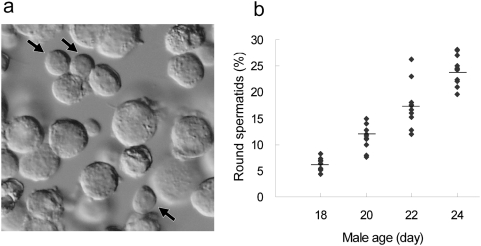
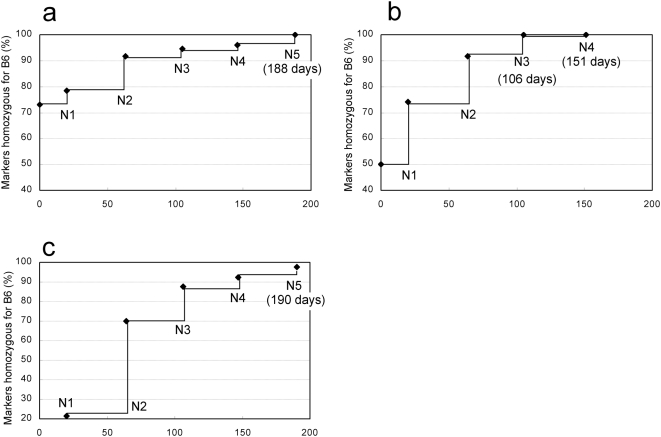
METHODOLOGY/PRINCIPAL FINDINGS: Here we describe a new high-speed congenic system using round spermatids retrieved from immature males (22-25 days of age). We applied the technique to three genetically modified strains of mice: transgenic (TG), knockin (KI) and N-ethyl-N-nitrosourea (ENU)-induced mutants. The donor mice had mixed genetic backgrounds of C57BL/6 (B6):DBA/2 or B6:129 strains. At each generation, males used for backcrossing were selected based on polymorphic marker analysis and their round spermatids were injected into B6 strain oocytes. Backcrossing was repeated until N4 or N5. For the TG and ENU-mutant strains, the N5 generation was achieved on days 188 and 190 and the proportion of B6-homozygous loci was 100% (74 markers) and 97.7% (172/176 markers), respectively. For the KI strain, N4 was achieved on day 151, all the 86 markers being B6-homozygous as early as on day 106 at N3. The carrier males at the final generation were all fertile and propagated the modified genes. Thus, three congenic strains were established through rapid generation turnover between 41 and 44 days.
CONCLUSIONS/SIGNIFICANCE: This new high-speed breeding strategy enables us to produce congenic strains within about half a year. It should provide the fastest protocol for precise definition of the phenotypic effects of genes of interest on desired genetic backgrounds.
在实验室小鼠和大鼠中,近交系培育对于在特定遗传背景下分析感兴趣的基因以及分析数量性状基因座至关重要。然而,理论上在第十次回交(N10)时获得携带约99%受体基因组的品系需要大约3至4年时间。即使采用标记辅助选择,即所谓的“快速近交系策略”,在N4或N5时也需要一年多时间。
方法/主要发现:在此,我们描述了一种新的高速近交系系统,该系统使用从未成熟雄性(22至25日龄)获取的圆形精子细胞。我们将该技术应用于三种基因工程改造的小鼠品系:转基因(TG)、敲入(KI)和N-乙基-N-亚硝基脲(ENU)诱导的突变体。供体小鼠具有C57BL/6(B6):DBA/2或B6:129品系的混合遗传背景。在每一代,用于回交的雄性小鼠通过多态性标记分析进行选择,其圆形精子细胞被注射到B6品系的卵母细胞中。回交重复进行直至N4或N5。对于TG和ENU突变品系,分别在第188天和第190天获得N5代,B6纯合位点的比例分别为100%(74个标记)和97.7%(172/176个标记)。对于KI品系,在第151天获得N4代,早在N3的第106天所有86个标记就已为B6纯合。最后一代的携带雄性均具有生育能力并能传递改造后的基因。因此,通过41至44天的快速世代更替建立了三个近交系。
结论/意义:这种新的高速育种策略使我们能够在大约半年内培育出近交系。它应为在所需遗传背景下精确定义感兴趣基因的表型效应提供最快的方案。