Namjou Bahram, Sestak Andrea L, Armstrong Don L, Zidovetzki Raphael, Kelly Jennifer A, Jacob Noam, Ciobanu Voicu, Kaufman Kenneth M, Ojwang Joshua O, Ziegler Julie, Quismorio Francesco P, Reiff Andreas, Myones Barry L, Guthridge Joel M, Nath Swapan K, Bruner Gail R, Mehrian-Shai Ruth, Silverman Earl, Klein-Gitelman Marisa, McCurdy Deborah, Wagner-Weiner Linda, Nocton James J, Putterman Chaim, Bae Sang-Cheol, Kim Yun Jung, Petri Michelle, Reveille John D, Vyse Timothy J, Gilkeson Gary S, Kamen Diane L, Alarcón-Riquelme Marta E, Gaffney Patrick M, Moser Kathy L, Merrill Joan T, Scofield R Hal, James Judith A, Langefeld Carl D, Harley John B, Jacob Chaim O
Oklahoma Medical Research Foundation, Oklahoma City, USA.
Arthritis Rheum. 2009 Apr;60(4):1085-95. doi: 10.1002/art.24387.
Systemic lupus erythematosus (SLE) is the prototypical systemic autoimmune disorder, with complex etiology and a strong genetic component. Recently, gene products involved in the interferon pathway have been under intense investigation in terms of the pathogenesis of SLE. STAT-1 and STAT-4 are transcription factors that play key roles in the interferon and Th1 signaling pathways, making them attractive candidates for involvement in SLE susceptibility.
Fifty-six single-nucleotide polymorphisms (SNPs) across STAT1 and STAT4 on chromosome 2 were genotyped using the Illumina platform, as part of an extensive association study in a large collection of 9,923 lupus patients and control subjects from different racial groups. DNA samples were obtained from the peripheral blood of patients with SLE and control subjects. Principal components analyses and population-based case-control association analyses were performed, and the P values, false discovery rate q values, and odds ratios with 95% confidence intervals were calculated.
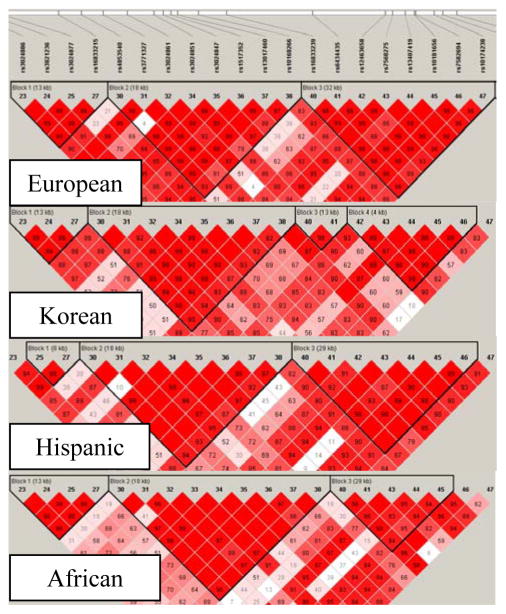
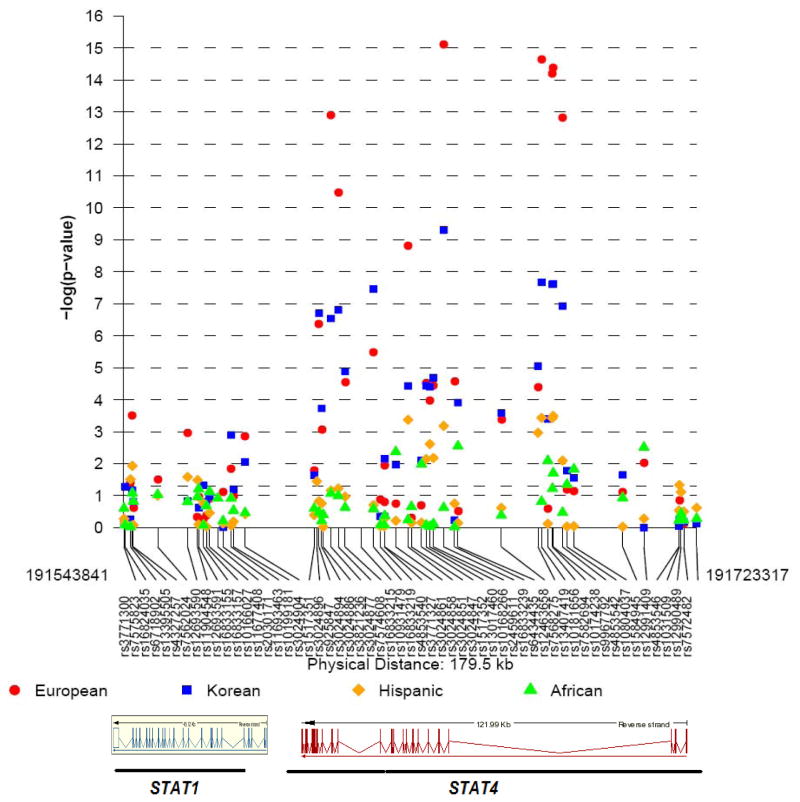
We observed strong genetic associations with SLE and multiple SNPs located within STAT4 in different ethnic groups (Fisher's combined P = 7.02 x 10(-25)). In addition to strongly confirming the previously reported association in the third intronic region of this gene, we identified additional haplotypic association across STAT4 and, in particular, a common risk haplotype that is found in multiple racial groups. In contrast, only a relatively weak suggestive association was observed with STAT1, probably due to its proximity to STAT4.
Our findings indicate that STAT4 is likely to be a crucial component in SLE pathogenesis in multiple racial groups. Knowledge of the functional effects of this association, when they are revealed, might improve our understanding of the disease and provide new therapeutic targets.
系统性红斑狼疮(SLE)是典型的系统性自身免疫性疾病,病因复杂且具有很强的遗传因素。最近,参与干扰素通路的基因产物在SLE发病机制方面受到了深入研究。STAT-1和STAT-4是在干扰素和Th1信号通路中起关键作用的转录因子,这使得它们成为参与SLE易感性的有吸引力的候选因素。
作为一项针对来自不同种族群体的9923名狼疮患者和对照受试者的大型综合关联研究的一部分,使用Illumina平台对2号染色体上STAT1和STAT4的56个单核苷酸多态性(SNP)进行基因分型。从SLE患者和对照受试者的外周血中获取DNA样本。进行主成分分析和基于人群的病例对照关联分析,并计算P值、错误发现率q值以及95%置信区间的比值比。
我们在不同种族群体中观察到SLE与位于STAT4内的多个SNP之间存在强遗传关联(Fisher联合P = 7.02×10⁻²⁵)。除了有力地证实了先前报道的该基因第三个内含子区域的关联外,我们还确定了STAT4上的其他单倍型关联,特别是在多个种族群体中发现的一种常见风险单倍型。相比之下,与STAT1仅观察到相对较弱的提示性关联,可能是由于其与STAT4距离较近。
我们的研究结果表明,STAT4可能是多个种族群体SLE发病机制中的关键组成部分。当揭示这种关联的功能效应时,可能会增进我们对该疾病的理解并提供新的治疗靶点。