Canizares Mayilee, MacKay Crystal, Davis Aileen M, Mahomed Nizar, Badley Elizabeth M
Arthritis Community Research and Evaluation Unit, Division of Health Care and Outcomes Research, Toronto Western Research Institute, Toronto, Ontario, Canada.
BMC Health Serv Res. 2009 Mar 31;9:56. doi: 10.1186/1472-6963-9-56.
The ongoing process of population aging is associated with an increase in prevalence of musculoskeletal conditions with a concomitant increase in the demand of orthopaedic services. Shortages of orthopaedic services have been documented in Canada and elsewhere. This population-based study describes the number of patients seen by orthopaedic surgeons in office and hospital settings to set the scene for the development of strategies that could maximize the availability of orthopaedic resources.
Administrative data from the Ontario Health Insurance Plan and Canadian Institute for Health Information hospital separation databases for the 2005/06 fiscal year were used to identify individuals accessing orthopaedic services in Ontario, Canada. The number of patients with encounters with orthopaedic surgeons, the number of encounters and the number of surgeries carried out by orthopaedic surgeons were estimated according to condition groups, service location, patient's age and sex.
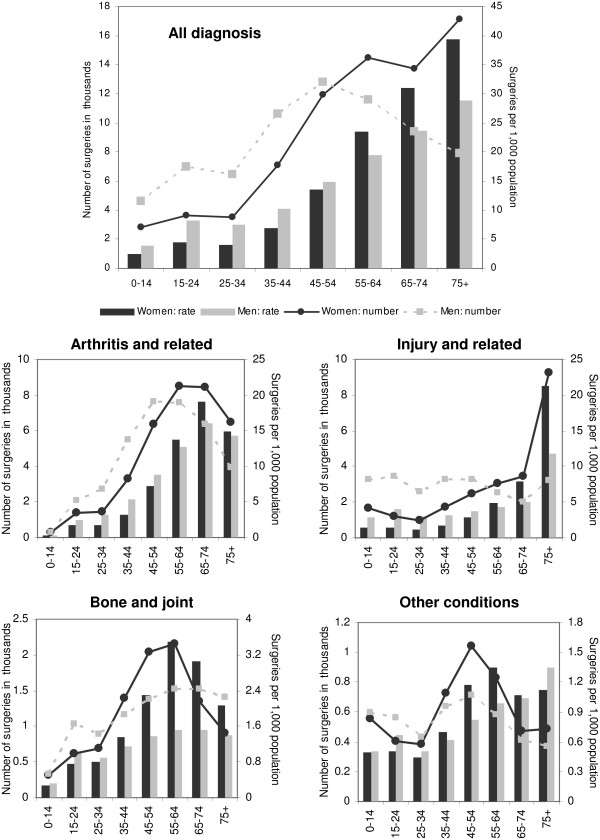
In 2005/06, over 520,000 Ontarians (41 per 1,000 population) had over 1.3 million encounters with orthopaedic surgeons. Of those 86% were ambulatory encounters and 14% were in hospital encounters. The majority of ambulatory encounters were for an injury or related condition (44%) followed by arthritis and related conditions (37%). Osteoarthritis accounted for 16% of all ambulatory encounters. Orthopaedic surgeons carried out over 140,000 surgeries in 2005/06: joint replacement accounted for 25% of all orthopaedic surgeries, whereas closed repair accounted for 16% and reductions accounted for 21%. Half of the orthopaedic surgeries were for arthritis and related conditions.
The large volume of ambulatory care points to the significant contribution of orthopaedic surgeons to the medical management of chronic musculoskeletal conditions including arthritis and injuries. The findings highlight that surgery is only one component of the work of orthopaedic surgeons in the management of these conditions. Policy makers and orthopaedic surgeons need to be creative in developing strategies to accommodate the growing workload of orthopaedic surgeons without sacrificing quality of care of patients with musculoskeletal conditions.
人口老龄化进程的持续与肌肉骨骼疾病患病率的上升相关,同时对骨科服务的需求也在增加。加拿大及其他地区已记录到骨科服务短缺的情况。这项基于人群的研究描述了骨科外科医生在门诊和医院环境中诊治的患者数量,为制定能够最大限度提高骨科资源可用性的策略奠定基础。
使用安大略省医疗保险计划和加拿大卫生信息研究所2005/06财政年度医院出院数据库的行政数据,来识别加拿大安大略省接受骨科服务的个体。根据疾病分组、服务地点、患者年龄和性别,估算了与骨科外科医生接触的患者数量、接触次数以及骨科外科医生进行的手术数量。
在2005/06年度,超过52万安大略人(每1000人口中有41人)与骨科外科医生有超过130万次接触。其中86%为门诊接触,14%为住院接触。大多数门诊接触是因损伤或相关疾病(44%),其次是关节炎及相关疾病(37%)。骨关节炎占所有门诊接触的16%。2005/06年度,骨科外科医生进行了超过14万例手术:关节置换占所有骨科手术的25%,而闭合修复占16%,复位占21%。一半的骨科手术是针对关节炎及相关疾病。
大量的门诊护理表明骨科外科医生对包括关节炎和损伤在内的慢性肌肉骨骼疾病的医疗管理做出了重大贡献。研究结果突出表明,手术只是骨科外科医生在这些疾病管理工作中的一个组成部分。政策制定者和骨科外科医生在制定策略时需要发挥创造力,以适应骨科外科医生不断增加的工作量,同时不牺牲肌肉骨骼疾病患者的护理质量。