Hermann Brian P, Sukhwani Meena, Simorangkir David R, Chu Tianjiao, Plant Tony M, Orwig Kyle E
Department of Obstetrics, Gynecology and Reproductive Sciences, University of Pittsburgh School of Medicine, Pittsburgh, PA 15260, USA.
Hum Reprod. 2009 Jul;24(7):1704-16. doi: 10.1093/humrep/dep073. Epub 2009 Mar 31.
The spermatogonial stem cell (SSC) pool in the testes of non-human primates is poorly defined.
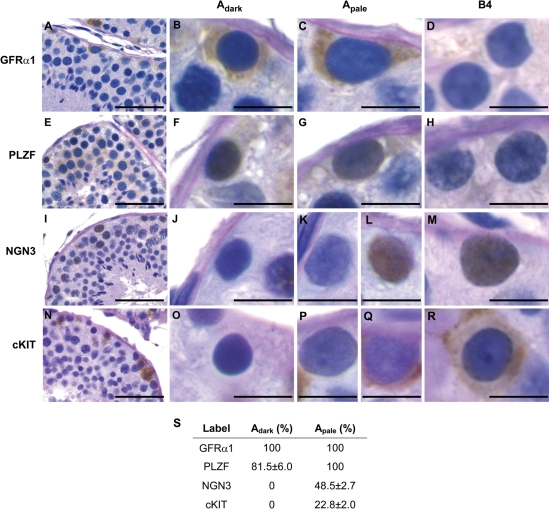
To begin characterizing SSCs in rhesus macaque testes, we employed fluorescence-activated cell sorting (FACS), a xenotransplant bioassay and immunohistochemical methods and correlated our findings with classical descriptions of germ cell nuclear morphology (i.e. A(dark) and A(pale) spermatogonia).
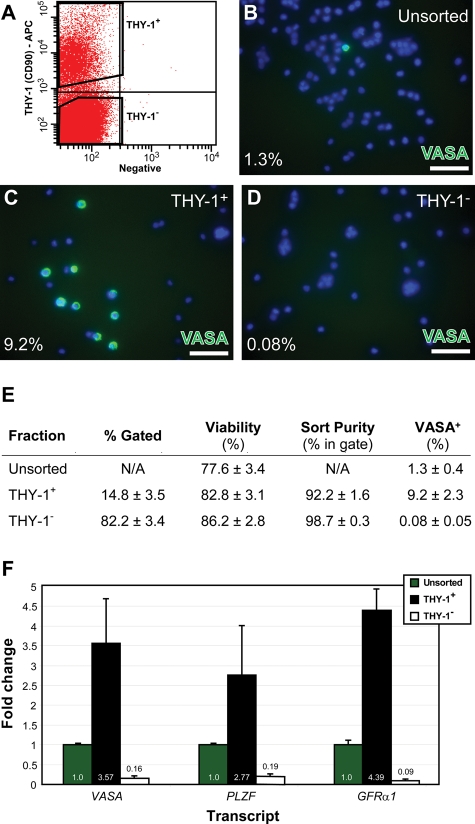
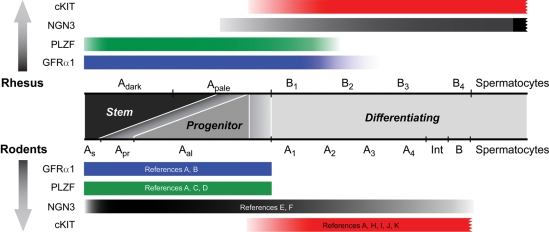
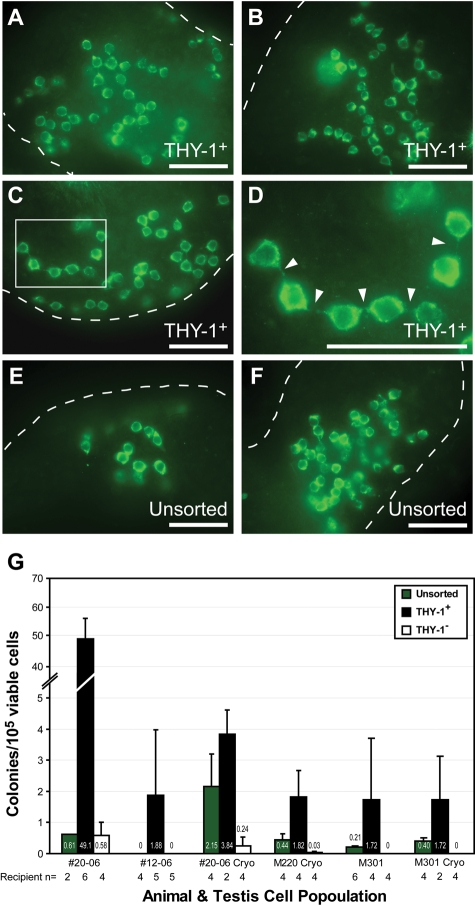
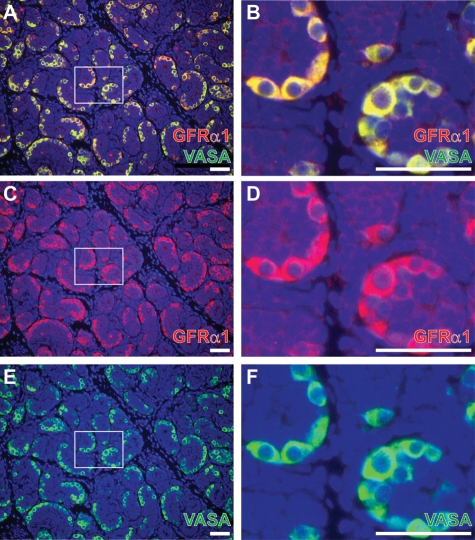
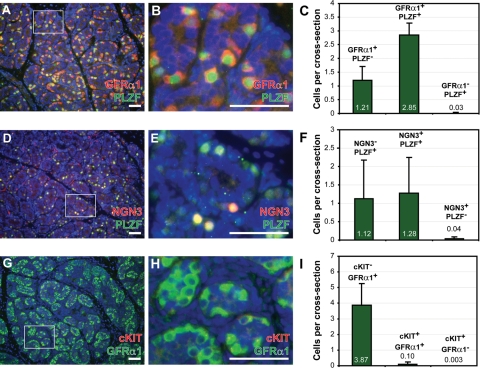
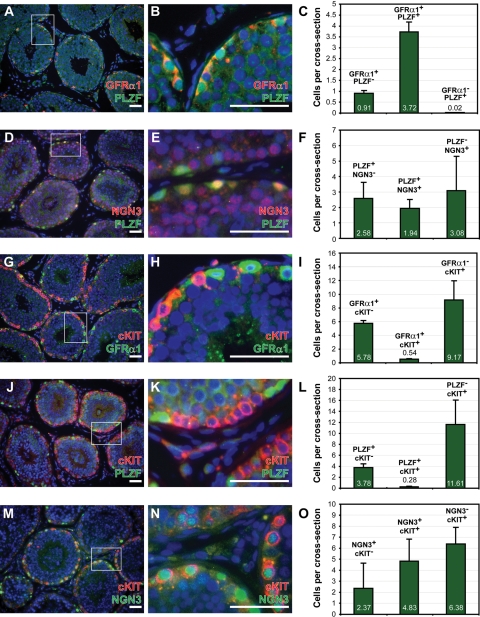
FACS analysis identified a THY-1+ fraction of rhesus testis cells that was enriched for consensus SSC markers (i.e. PLZF, GFRalpha1) and exhibited enhanced colonizing activity upon transplantation to nude mouse testes. We observed a substantial conservation of spermatogonial markers from mice to monkeys [PLZF, GFRalpha1, Neurogenin 3 (NGN3), cKIT]. Assuming that molecular characteristics correlate with function, the pool of putative SSCs (THY-1+, PLZF+, GFRalpha1+, NGN3+/-, cKIT-) comprises most A(dark) and A(pale) and is considerably larger in primates than in rodents. It is noteworthy that the majority of A(dark) and A(pale) share a common molecular phenotype, considering their distinct functional classifications as reserve and renewing stem cells, respectively. NGN3 is absent from A(dark), but is expressed by some A(pale) and may mark the transition from undifferentiated (cKIT-) to differentiating (cKIT+) spermatogonia. Finally, the pool of transit-amplifying progenitor spermatogonia (PLZF+, GFRalpha1+, NGN3+, cKIT+/-) is smaller in primates than in rodents. CONCLUSIONS These results provide an in-depth analysis of molecular characteristics of primate spermatogonia, including SSCs, and lay a foundation for future studies investigating the kinetics of spermatogonial renewal, clonal expansion and differentiation during primate spermatogenesis.
非人灵长类动物睾丸中的精原干细胞(SSC)库定义不明确。
为了开始对恒河猴睾丸中的SSC进行特征描述,我们采用了荧光激活细胞分选(FACS)、异种移植生物测定法和免疫组织化学方法,并将我们的研究结果与生殖细胞核形态的经典描述(即暗型A和亮型A精原细胞)相关联。
FACS分析确定了恒河猴睾丸细胞中的一个THY-1+部分,该部分富含公认的SSC标记物(即PLZF、GFRalpha1),并且在移植到裸鼠睾丸后表现出增强的定植活性。我们观察到从小鼠到猴子的精原细胞标记物有大量保守性[PLZF、GFRalpha1、神经生成素3(NGN3)、cKIT]。假设分子特征与功能相关,推测的SSC库(THY-1+、PLZF+、GFRalpha1+、NGN3+/-、cKIT-)包含大多数暗型A和亮型A精原细胞,并且在灵长类动物中比在啮齿动物中要大得多。值得注意的是,考虑到暗型A和亮型A分别作为储备干细胞和更新干细胞的不同功能分类,它们中的大多数具有共同的分子表型。暗型A中不存在NGN3,但一些亮型A中表达NGN3,并且它可能标记了从未分化(cKIT-)到分化(cKIT+)的精原细胞的转变。最后,过渡增殖祖精原细胞库(PLZF+、GFRalpha1+、NGN3+、cKIT+/-)在灵长类动物中比在啮齿动物中要小。结论这些结果提供了对灵长类动物精原细胞包括SSC的分子特征的深入分析,并为未来研究灵长类动物精子发生过程中精原细胞更新、克隆扩增和分化的动力学奠定了基础。