Seo Jeong Won, Park In Won
Department of Ophthalmology, Hallym University College of Medicine, Hallym University Sacred Heart Hospital, Anyang, Korea.
Korean J Ophthalmol. 2009 Mar;23(1):17-22. doi: 10.3341/kjo.2009.23.1.17. Epub 2009 Mar 9.
To evaluate the effect of intravitreal bevacizumab on visual function and retinal thickness in patients with diabetic macular edema (DME).
Thirty eyes of twenty-eight patients (mean age, 57.9+/-13.8 years) with DME were included in this study. Complete ophthalmic examination, including determination of best-corrected visual acuity (BCVA), stereoscopic biomicroscopy, and retinal thickness measurement by optical coherence tomography (OCT), was done at baseline and at each follow-up visit. All patients were treated with a 0.05 mL intravitreal injection containing 1.25 mg of bevacizumab.
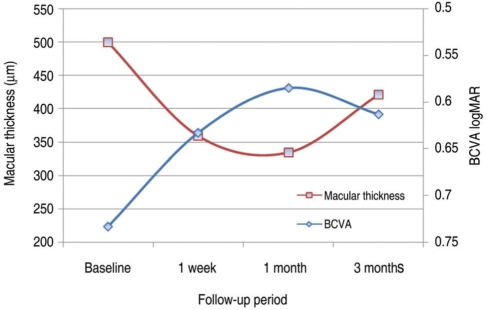
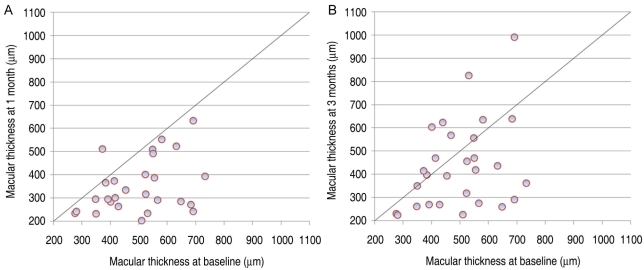
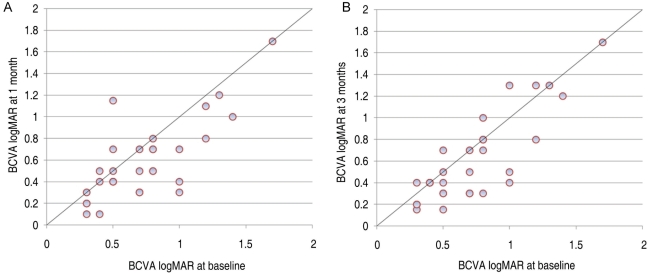
All patients completed 3 months of follow-up with a mean follow-up period of 5.26+/-2.39 months. The mean BCVA at baseline was 0.73+/-0.36 logMAR, which significantly improved to 0.63+/-0.41 (p=0.02), 0.58+/-0.36 (p=0.003), and 0.61+/-0.40 logMAR (p=0.006) at 1 week, 1 month, and 3 months. Final BCVA analysis demonstrated that 15 eyes (50%) remained stable and 12 (40%) improved >or=2 lines on BCVA. The mean central retinal thickness was 498.96+/-123.99 microm at baseline and decreased to 359.06+/-105.97 (p<0.001), 334.40+/-121.76 (p<0.001), 421.40+/-192.76 microm (p=0.035) at 1 week, 1 month, and 3 months. No ocular toxicity or adverse effects were observed.
Intravitreal bevacizumab injection resulted in significant improvement in BCVA and central retinal thickness as early as 1 week after injection in patients with DME, and this beneficial effect persisted for up to 3 months. However, the slight reduction in this improvement at 3 months suggests that repeated bevacizumab injections might be necessary. To evaluate the long-term safety and efficacy, further prospective randomized controlled clinical trials will be needed.
评估玻璃体内注射贝伐单抗对糖尿病性黄斑水肿(DME)患者视觉功能和视网膜厚度的影响。
本研究纳入了28例(平均年龄57.9±13.8岁)患有DME的患者的30只眼。在基线和每次随访时进行了全面的眼科检查,包括最佳矫正视力(BCVA)测定、立体生物显微镜检查以及通过光学相干断层扫描(OCT)测量视网膜厚度。所有患者均接受了一次玻璃体内注射,注射量为0.05 mL,其中含有1.25 mg贝伐单抗。
所有患者均完成了3个月的随访,平均随访期为5.26±2.39个月。基线时平均BCVA为0.73±0.36 logMAR,在1周、1个月和3个月时分别显著改善至0.63±0.41(p = 0.02)、0.58±0.36(p = 0.003)和0.61±0.40 logMAR(p = 0.006)。最终BCVA分析显示,15只眼(50%)保持稳定,12只眼(40%)的BCVA提高了≥2行。基线时平均中央视网膜厚度为498.96±123.99微米,在1周、1个月和3个月时分别降至359.06±105.97(p<0.001)、334.40±121.76(p<0.001)、421.40±192.76微米(p = 0.035)。未观察到眼部毒性或不良反应。
玻璃体内注射贝伐单抗可使DME患者在注射后1周即出现BCVA和中央视网膜厚度的显著改善,且这种有益效果可持续长达3个月。然而,3个月时这种改善略有下降,提示可能需要重复注射贝伐单抗。为评估长期安全性和疗效,还需要进一步的前瞻性随机对照临床试验。