Ostro Bart, Roth Lindsey, Malig Brian, Marty Melanie
Office of Environmental Health Hazard Assessment, California Environmental Protection Agency, Oakland, California 94612, USA.
Environ Health Perspect. 2009 Mar;117(3):475-80. doi: 10.1289/ehp.11848. Epub 2008 Dec 16.
Epidemiologic studies have demonstrated an association between acute exposure to ambient fine particles and both mortality and morbidity. Less is known about the relative impacts of the specific chemical constituents of particulate matter<2.5 microm in aerodynamic diameter (PM2.5) on hospital admissions.
This study was designed to estimate the risks of exposure to PM2.5 and several species on hospital admissions for respiratory diseases among children.
We obtained data on daily counts of hospitalizations for children<19 and <5 years of age for total respiratory diseases and several subcategories including pneumonia, acute bronchitis, and asthma for six California counties from 2000 through 2003, as well as ambient concentrations of PM2.5 and its constituents, including elemental carbon (EC), organic carbon (OC), and nitrates (NO3). We used Poisson regression to estimate risks while controlling for important covariates.
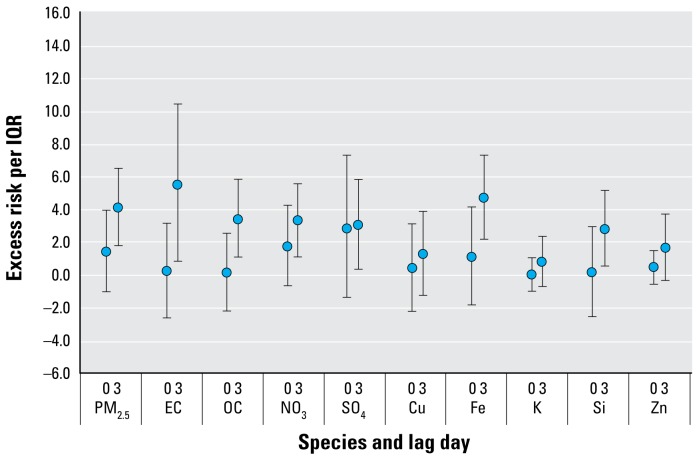
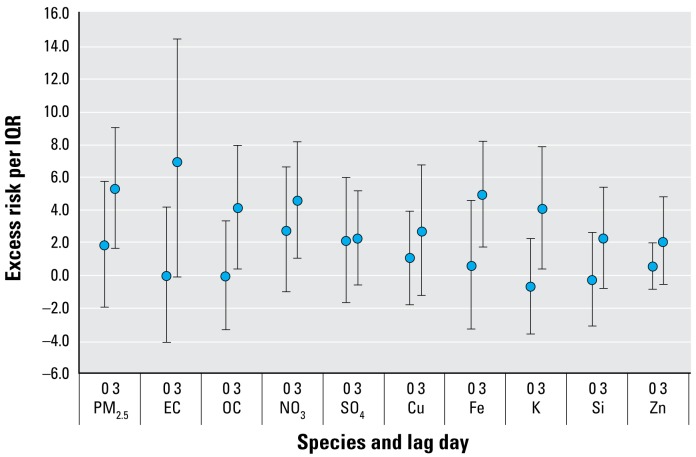
We observed associations between several components of PM2.5 and hospitalization for all of the respiratory outcomes examined. For example, for total respiratory admissions for children<19 years of age, the interquartile range for a 3-day lag of PM2.5, EC, OC, NO3, and sulfates was associated with an excess risk of 4.1% [95% confidence interval (CI), 1.8-6.4], 5.4% (95% CI, 0.8-10.3), 3.4% (95% CI, 1.1-5.7), 3.3% (95% CI, 1.1-5.5), and 3.0% (95% CI, 0.4-5.7), respectively. We also observed associations for several metals. Additional associations with several of the species, including potassium, were observed in the cool season.
Components of PM2.5 were associated with hospitalization for several childhood respiratory diseases including pneumonia, bronchitis, and asthma. Because exposure to components (e.g., EC, OC, NO3, and K) and their related sources, including diesel and gasoline exhaust, wood smoke, and other combustion sources, are ubiquitous in the urban environment, it likely represents an identifiable and preventable risk factor for hospitalization for children.
流行病学研究表明,急性暴露于环境细颗粒物与死亡率和发病率之间存在关联。关于空气动力学直径小于2.5微米的颗粒物(PM2.5)的特定化学成分对住院率的相对影响,人们了解较少。
本研究旨在评估儿童接触PM2.5及其几种成分与呼吸系统疾病住院风险之间的关系。
我们获取了2000年至2003年加利福尼亚州6个县19岁及以下和5岁及以下儿童因各类呼吸系统疾病(包括肺炎、急性支气管炎和哮喘等几个亚类)住院的每日计数数据,以及PM2.5及其成分(包括元素碳(EC)、有机碳(OC)和硝酸盐(NO3))的环境浓度数据。我们使用泊松回归来估计风险,同时控制重要的协变量。
我们观察到PM2.5的几种成分与所有所检查的呼吸系统疾病结局的住院率之间存在关联。例如,对于19岁及以下儿童的总呼吸系统疾病住院病例,PM2.5、EC、OC、NO3和硫酸盐3天滞后的四分位距分别与4.1%[95%置信区间(CI),1.8 - 6.4]、5.4%(95%CI,0.8 - 10.3)、3.4%(95%CI,1.1 - 5.7)、3.3%(95%CI,1.1 - 5.5)和3.0%(95%CI,0.4 - 5.7)的超额风险相关。我们还观察到几种金属的关联。在寒冷季节观察到与包括钾在内的几种成分的其他关联。
PM2.5的成分与几种儿童呼吸系统疾病(包括肺炎、支气管炎和哮喘)的住院率相关。由于在城市环境中,接触这些成分(如EC、OC、NO3和K)及其相关来源(包括柴油和汽油尾气、木烟和其他燃烧源)普遍存在,这可能是儿童住院的一个可识别且可预防的风险因素。