Kobak Roger, Zajac Kristyn, Levine Seymour
Roger Kobak, Department of Psychology, University of Delaware, Newark, DE 19716, USA.
Dev Psychopathol. 2009 Spring;21(2):579-91. doi: 10.1017/S0954579409000315.
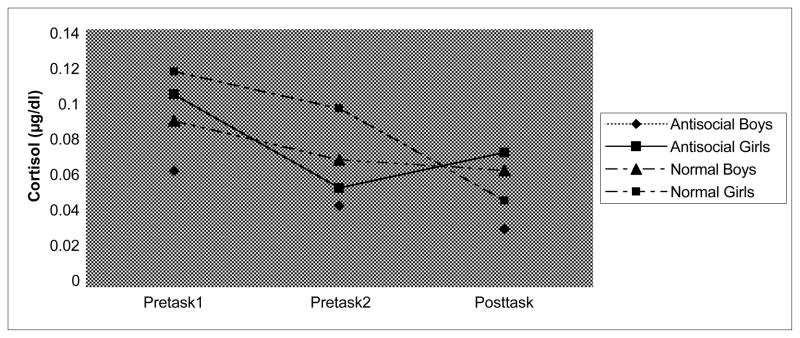
This study examines the relation between adolescents' antisocial behaviors and adrenocortical activity during a laboratory visit in a sample of economically disadvantaged families (N = 116, ages 12-14, 51% female). Pretask cortisol levels indexed adolescents' prechallenge response to the lab visit, whereas adolescents' response to a conflict discussion with their caregivers was indexed with residualized change in pre- to postconflict cortisol levels. A trait measure of antisocial behavior (derived from parent, teacher, and self-reports) was associated with lower pretask cortisol levels but greater cortisol response to the conflict discussion. Gender moderated antisocial adolescents' cortisol response to the conflict discussion with girls who reported more covert risky problem behaviors showing an increased cortisol response. The findings suggest that, although antisocial adolescents had lower pretask cortisol levels, conflict discussions with caregivers present a unique challenge to antisocial girls compared with antisocial boys.
本研究在一个经济弱势家庭样本(N = 116,年龄12 - 14岁,51%为女性)中,考察了青少年在实验室访问期间的反社会行为与肾上腺皮质活动之间的关系。任务前皮质醇水平反映了青少年对实验室访问的挑战前反应,而青少年对与照顾者进行冲突讨论的反应则通过冲突前到冲突后皮质醇水平的残差变化来反映。一种反社会行为的特质测量(源自父母、教师和自我报告)与较低的任务前皮质醇水平相关,但与对冲突讨论的皮质醇反应更大相关。性别调节了反社会青少年对与照顾者冲突讨论的皮质醇反应,报告更多隐蔽风险问题行为的女孩表现出更高的皮质醇反应。研究结果表明,尽管反社会青少年的任务前皮质醇水平较低,但与照顾者的冲突讨论对反社会女孩来说是一个比反社会男孩更独特的挑战。