Cordeiro Marli Tenório, Braga-Neto Ulisses, Nogueira Rita Maria Ribeiro, Marques Ernesto T A
Virology and Experimental Therapy Laboratory, Aggeu Magalhães Research Center, Fiocruz, Recife, Pernambuco, Brazil.
PLoS One. 2009;4(4):e4945. doi: 10.1371/journal.pone.0004945. Epub 2009 Apr 2.
Dengue virus infection causes a wide spectrum of illness, ranging from sub-clinical to severe disease. Severe dengue is associated with sequential viral infections. A strict definition of primary versus secondary dengue infections requires a combination of several tests performed at different stages of the disease, which is not practical.
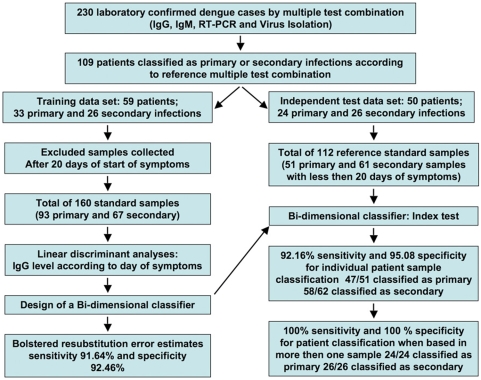
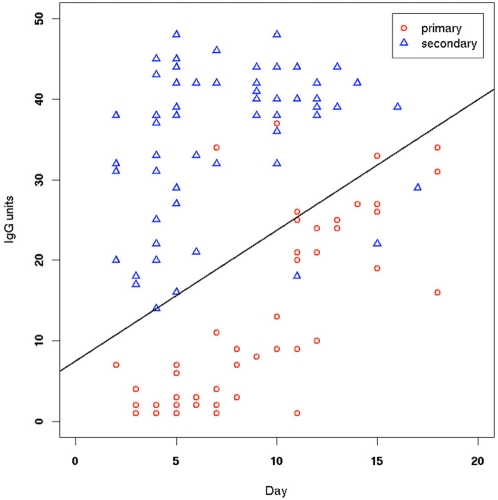
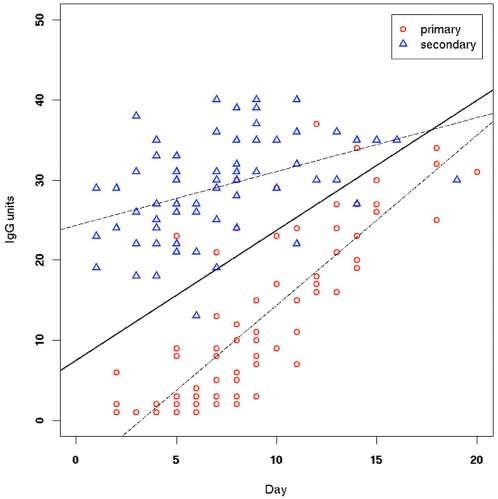
We developed a simple method to classify dengue infections as primary or secondary based on the levels of dengue-specific IgG. A group of 109 dengue infection patients were classified as having primary or secondary dengue infection on the basis of a strict combination of results from assays of antigen-specific IgM and IgG, isolation of virus and detection of the viral genome by PCR tests performed on multiple samples, collected from each patient over a period of 30 days. The dengue-specific IgG levels of all samples from 59 of the patients were analyzed by linear discriminant analysis (LDA), and one- and two-dimensional classifiers were designed. The one-dimensional classifier was estimated by bolstered resubstitution error estimation to have 75.1% sensitivity and 92.5% specificity. The two-dimensional classifier was designed by taking also into consideration the number of days after the onset of symptoms, with an estimated sensitivity and specificity of 91.64% and 92.46%. The performance of the two-dimensional classifier was validated using an independent test set of standard samples from the remaining 50 patients. The classifications of the independent set of samples determined by the two-dimensional classifiers were further validated by comparing with two other dengue classification methods: hemagglutination inhibition (HI) assay and an in-house anti-dengue IgG-capture ELISA method. The decisions made with the two-dimensional classifier were in 100% accordance with the HI assay and 96% with the in-house ELISA.
Once acute dengue infection has been determined, a 2-D classifier based on common dengue virus IgG kits can reliably distinguish primary and secondary dengue infections. Software for calculation and validation of the 2-D classifier is made available for download.
登革病毒感染可导致从亚临床到严重疾病的广泛病症。严重登革热与连续的病毒感染相关。对原发性与继发性登革病毒感染进行严格定义需要在疾病不同阶段进行多项检测的组合,这并不实际。
我们开发了一种基于登革热特异性IgG水平将登革热感染分类为原发性或继发性的简单方法。一组109例登革热感染患者根据抗原特异性IgM和IgG检测结果、病毒分离以及通过对每位患者在30天内采集的多个样本进行PCR检测来检测病毒基因组的严格组合,被分类为原发性或继发性登革热感染。对59例患者所有样本的登革热特异性IgG水平进行线性判别分析(LDA),并设计了一维和二维分类器。通过增强重代入误差估计,一维分类器的灵敏度估计为75.1%,特异性为92.5%。二维分类器在设计时还考虑了症状出现后的天数,估计灵敏度和特异性分别为91.64%和92.46%。使用其余50例患者的标准样本独立测试集对二维分类器的性能进行了验证。通过与另外两种登革热分类方法:血凝抑制(HI)试验和内部抗登革热IgG捕获ELISA方法进行比较,进一步验证了二维分类器对独立样本集的分类。二维分类器做出的判定与HI试验100%一致,与内部ELISA 96%一致。
一旦确定为急性登革热感染,基于常见登革病毒IgG试剂盒的二维分类器可可靠地区分原发性和继发性登革热感染。二维分类器的计算和验证软件可供下载。