Sasani Shahryar, Hemming Megan N, Oliver Sandra N, Greenup Aaron, Tavakkol-Afshari Reza, Mahfoozi Siroos, Poustini Kazem, Sharifi Hamid-Reza, Dennis Elizabeth S, Peacock W James, Trevaskis Ben
CSIRO, Division of Plant Industry, GPO Box 1600, Canberra, ACT, 2601, Australia.
J Exp Bot. 2009;60(7):2169-78. doi: 10.1093/jxb/erp098. Epub 2009 Apr 8.
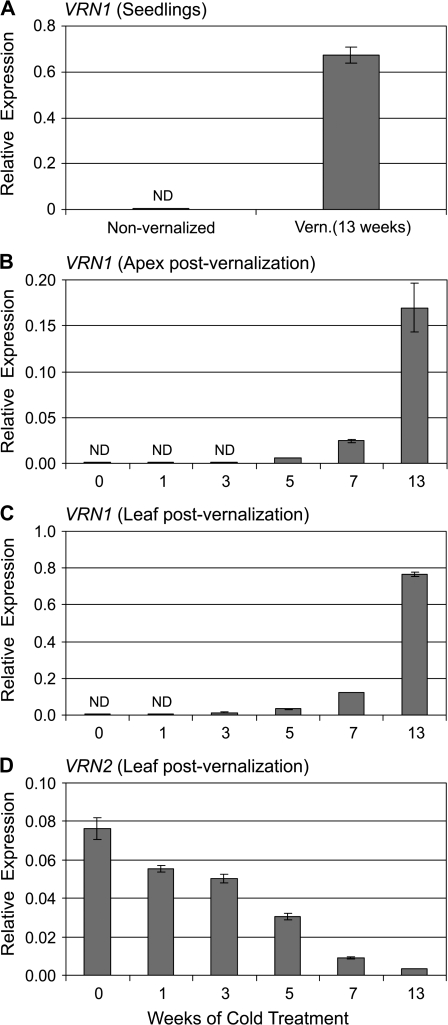
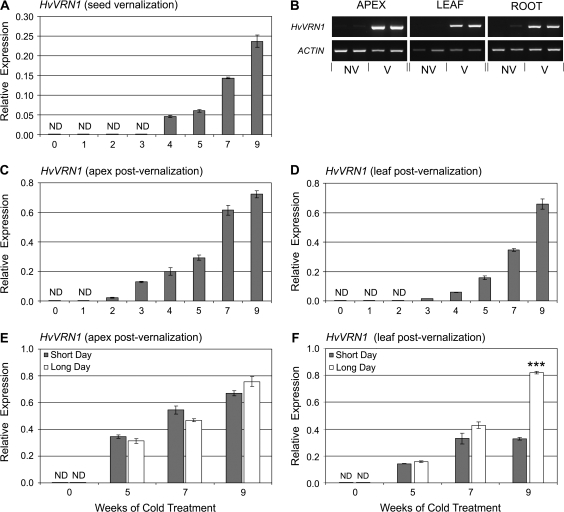
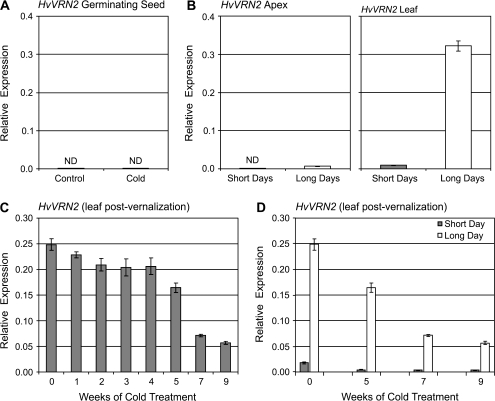
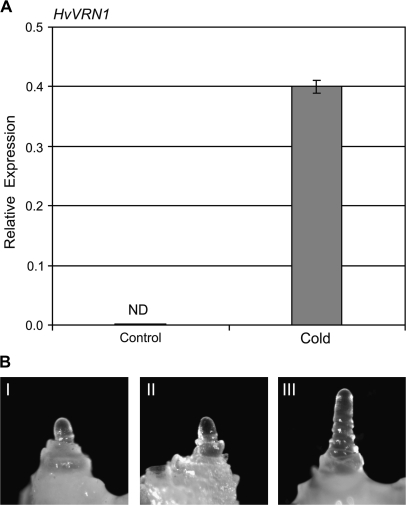
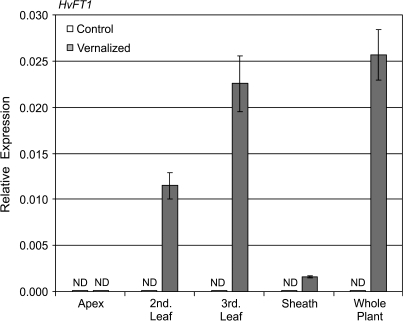
Responses to prolonged low-temperature treatment of imbibed seeds (vernalization) were examined in barley (Hordeum vulgare). These occurred in two phases: the perception of prolonged cold, which occurred gradually at low temperatures, and the acceleration of reproductive development, which occurred after vernalization. Expression of the VERNALIZATION1 gene (HvVRN1) increased gradually in germinating seedlings during vernalization, both at the shoot apex and in the developing leaves. This occurred in darkness, independently of VERNALIZATION2 (HvVRN2), consistent with the hypothesis that expression of HvVRN1 is induced by prolonged cold independently of daylength flowering-response pathways. After vernalization, expression of HvVRN1 was maintained in the shoot apex and leaves. This was associated with accelerated inflorescence initiation and with down-regulation of HvVRN2 in the leaves. The largest determinant of HvVRN1 expression levels in vernalized plants was the length of seed vernalization treatment. Daylength did not influence HvVRN1 expression levels in shoot apices and typically did not affect expression in leaves. In the leaves of plants that had experienced a saturating seed vernalization treatment, expression of HvVRN1 was higher in long days, however. HvFT1 was expressed in the leaves of these plants in long days, which might account for the elevated HvVRN1 expression. Long-day up-regulation of HvVRN1 was not required for inflorescence initiation, but might accelerate subsequent stages of inflorescence development. Similar responses to seed vernalization were also observed in wheat (Triticum aestivum). These data support the hypothesis that VRN1 is induced by cold during winter to promote spring flowering in vernalization-responsive cereals.
在大麦(Hordeum vulgare)中研究了吸胀种子经长时间低温处理(春化)后的反应。这些反应分为两个阶段:对长时间低温的感知,这在低温下逐渐发生;以及生殖发育的加速,这在春化后发生。在春化过程中,发芽幼苗的茎尖和发育中的叶片中,VERNALIZATION1基因(HvVRN1)的表达逐渐增加。这一过程在黑暗中发生,独立于VERNALIZATION2(HvVRN2),这与HvVRN1的表达由长时间低温诱导而独立于光周期开花反应途径的假设一致。春化后,HvVRN1的表达在茎尖和叶片中维持。这与花序起始加速以及叶片中HvVRN2的下调相关。春化植株中HvVRN1表达水平的最大决定因素是种子春化处理的时长。光周期不影响茎尖中HvVRN1的表达水平,通常也不影响叶片中的表达。然而,在经历了饱和种子春化处理的植株叶片中,HvVRN1在长日照下的表达更高。HvFT1在这些植株的叶片中长日照下表达,这可能解释了HvVRN1表达的升高。HvVRN1的长日照上调对于花序起始不是必需的,但可能加速花序发育的后续阶段。在小麦(Triticum aestivum)中也观察到了对种子春化的类似反应。这些数据支持了VRN1在冬季由寒冷诱导以促进春化响应型谷类作物春季开花的假设。