Talieri M, Li L, Zheng Y, Alexopoulou D K, Soosaipillai A, Scorilas A, Xynopoulos D, Diamandis E P
Department of Cellular Physiology, G Papanicolaou Research Center of Oncology, Saint Savvas Hospital, Athens, Greece.
Br J Cancer. 2009 May 19;100(10):1659-65. doi: 10.1038/sj.bjc.6605033. Epub 2009 Apr 14.
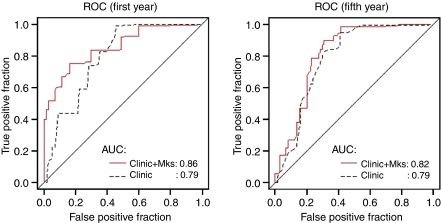
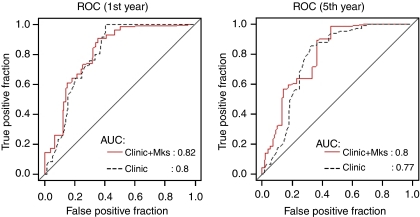
Several members of the human tissue kallikrein-related peptidase (KLK) family are emerging cancer biomarkers. The aim of this study was to analyse the expression of a panel of KLKs in colorectal cancer and to find out if the multiparametric combination of them can increase the accuracy of prediction of patients survival beyond the traditional clinical information. Nine KLKs (KLK5-8, KLK10, KLK11, KLK13-15) were measured using ELISA assays in cytosolic extracts of 122 colon cancer tissues and their nearby normal mucosa, obtained during surgery. The mean levels of almost all KLKs in tumour tissues were significantly different from their counterparts of normal tissue (P<0.0001). KLK 5, 6, 7, 13, 14 were significantly associated with overall survival in univariate analysis, but after adjusting for age, TNM and differentiation stage, only KLK5 (HR: 1.24 (95% CI: 1.05-1.47)), KLK7 (HR: 1.57 (95% CI: 1.04-2.37)) and KLK14 (HR: 1.43 (95% CI: 1.05-1.94)) remained significant. Addition of a panel of selected KLK markers to clinical parameters gave an increment in AUC of 0.86 beyond the clinical factors at year 1, showing that it can increase the accuracy of prediction of overall survival beyond the traditional clinical information, particularly the short-term (1 year) survival after surgery.
人类组织激肽释放酶相关肽酶(KLK)家族的多个成员正成为癌症生物标志物。本研究的目的是分析一组KLK在结直肠癌中的表达,并探究它们的多参数组合是否能提高预测患者生存的准确性,超越传统临床信息。在手术过程中获取了122例结肠癌组织及其附近正常黏膜的胞质提取物,采用ELISA检测法测定了9种KLK(KLK5 - 8、KLK10、KLK11、KLK13 - 15)。肿瘤组织中几乎所有KLK的平均水平与正常组织中的对应水平均有显著差异(P<0.0001)。在单因素分析中,KLK 5、6、7、13、14与总生存期显著相关,但在调整年龄、TNM和分化阶段后,只有KLK5(风险比:1.24(95%置信区间:1.05 - 1.47))、KLK7(风险比:1.57(95%置信区间:1.04 - 2.37))和KLK14(风险比:1.43(95%置信区间:1.05 - 1.94))仍具有显著性。将一组选定的KLK标志物添加到临床参数中,在第1年时,曲线下面积(AUC)比临床因素提高了0.86,表明它可以提高预测总生存期的准确性,超越传统临床信息,特别是术后短期(1年)生存期。