Wong Christopher Ern-Yoong, Ang Angelina Su-Yin, Ng Kee-Chong
Department of Emergency Medicine, KK Women and Children's Hospital, Singapore, Singapore.
Int J Emerg Med. 2008 Dec;1(4):267-71. doi: 10.1007/s12245-008-0072-9. Epub 2008 Nov 19.
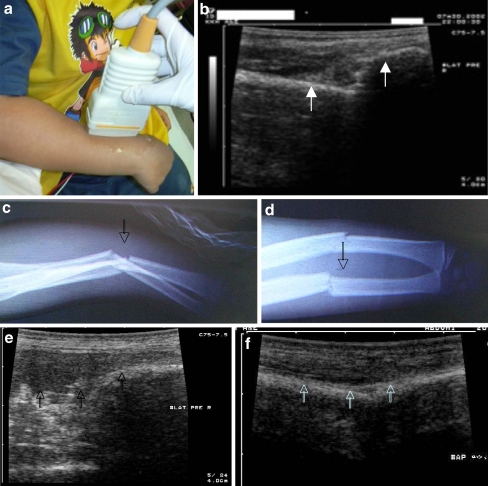
Displaced distal forearm fractures are frequently reduced in emergency departments. Not infrequently, some are not done adequately and require the tedious process of repeating the procedure, with repeated X-rays and radiation exposure, and inconvenience to patient and staff. The use of ultrasound (US) in its expanding role in the practice of emergency medicine has been proposed to visualise bone positioning.
Our department embarked on this proof of concept study to assess the usefulness of this tool.
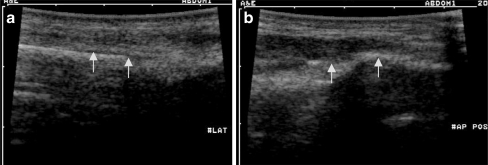
By way of convenience sampling, we looked at whether our US interpretation correlated with the corresponding X-ray findings, pre and post manipulation of suitable fractures.
Out of 42 patients recruited over a 1-year period, we were successful in 38 (90%). Four were "unsuccessful" (10%) due to technique rather than equipment or patient factors.
Whilst before we were blind prior to a post-reduction X-ray, this "new" additional role of the ultrasound (very accessible, cost effective and safe) can now aid us in our decision making, thereby enhancing the work flow of this group of patients through the department.
急诊科室经常对移位的前臂远端骨折进行复位。不少情况下,复位操作不够充分,需要重复进行这一繁琐过程,包括多次X光检查及辐射暴露,给患者和医护人员带来不便。有人提议利用超声(US)在急诊医学实践中日益拓展的作用来观察骨骼复位情况。
我们科室开展了这项概念验证研究,以评估该工具的实用性。
通过便利抽样,我们观察了合适骨折在手法复位前后,超声解读结果与相应X光检查结果是否相关。
在为期1年招募的42例患者中,38例(90%)成功。4例(10%)“未成功”是由于技术原因,而非设备或患者因素。
在复位后X光检查之前,我们之前对此是盲目的,而超声这个“新”的额外作用(非常便捷、经济高效且安全)现在可以帮助我们进行决策,从而改善这类患者在科室的诊疗流程。