York Robyn M B, Gordon Ian L
Division of Vascular Surgery, Department of Surgery, University of California Irvine Medical Center, Orange CA, USA.
BMC Complement Altern Med. 2009 Apr 22;9:10. doi: 10.1186/1472-6882-9-10.
Increasing experimental and clinical evidence suggests that illumination of the skin with relatively low intensity light may lead to therapeutic results such as reduced pain or improved wound healing. The goal of this study was to evaluate prospectively whether socks made from polyethylene terephthalate (PET) incorporating optically active particles (Celliant) ameliorates chronic foot pain resulting from diabetic neuropathy or other disorders. Such optically modified fiber is thought to modify the illumination of the skin in the visible and infrared portions of the spectrum, and consequently reduce pain.
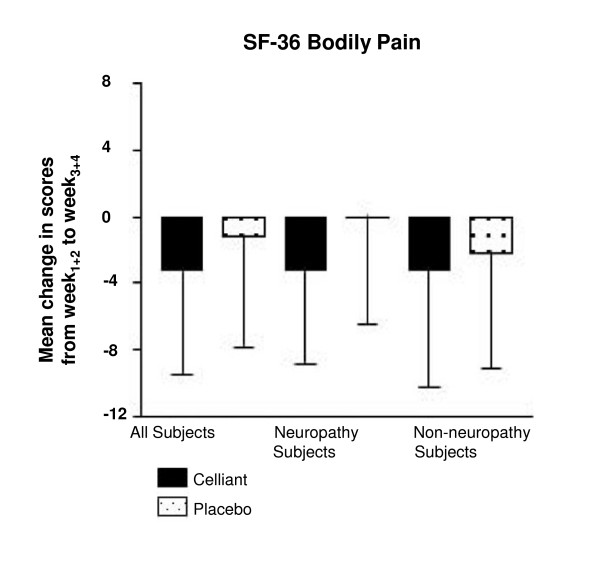
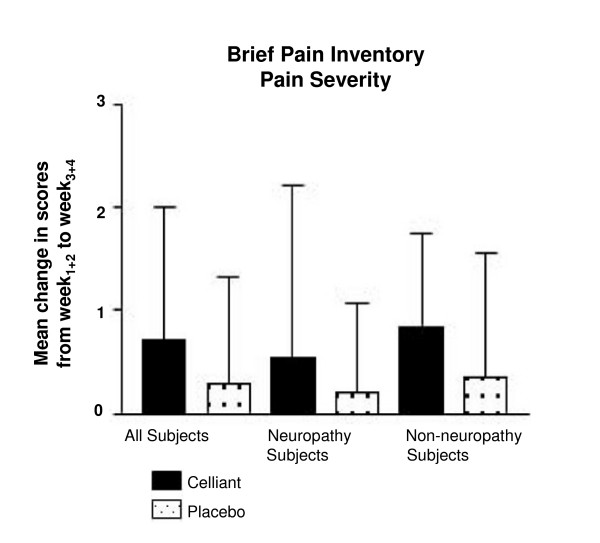
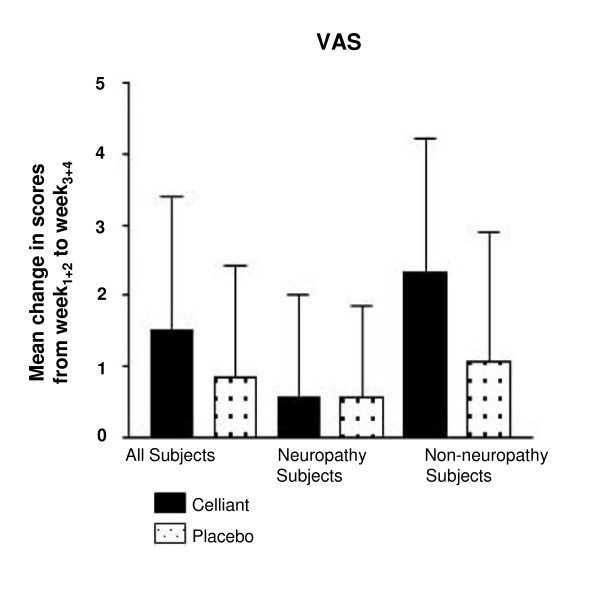
A double-blind, randomized trial with 55 subjects (38 men, 17 women) enrolled (average age 59.7 +/- 11.9 years), 26 with diabetic neuropathy and 29 with other pain etiologies. Subjects twice completed the Visual Analogue Scale (VAS), Brief Pain Inventory (BPI), McGill Pain Questionnaire (MPQ), and SF-36 a week apart (W(1+2)) before receiving either control or Celliant socks. The same questionnaires were answered again one and two weeks (W(3+4)) later. The questionnaires provided nine scores for analyzing pain reduction: one VAS score, two BPI scores, five MPQ scores, and the bodily pain score on the SF-36. Mean W(1+2) and W(3+4) scores were compared to measure pain reduction.
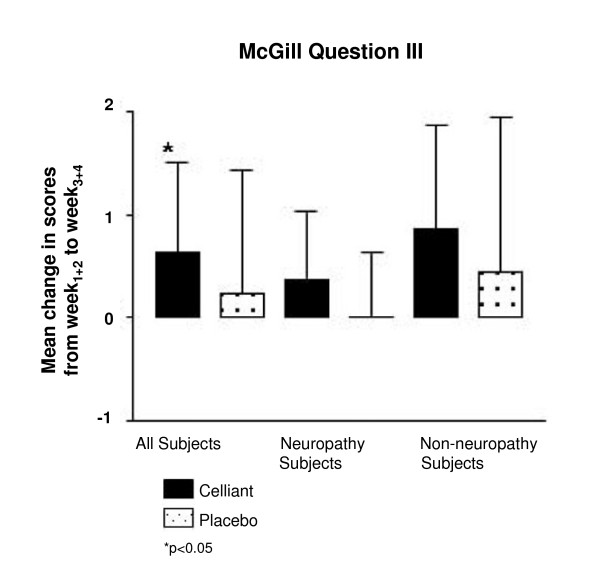
More pain reduction was reported by Celliant subjects for 8 of the 9 pain questions employed, with a significant (p = 0.043) difference between controls and Celliant for McGill question III. In neuropathic subjects, Celliant caused more pain reduction in 6 of the 9 questions, but not significantly. In non-neuropathic subjects 8 of 9 questions showed more pain reduction with the Celliant socks.
Socks with optically modified PET (Celliant) appear to have a beneficial impact on chronic foot pain. The mechanism could be related to the effects seen with illumination of tissues with visible and infrared light.
ClinicalTrials.gov NCT00458497.
越来越多的实验和临床证据表明,用相对低强度的光照射皮肤可能会产生治疗效果,如减轻疼痛或促进伤口愈合。本研究的目的是前瞻性评估由聚对苯二甲酸乙二酯(PET)制成并掺入光学活性颗粒(Celliant)的袜子是否能改善由糖尿病神经病变或其他疾病引起的慢性足部疼痛。这种经过光学改性的纤维被认为可以改变皮肤在光谱可见和红外部分的光照情况,从而减轻疼痛。
一项双盲、随机试验,纳入了55名受试者(38名男性,17名女性)(平均年龄59.7±11.9岁),其中26名患有糖尿病神经病变,29名有其他疼痛病因。受试者在接受对照袜子或Celliant袜子之前,相隔一周两次完成视觉模拟量表(VAS)、简明疼痛问卷(BPI)、麦吉尔疼痛问卷(MPQ)和SF-36(W(1+2))。在一周和两周后(W(3+4))再次回答相同的问卷。这些问卷提供了九个用于分析疼痛减轻情况的分数:一个VAS分数、两个BPI分数、五个MPQ分数以及SF-36上的身体疼痛分数。比较W(1+2)和W(3+4)的平均分数以衡量疼痛减轻情况。
在使用的9个疼痛问题中,Celliant组受试者报告的疼痛减轻情况在8个问题上更多,麦吉尔问卷第三个问题中对照组和Celliant组之间存在显著差异(p = 0.043)。在神经病变受试者中,Celliant在9个问题中的6个问题上导致更多的疼痛减轻,但不显著。在非神经病变受试者中,9个问题中的8个问题显示Celliant袜子的疼痛减轻更多。
具有光学改性PET(Celliant)的袜子似乎对慢性足部疼痛有有益影响。其机制可能与用可见光和红外光照射组织所产生的效果有关。
ClinicalTrials.gov NCT00458497。