Gliozzi Antonio S, Guiot Caterina, Delsanto Pier Paolo
Department of Physics, Politecnico di Torino, Torino, Italy.
PLoS One. 2009;4(4):e5358. doi: 10.1371/journal.pone.0005358. Epub 2009 Apr 27.
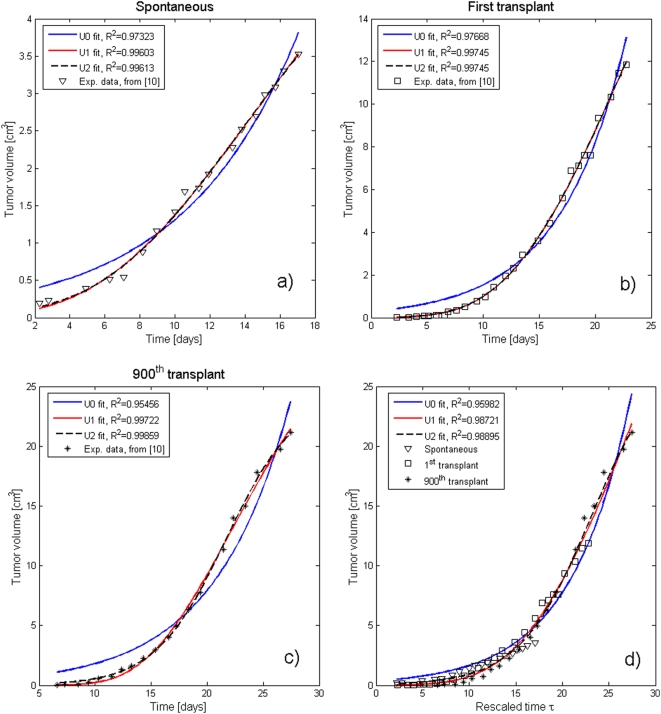
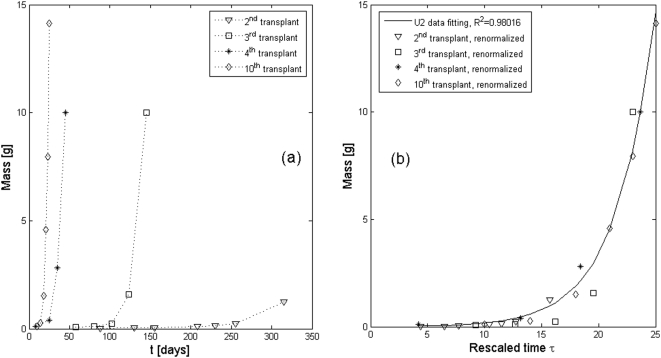
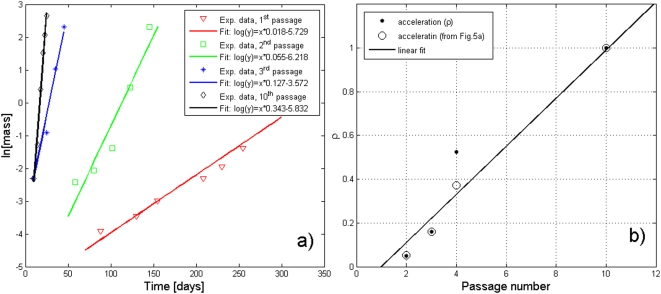
Multipassage experiments are performed by subcutaneous implantation in lab animals (usually mice) of a small number of cells from selected human lines. Tumor cells are then passaged from one mouse to another by harvesting them from a growing tumor and implanting them into other healthy animals. This procedure may be extremely useful to investigate the various mechanisms involved in the long term evolution of tumoral growth. It has been observed by several researchers that, contrary to what happens in in vitro experiments, there is a significant growth acceleration at each new passage. This result is explained by a new method of analysis, based on the Phenomenological Universalities approach. It is found that, by means of a simple rescaling of time, it is possible to collapse all the growth curves, corresponding to the successive passages, into a single curve, belonging to the Universality Class U2. Possible applications are proposed and the need of further experimental evidence is discussed.
多代移植实验是通过将从选定人类细胞系中获取的少量细胞皮下植入实验动物(通常是小鼠)来进行的。然后,通过从生长的肿瘤中采集肿瘤细胞并将其植入其他健康动物体内,使肿瘤细胞从一只小鼠传递到另一只小鼠。该程序对于研究肿瘤生长长期演变所涉及的各种机制可能极为有用。几位研究人员已经观察到,与体外实验的情况相反,每次新的传代都会出现显著的生长加速。这一结果通过一种基于唯象普遍性方法的新分析方法得到了解释。研究发现,通过对时间进行简单的重新标度,可以将对应于连续传代的所有生长曲线合并为一条属于普遍性类U2的单一曲线。文中提出了可能的应用,并讨论了进一步实验证据的必要性。