Wei Ji-Fu, Wei Xiao-Long, Mo Ya-Zhen, He Shao-Heng
Clinical Experiment Center, the First Affiliated Hospital of Nanjing Medical University, Nanjing, PR China.
BMC Immunol. 2009 Apr 28;10:21. doi: 10.1186/1471-2172-10-21.
It has been recognized that phospholipase A2 (PLA2) is a crucial component of snake venom, which contributes greatly to snake venom induced inflammation in man. However, the mechanisms through which N49 PLA2 provoke inflammation remain unclear. Recently, a N49 PLA2, TM-N49 from Protobothrops mucrosquamatus crude venom was characterized in our laboratory. Since the purification procedure developed is able to supply us with relatively large quantity of highly purified TM-N49, we investigated the ability of TM-N49 in induction of inflammation.
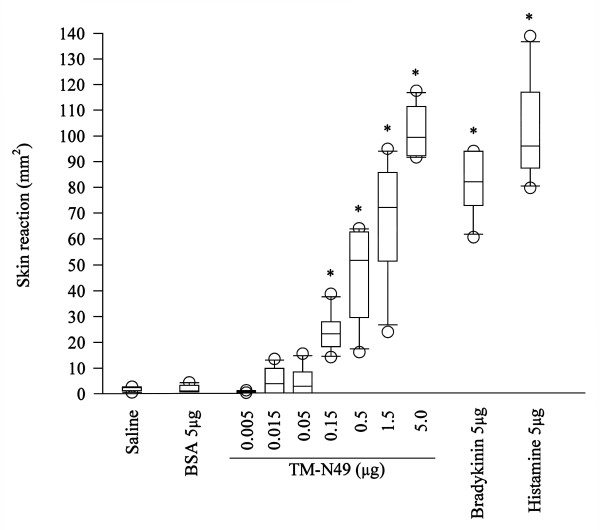
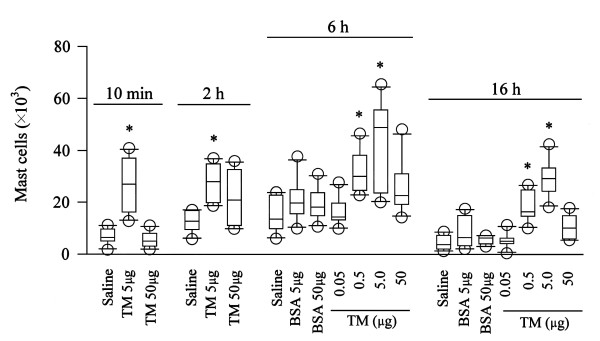
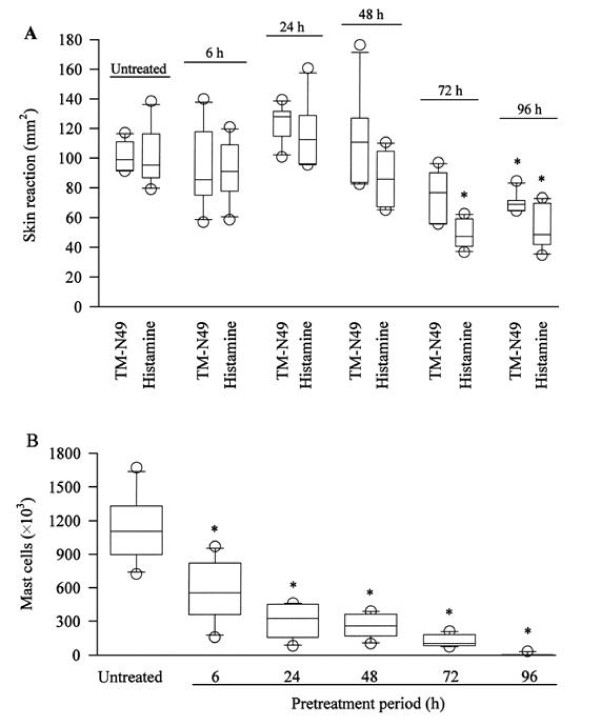
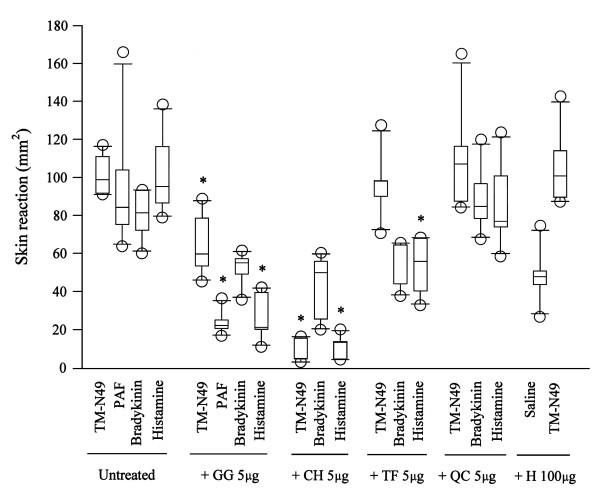
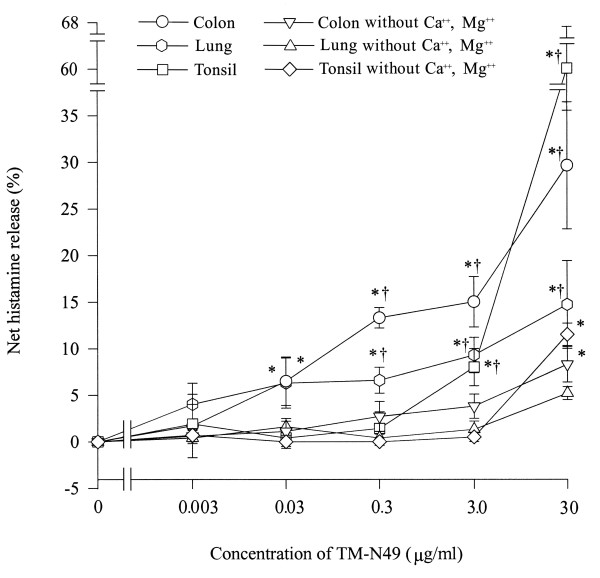
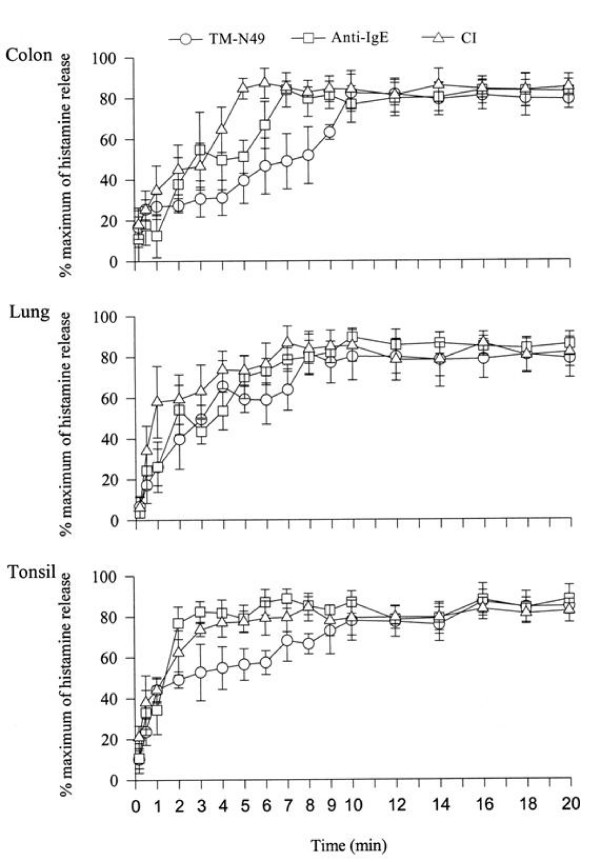
The results showed that TM-N49 provoked a dose dependent increase in microvascular leakage in the skin of rats. The potency of TM-N49 in induction of skin edema appeared similar potency of bradykinin and histamine. Pretreatment of rats with compound 48/80 diminished TM-N49 induced skin reaction and reduced mast cell numbers in rats. Ginkgolide B and cyproheptadine, but not terfenadine and quinacrine, inhibited TM-N49 elicited microvascular leakage when they were co-injected with the stimulus to rat skin. Moreover, TM-N49 was found to induce histamine release from human colon, lung and tonsil mast cells, and both metabolic inhibitors and pertussis toxin were capable of inhibiting TM-N49 elicited histamine release. TM-N49 induced mast cell accumulation in the peritoneum of mice, which was inhibited by co-injection of ginkgolide B, cyproheptadine and terfenadine. Intravenous injection of monoclonal antibodies against CD18, ICAM-1 and CD11a also blocked TM-N49 induced mast cell accumulation.
TM-N49 is a potent stimulus for skin edema, mast cell activation and accumulation.
磷脂酶A2(PLA2)被认为是蛇毒的关键成分,对蛇毒诱导的人体炎症有很大影响。然而,N49 PLA2引发炎症的机制尚不清楚。最近,我们实验室对来自原矛头蝮粗毒的一种N49 PLA2,即TM-N49进行了表征。由于所开发的纯化程序能够为我们提供相对大量的高纯度TM-N49,我们研究了TM-N49诱导炎症的能力。
结果表明,TM-N49可引起大鼠皮肤微血管渗漏呈剂量依赖性增加。TM-N49诱导皮肤水肿的效力与缓激肽和组胺相似。用化合物48/80预处理大鼠可减少TM-N49诱导的皮肤反应,并减少大鼠体内肥大细胞数量。当银杏内酯B和赛庚啶与刺激物共同注射到大鼠皮肤时,可抑制TM-N49引起的微血管渗漏,而特非那定和奎纳克林则无此作用。此外,发现TM-N49可诱导人结肠、肺和扁桃体肥大细胞释放组胺,代谢抑制剂和百日咳毒素均能抑制TM-N49引起的组胺释放。TM-N49可诱导小鼠腹腔肥大细胞聚集,银杏内酯B、赛庚啶和特非那定共同注射可抑制此作用。静脉注射抗CD18、ICAM-1和CD11a单克隆抗体也可阻断TM-N49诱导的肥大细胞聚集。
TM-N49是皮肤水肿、肥大细胞活化和聚集的有效刺激物。