• 文献检索
  • 文档翻译
  • 深度研究
  • 学术资讯
  • Suppr Zotero 插件Zotero 插件
  • 邀请有礼
  • 套餐&价格
  • 历史记录
应用&插件
Suppr Zotero 插件Zotero 插件浏览器插件Mac 客户端Windows 客户端微信小程序
定价
高级版会员购买积分包购买API积分包
服务
文献检索文档翻译深度研究API 文档MCP 服务
关于我们
关于 Suppr公司介绍联系我们用户协议隐私条款
关注我们

Suppr 超能文献

核心技术专利:CN118964589B侵权必究
粤ICP备2023148730 号-1Suppr @ 2026

文献检索

告别复杂PubMed语法,用中文像聊天一样搜索,搜遍4000万医学文献。AI智能推荐,让科研检索更轻松。

立即免费搜索

文件翻译

保留排版,准确专业,支持PDF/Word/PPT等文件格式,支持 12+语言互译。

免费翻译文档

深度研究

AI帮你快速写综述,25分钟生成高质量综述,智能提取关键信息,辅助科研写作。

立即免费体验

S-腺苷同型半胱氨酸和DNA末端刺激III型限制性内切酶EcoPI中的混杂核酸酶活性。

S-adenosyl homocysteine and DNA ends stimulate promiscuous nuclease activities in the Type III restriction endonuclease EcoPI.

作者信息

Peakman Luke J, Szczelkun Mark D

机构信息

DNA-Protein Interactions Unit, Department of Biochemistry, School of Medical Sciences, University of Bristol, Bristol BS8 1TD, UK.

出版信息

Nucleic Acids Res. 2009 Jul;37(12):3934-45. doi: 10.1093/nar/gkp267. Epub 2009 Apr 28.

DOI:10.1093/nar/gkp267
PMID:19401438
原文链接:https://pmc.ncbi.nlm.nih.gov/articles/PMC2709564/
Abstract

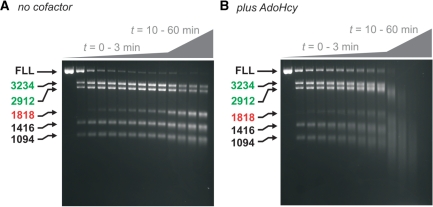
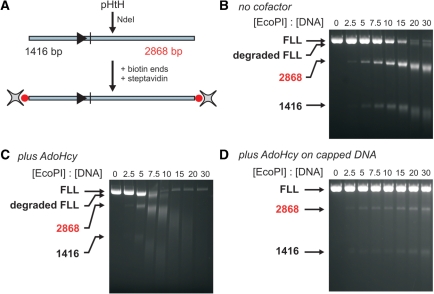
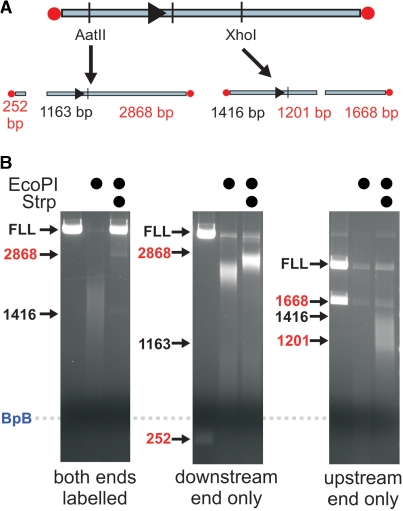
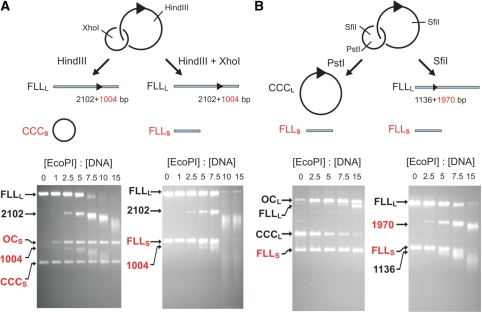
In the absence of the methyl donor S-adenosyl methionine and under certain permissive reaction conditions, EcoPI shows non-specific endonuclease activity. We show here that the cofactor analogue S-adenosyl homocysteine promotes this promiscuous DNA cleavage. Additionally, an extensive exonuclease-like processing of the DNA is also observed that can even result in digestion of non-specific DNA in trans. We suggest a model for how DNA communication events initiating from non-specific sites, and in particular free DNA ends, could produce the observed cleavage patterns.

摘要

在缺乏甲基供体S-腺苷甲硫氨酸且在某些允许的反应条件下,EcoPI表现出非特异性核酸内切酶活性。我们在此表明,辅因子类似物S-腺苷高半胱氨酸促进了这种杂乱的DNA切割。此外,还观察到对DNA进行广泛的类似核酸外切酶的加工,甚至可导致反式非特异性DNA的消化。我们提出了一个模型,说明从非特异性位点(特别是游离DNA末端)起始的DNA通讯事件如何产生观察到的切割模式。
https://cdn.ncbi.nlm.nih.gov/pmc/blobs/087a/2709564/c83ec8f17752/gkp267f11.jpg
https://cdn.ncbi.nlm.nih.gov/pmc/blobs/087a/2709564/9375a22eabf5/gkp267f1.jpg
https://cdn.ncbi.nlm.nih.gov/pmc/blobs/087a/2709564/19360772ffa3/gkp267f2.jpg
https://cdn.ncbi.nlm.nih.gov/pmc/blobs/087a/2709564/a8033a37274e/gkp267f3.jpg
https://cdn.ncbi.nlm.nih.gov/pmc/blobs/087a/2709564/7500efc5c01b/gkp267f4.jpg
https://cdn.ncbi.nlm.nih.gov/pmc/blobs/087a/2709564/8941d7047b73/gkp267f5.jpg
https://cdn.ncbi.nlm.nih.gov/pmc/blobs/087a/2709564/969de79fb448/gkp267f6.jpg
https://cdn.ncbi.nlm.nih.gov/pmc/blobs/087a/2709564/5e48441b594c/gkp267f7.jpg
https://cdn.ncbi.nlm.nih.gov/pmc/blobs/087a/2709564/177e1da139ce/gkp267f8.jpg
https://cdn.ncbi.nlm.nih.gov/pmc/blobs/087a/2709564/d831798f4751/gkp267f9.jpg
https://cdn.ncbi.nlm.nih.gov/pmc/blobs/087a/2709564/e82e34e6ac35/gkp267f10.jpg
https://cdn.ncbi.nlm.nih.gov/pmc/blobs/087a/2709564/c83ec8f17752/gkp267f11.jpg
https://cdn.ncbi.nlm.nih.gov/pmc/blobs/087a/2709564/9375a22eabf5/gkp267f1.jpg
https://cdn.ncbi.nlm.nih.gov/pmc/blobs/087a/2709564/19360772ffa3/gkp267f2.jpg
https://cdn.ncbi.nlm.nih.gov/pmc/blobs/087a/2709564/a8033a37274e/gkp267f3.jpg
https://cdn.ncbi.nlm.nih.gov/pmc/blobs/087a/2709564/7500efc5c01b/gkp267f4.jpg
https://cdn.ncbi.nlm.nih.gov/pmc/blobs/087a/2709564/8941d7047b73/gkp267f5.jpg
https://cdn.ncbi.nlm.nih.gov/pmc/blobs/087a/2709564/969de79fb448/gkp267f6.jpg
https://cdn.ncbi.nlm.nih.gov/pmc/blobs/087a/2709564/5e48441b594c/gkp267f7.jpg
https://cdn.ncbi.nlm.nih.gov/pmc/blobs/087a/2709564/177e1da139ce/gkp267f8.jpg
https://cdn.ncbi.nlm.nih.gov/pmc/blobs/087a/2709564/d831798f4751/gkp267f9.jpg
https://cdn.ncbi.nlm.nih.gov/pmc/blobs/087a/2709564/e82e34e6ac35/gkp267f10.jpg
https://cdn.ncbi.nlm.nih.gov/pmc/blobs/087a/2709564/c83ec8f17752/gkp267f11.jpg

相似文献

1
S-adenosyl homocysteine and DNA ends stimulate promiscuous nuclease activities in the Type III restriction endonuclease EcoPI.S-腺苷同型半胱氨酸和DNA末端刺激III型限制性内切酶EcoPI中的混杂核酸酶活性。
Nucleic Acids Res. 2009 Jul;37(12):3934-45. doi: 10.1093/nar/gkp267. Epub 2009 Apr 28.
2
ATP hydrolysis is required for DNA cleavage by EcoPI restriction enzyme.EcoPI限制酶切割DNA需要ATP水解。
J Mol Biol. 1995 Apr 7;247(4):559-67. doi: 10.1016/s0022-2836(05)80137-8.
3
S-adenosyl methionine prevents promiscuous DNA cleavage by the EcoP1I type III restriction enzyme.S-腺苷甲硫氨酸可防止EcoP1I III型限制酶随意切割DNA。
J Mol Biol. 2003 Oct 17;333(2):321-35. doi: 10.1016/j.jmb.2003.08.042.
4
S-adenosyl-L-methionine is required for DNA cleavage by type III restriction enzymes.III型限制酶切割DNA需要S-腺苷-L-甲硫氨酸。
J Mol Biol. 2001 Jun 29;310(1):93-109. doi: 10.1006/jmbi.2001.4744.
5
Mutations in the Res subunit of the EcoPI restriction enzyme that affect ATP-dependent reactions.影响ATP依赖性反应的EcoPI限制酶Res亚基中的突变。
J Mol Biol. 1997 Jun 13;269(3):342-54. doi: 10.1006/jmbi.1997.1045.
6
DNA cleavage by type III restriction-modification enzyme EcoP15I is independent of spacer distance between two head to head oriented recognition sites.III型限制修饰酶EcoP15I的DNA切割与两个头对头定向识别位点之间的间隔距离无关。
J Mol Biol. 2001 Sep 28;312(4):687-98. doi: 10.1006/jmbi.2001.4998.
7
Single-site DNA cleavage by Type III restriction endonuclease requires a site-bound enzyme and a trans-acting enzyme that are ATPase-activated.III 型限制内切酶的单链 DNA 切割需要一个结合在靶位上的酶和一个具有 ATP 酶激活活性的反式作用酶。
Nucleic Acids Res. 2018 Jul 6;46(12):6229-6237. doi: 10.1093/nar/gky344.
8
Type III restriction endonucleases are heterotrimeric: comprising one helicase-nuclease subunit and a dimeric methyltransferase that binds only one specific DNA.III 型限制内切酶是异源三聚体:由一个解旋酶-核酸酶亚基和一个二聚体甲基转移酶组成,后者仅与一种特定的 DNA 结合。
Nucleic Acids Res. 2014 Apr;42(8):5139-50. doi: 10.1093/nar/gku122. Epub 2014 Feb 7.
9
Functional characterization and modulation of the DNA cleavage efficiency of type III restriction endonuclease EcoP15I in its interaction with two sites in the DNA target.III型限制性内切酶EcoP15I与DNA靶标中两个位点相互作用时DNA切割效率的功能表征与调控
J Mol Biol. 2009 Apr 17;387(5):1309-19. doi: 10.1016/j.jmb.2009.02.047. Epub 2009 Feb 26.
10
DNA recognition by the EcoP15I and EcoPI modification methyltransferases.EcoP15I和EcoPI甲基化修饰转移酶对DNA的识别
Gene. 1995 May 19;157(1-2):143-7. doi: 10.1016/0378-1119(95)00671-r.

引用本文的文献

1
Single-site DNA cleavage by Type III restriction endonuclease requires a site-bound enzyme and a trans-acting enzyme that are ATPase-activated.III 型限制内切酶的单链 DNA 切割需要一个结合在靶位上的酶和一个具有 ATP 酶激活活性的反式作用酶。
Nucleic Acids Res. 2018 Jul 6;46(12):6229-6237. doi: 10.1093/nar/gky344.
2
Re-evaluating the kinetics of ATP hydrolysis during initiation of DNA sliding by Type III restriction enzymes.重新评估III型限制酶引发DNA滑动过程中ATP水解的动力学。
Nucleic Acids Res. 2015 Dec 15;43(22):10870-81. doi: 10.1093/nar/gkv1154. Epub 2015 Nov 3.
3
Type III restriction endonucleases are heterotrimeric: comprising one helicase-nuclease subunit and a dimeric methyltransferase that binds only one specific DNA.

本文引用的文献

1
Functional characterization and modulation of the DNA cleavage efficiency of type III restriction endonuclease EcoP15I in its interaction with two sites in the DNA target.III型限制性内切酶EcoP15I与DNA靶标中两个位点相互作用时DNA切割效率的功能表征与调控
J Mol Biol. 2009 Apr 17;387(5):1309-19. doi: 10.1016/j.jmb.2009.02.047. Epub 2009 Feb 26.
2
Type III restriction enzymes communicate in 1D without looping between their target sites.III型限制酶在一维空间中进行通讯,其靶位点之间不会形成环。
Proc Natl Acad Sci U S A. 2009 Feb 10;106(6):1748-53. doi: 10.1073/pnas.0807193106. Epub 2009 Jan 30.
3
RecBCD enzyme and the repair of double-stranded DNA breaks.
III 型限制内切酶是异源三聚体:由一个解旋酶-核酸酶亚基和一个二聚体甲基转移酶组成,后者仅与一种特定的 DNA 结合。
Nucleic Acids Res. 2014 Apr;42(8):5139-50. doi: 10.1093/nar/gku122. Epub 2014 Feb 7.
4
Dissociation from DNA of Type III Restriction-Modification enzymes during helicase-dependent motion and following endonuclease activity.III 型限制修饰酶在解旋酶依赖性运动过程中以及内切酶活性之后与 DNA 的解离。
Nucleic Acids Res. 2012 Aug;40(14):6752-64. doi: 10.1093/nar/gks328. Epub 2012 Apr 20.
5
DNA cleavage site selection by Type III restriction enzymes provides evidence for head-on protein collisions following 1D bidirectional motion.III 型限制酶对 DNA 切割位点的选择为沿 1D 双向运动的蛋白迎面相撞提供了证据。
Nucleic Acids Res. 2011 Oct;39(18):8042-51. doi: 10.1093/nar/gkr502. Epub 2011 Jun 30.
6
DNA translocation by type III restriction enzymes: a comparison of current models of their operation derived from ensemble and single-molecule measurements.III 型限制酶的 DNA 易位:基于集合和单分子测量的操作模型比较。
Nucleic Acids Res. 2011 Jun;39(11):4525-31. doi: 10.1093/nar/gkq1285. Epub 2011 Feb 10.
7
Maintaining a sense of direction during long-range communication on DNA.在 DNA 的远程通信中保持方向感。
Biochem Soc Trans. 2010 Apr;38(2):404-9. doi: 10.1042/BST0380404.
8
The single polypeptide restriction-modification enzyme LlaGI is a self-contained molecular motor that translocates DNA loops.单个多肽限制修饰酶 LlaGI 是一种自给自足的分子马达,可以转运 DNA 环。
Nucleic Acids Res. 2009 Nov;37(21):7219-30. doi: 10.1093/nar/gkp794.
RecBCD酶与双链DNA断裂的修复
Microbiol Mol Biol Rev. 2008 Dec;72(4):642-71, Table of Contents. doi: 10.1128/MMBR.00020-08.
4
MmeI: a minimal Type II restriction-modification system that only modifies one DNA strand for host protection.MmeI:一种最小型的II型限制修饰系统,仅修饰一条DNA链以实现宿主保护。
Nucleic Acids Res. 2008 Nov;36(20):6558-70. doi: 10.1093/nar/gkn711. Epub 2008 Oct 17.
5
Activation and inhibition of DNA methyltransferases by S-adenosyl-L-homocysteine analogues.S-腺苷-L-高半胱氨酸类似物对DNA甲基转移酶的激活与抑制作用
Bioorg Med Chem. 2008 Mar 1;16(5):2276-85. doi: 10.1016/j.bmc.2007.11.075. Epub 2007 Dec 3.
6
Restriction endonuclease BpuJI specific for the 5'-CCCGT sequence is related to the archaeal Holliday junction resolvase family.对5'-CCCGT序列具有特异性的限制性内切酶BpuJI与古细菌霍利迪连接体解离酶家族相关。
Nucleic Acids Res. 2007;35(7):2377-89. doi: 10.1093/nar/gkm164. Epub 2007 Mar 28.
7
REBASE--enzymes and genes for DNA restriction and modification.REBASE——DNA 限制与修饰的酶及基因
Nucleic Acids Res. 2007 Jan;35(Database issue):D269-70. doi: 10.1093/nar/gkl891.
8
Characterization of the Type III restriction endonuclease PstII from Providencia stuartii.斯氏普罗威登斯菌III型限制性内切酶PstII的特性分析。
Nucleic Acids Res. 2005 Aug 24;33(15):4775-87. doi: 10.1093/nar/gki787. Print 2005.
9
Exogenous AdoMet and its analogue sinefungin differentially influence DNA cleavage by R.EcoP15I--usefulness in SAGE.
Biochem Biophys Res Commun. 2005 Sep 2;334(3):803-11. doi: 10.1016/j.bbrc.2005.06.171.
10
Unidirectional translocation from recognition site and a necessary interaction with DNA end for cleavage by Type III restriction enzyme.来自识别位点的单向易位以及与DNA末端的必要相互作用,以便III型限制酶进行切割。
Nucleic Acids Res. 2004 Oct 22;32(19):5703-11. doi: 10.1093/nar/gkh899. Print 2004.