Chaouche-Drider Nadia, Kaparakis Maria, Karrar Abdulgader, Fernandez Maria-Isabel, Carneiro Letitia A M, Viala Jérôme, Boneca Ivo Gomperts, Moran Anthony P, Philpott Dana J, Ferrero Richard L
Institut Pasteur, Unité de Pathogénie Bactérienne des Muqueuses, Paris, France.
PLoS One. 2009;4(4):e5396. doi: 10.1371/journal.pone.0005396. Epub 2009 Apr 29.
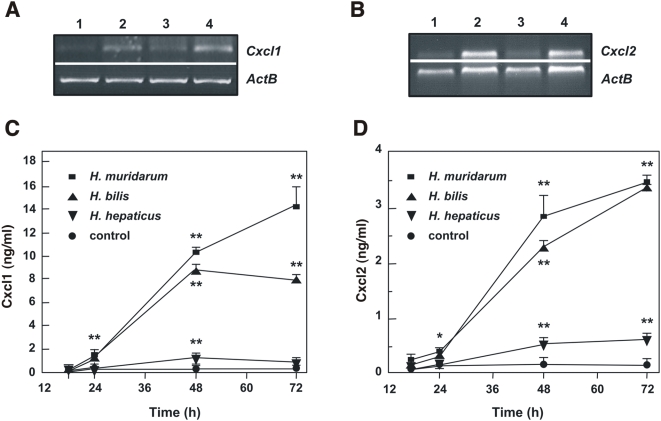
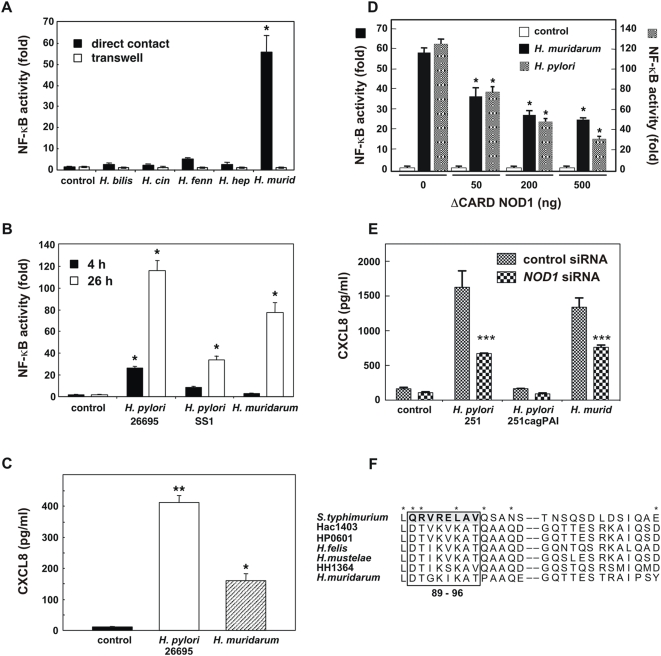
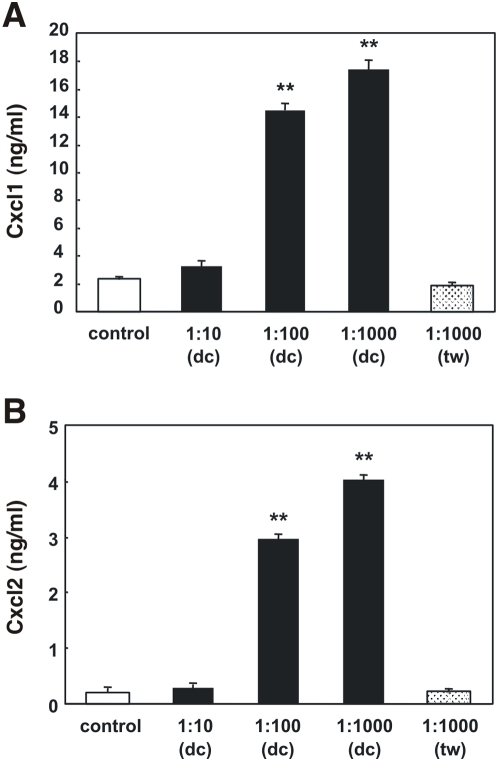
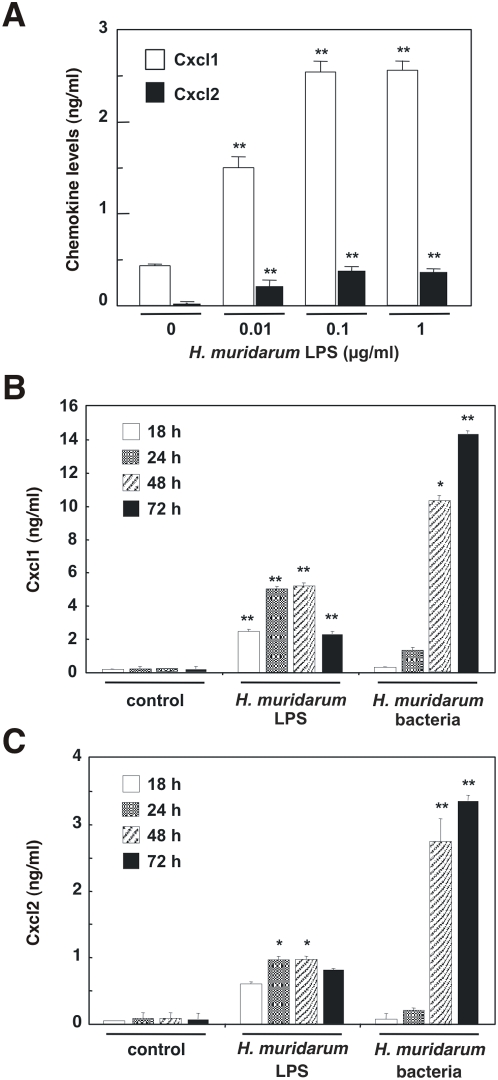
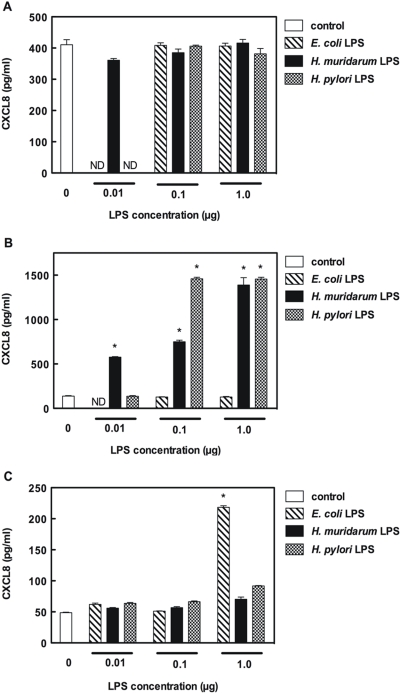
Helicobacter spp. represent a proportionately small but significant component of the normal intestinal microflora of animal hosts. Several of these intestinal Helicobacter spp. are known to induce colitis in mouse models, yet the mechanisms by which these bacteria induce intestinal inflammation are poorly understood. To address this question, we performed in vitro co-culture experiments with mouse and human epithelial cell lines stimulated with a selection of Helicobacter spp., including known pathogenic species as well as ones for which the pathogenic potential is less clear. Strikingly, a member of the normal microflora of rodents, Helicobacter muridarum, was found to be a particularly strong inducer of CXC chemokine (Cxcl1/KC, Cxcl2/MIP-2) responses in a murine intestinal epithelial cell line. Time-course studies revealed a biphasic pattern of chemokine responses in these cells, with H. muridarum lipopolysaccharide (LPS) mediating early (24-48 h) responses and live bacteria seeming to provoke later (48-72 h) responses. H. muridarum LPS per se was shown to induce CXC chemokine production in HEK293 cells stably expressing Toll-like receptor 2 (TLR2), but not in those expressing TLR4. In contrast, live H. muridarum bacteria were able to induce NF-kappaB reporter activity and CXC chemokine responses in TLR2-deficient HEK293 and in AGS epithelial cells. These responses were attenuated by transient transfection with a dominant negative construct to NOD1, and by stable expression of NOD1 siRNA, respectively. Thus, the data suggest that both TLR2 and NOD1 may be involved in innate immune sensing of H. muridarum by epithelial cells. This work identifies H. muridarum as a commensal bacterium with pathogenic potential and underscores the potential roles of ill-defined members of the normal flora in the initiation of inflammation in animal hosts. We suggest that H. muridarum may act as a confounding factor in colitis model studies in rodents.
幽门螺杆菌属在动物宿主的正常肠道微生物群中所占比例虽小,但却十分重要。已知其中几种肠道幽门螺杆菌可在小鼠模型中诱发结肠炎,然而这些细菌诱发肠道炎症的机制却鲜为人知。为解决这一问题,我们用多种幽门螺杆菌属菌株刺激小鼠和人类上皮细胞系进行了体外共培养实验,这些菌株包括已知的致病菌种以及致病潜力尚不明确的菌种。令人惊讶的是,啮齿动物正常微生物群的成员之一——鼠幽门螺杆菌,被发现是鼠肠道上皮细胞系中CXC趋化因子(Cxcl1/KC、Cxcl2/MIP-2)反应的特别强烈诱导剂。时间进程研究揭示了这些细胞中趋化因子反应的双相模式,鼠幽门螺杆菌脂多糖(LPS)介导早期(24 - 48小时)反应,而活菌似乎引发后期(48 - 72小时)反应。已表明鼠幽门螺杆菌LPS本身可在稳定表达Toll样受体2(TLR2)的HEK293细胞中诱导CXC趋化因子产生,但在表达TLR4的细胞中则不能。相反,活的鼠幽门螺杆菌能够在TLR2缺陷的HEK293细胞和AGS上皮细胞中诱导核因子κB报告基因活性和CXC趋化因子反应。这些反应分别通过用NOD1显性负性构建体瞬时转染以及NOD1 siRNA的稳定表达而减弱。因此,数据表明TLR2和NOD1可能都参与上皮细胞对鼠幽门螺杆菌的天然免疫感知。这项工作将鼠幽门螺杆菌鉴定为具有致病潜力的共生菌,并强调了正常菌群中未明确成员在动物宿主炎症起始中的潜在作用。我们认为鼠幽门螺杆菌可能在啮齿动物结肠炎模型研究中作为一个混杂因素。