• 文献检索
  • 文档翻译
  • 深度研究
  • 学术资讯
  • Suppr Zotero 插件Zotero 插件
  • 邀请有礼
  • 套餐&价格
  • 历史记录
应用&插件
Suppr Zotero 插件Zotero 插件浏览器插件Mac 客户端Windows 客户端微信小程序
定价
高级版会员购买积分包购买API积分包
服务
文献检索文档翻译深度研究API 文档MCP 服务
关于我们
关于 Suppr公司介绍联系我们用户协议隐私条款
关注我们

Suppr 超能文献

核心技术专利:CN118964589B侵权必究
粤ICP备2023148730 号-1Suppr @ 2026

文献检索

告别复杂PubMed语法,用中文像聊天一样搜索,搜遍4000万医学文献。AI智能推荐,让科研检索更轻松。

立即免费搜索

文件翻译

保留排版,准确专业,支持PDF/Word/PPT等文件格式,支持 12+语言互译。

免费翻译文档

深度研究

AI帮你快速写综述,25分钟生成高质量综述,智能提取关键信息,辅助科研写作。

立即免费体验

ClanTox:一种短动物毒素分类器。

ClanTox: a classifier of short animal toxins.

作者信息

Naamati Guy, Askenazi Manor, Linial Michal

机构信息

Computer Science and Engineering, The Hebrew University of Jerusalem, Israel.

出版信息

Nucleic Acids Res. 2009 Jul;37(Web Server issue):W363-8. doi: 10.1093/nar/gkp299. Epub 2009 May 8.

DOI:10.1093/nar/gkp299
PMID:19429697
原文链接:https://pmc.ncbi.nlm.nih.gov/articles/PMC2703885/
Abstract

Toxins are detected in sporadic species along the evolutionary tree of the animal kingdom. Venomous animals include scorpions, snakes, bees, wasps, frogs and numerous animals living in the sea such as the stonefish, snail, jellyfish, hydra and more. Interestingly, proteins that share a common scaffold with animal toxins also exist in non-venomous species. However, due to their short length and primary sequence diversity, these, toxin-like proteins remain undetected by classical search engines and genome annotation tools. We construct a toxin classification machine and web server called ClanTox (Classifier of Animal Toxins) that is based on the extraction of sequence-driven features from the primary protein sequence followed by the application of a classification system trained on known animal toxins. For a given input list of sequences, from venomous or non-venomous settings, the ClanTox system predicts whether each sequence is toxin-like. ClanTox provides a ranked list of positively predicted candidates according to statistical confidence. For each protein, additional information is presented including the presence of a signal peptide, the number of cysteine residues and the associated functional annotations. ClanTox is a discovery-prediction tool for a relatively overlooked niche of toxin-like cell modulators, many of which are therapeutic agent candidates. The ClanTox web server is freely accessible at http://www.clantox.cs.huji.ac.il.

摘要

在动物王国的进化树上,毒素在一些散在的物种中被检测到。有毒动物包括蝎子、蛇、蜜蜂、黄蜂、青蛙以及众多生活在海洋中的动物,如石鱼、蜗牛、水母、水螅等等。有趣的是,与动物毒素具有共同结构支架的蛋白质在无毒物种中也存在。然而,由于它们长度较短且一级序列具有多样性,这些类毒素蛋白仍未被传统搜索引擎和基因组注释工具检测到。我们构建了一个名为ClanTox(动物毒素分类器)的毒素分类机器和网络服务器,它基于从蛋白质一级序列中提取序列驱动特征,随后应用在已知动物毒素上训练的分类系统。对于给定的来自有毒或无毒环境的序列输入列表,ClanTox系统预测每个序列是否为类毒素。ClanTox根据统计置信度提供一个正向预测候选者的排名列表。对于每个蛋白质,还会呈现额外信息,包括信号肽的存在、半胱氨酸残基的数量以及相关的功能注释。ClanTox是一种用于相对被忽视的类毒素细胞调节剂领域的发现预测工具,其中许多是治疗剂候选物。ClanTox网络服务器可通过http://www.clantox.cs.huji.ac.il免费访问。
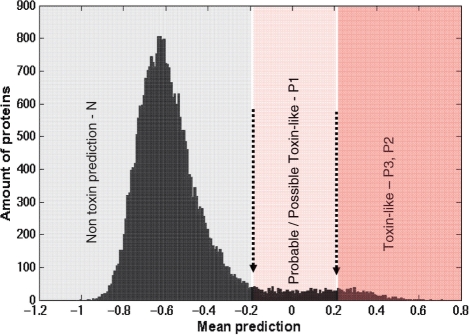
https://cdn.ncbi.nlm.nih.gov/pmc/blobs/c262/2703885/c61ccad2d4cd/gkp299f2.jpg
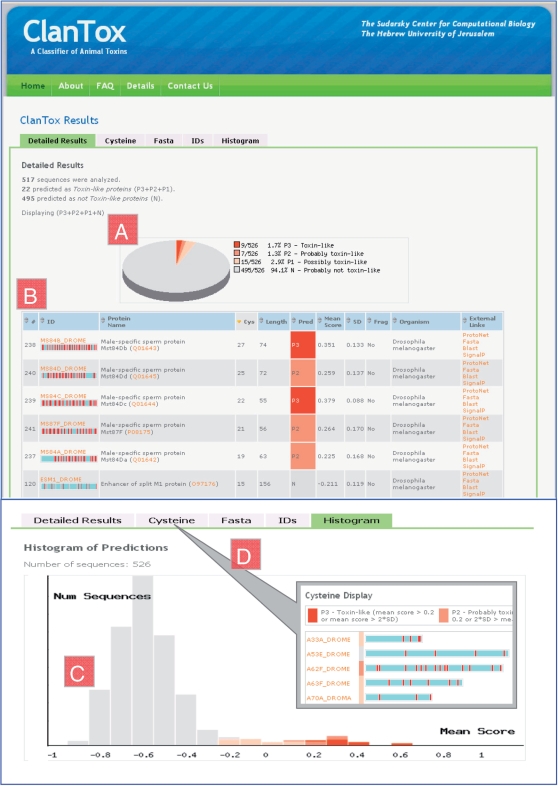
https://cdn.ncbi.nlm.nih.gov/pmc/blobs/c262/2703885/ef6ca0507c79/gkp299f1.jpg
https://cdn.ncbi.nlm.nih.gov/pmc/blobs/c262/2703885/c61ccad2d4cd/gkp299f2.jpg
https://cdn.ncbi.nlm.nih.gov/pmc/blobs/c262/2703885/ef6ca0507c79/gkp299f1.jpg
https://cdn.ncbi.nlm.nih.gov/pmc/blobs/c262/2703885/c61ccad2d4cd/gkp299f2.jpg

相似文献

1
ClanTox: a classifier of short animal toxins.ClanTox:一种短动物毒素分类器。
Nucleic Acids Res. 2009 Jul;37(Web Server issue):W363-8. doi: 10.1093/nar/gkp299. Epub 2009 May 8.
2
Short toxin-like proteins abound in Cnidaria genomes.短型类毒素蛋白广泛存在于刺胞动物基因组中。
Toxins (Basel). 2012 Nov 16;4(11):1367-84. doi: 10.3390/toxins4111367.
3
A predictor for toxin-like proteins exposes cell modulator candidates within viral genomes.一种预测毒素样蛋白的方法揭示了病毒基因组中细胞调节剂的候选物。
Bioinformatics. 2010 Sep 15;26(18):i482-8. doi: 10.1093/bioinformatics/btq375.
4
Overlooked Short Toxin-Like Proteins: A Shortcut to Drug Design.被忽视的短型毒素样蛋白:药物设计的捷径。
Toxins (Basel). 2017 Oct 29;9(11):350. doi: 10.3390/toxins9110350.
5
ATDB: a uni-database platform for animal toxins.ATDB:一个用于动物毒素的单一数据库平台。
Nucleic Acids Res. 2008 Jan;36(Database issue):D293-7. doi: 10.1093/nar/gkm832. Epub 2007 Oct 11.
6
Tox-Prot, the toxin protein annotation program of the Swiss-Prot protein knowledgebase.Tox-Prot,瑞士蛋白质数据库(Swiss-Prot)中的毒素蛋白注释程序。
Toxicon. 2005 Mar 1;45(3):293-301. doi: 10.1016/j.toxicon.2004.10.018. Epub 2004 Dec 15.
7
Novel families of toxin-like peptides in insects and mammals: a computational approach.昆虫和哺乳动物中新型毒素样肽家族:一种计算方法。
J Mol Biol. 2007 Jun 1;369(2):553-66. doi: 10.1016/j.jmb.2007.02.106. Epub 2007 Mar 15.
8
[Structures and functions of animal toxins].[动物毒素的结构与功能]
C R Seances Soc Biol Fil. 1997;191(3):329-44.
9
DeTox: a pipeline for the detection of toxins in venomous organisms.DeTox:一种用于检测有毒生物体内毒素的管道。
Brief Bioinform. 2024 Jan 22;25(2). doi: 10.1093/bib/bbae094.
10
Functional architectures of animal toxins: a clue to drug design?动物毒素的功能结构:药物设计的线索?
Toxicon. 1998 Nov;36(11):1557-72. doi: 10.1016/s0041-0101(98)00148-2.

引用本文的文献

1
Exo-Tox: Identifying Exotoxins from secreted bacterial proteins.外毒素:从分泌的细菌蛋白中鉴定外毒素
BioData Min. 2025 Aug 8;18(1):52. doi: 10.1186/s13040-025-00469-2.
2
ToxiPep: Peptide toxicity prediction via fusion of context-aware representation and atomic-level graph.ToxiPep:通过上下文感知表示与原子级图融合进行肽毒性预测
Comput Struct Biotechnol J. 2025 May 28;27:2347-2358. doi: 10.1016/j.csbj.2025.05.039. eCollection 2025.
3
ToxDL 2.0: Protein toxicity prediction using a pretrained language model and graph neural networks.

本文引用的文献

1
Defensins and the convergent evolution of platypus and reptile venom genes.防御素与鸭嘴兽和爬行动物毒液基因的趋同进化
Genome Res. 2008 Jun;18(6):986-94. doi: 10.1101/gr.7149808. Epub 2008 May 7.
2
The Protein Identifier Cross-Referencing (PICR) service: reconciling protein identifiers across multiple source databases.蛋白质标识符交叉引用(PICR)服务:协调多个源数据库中的蛋白质标识符。
BMC Bioinformatics. 2007 Oct 18;8:401. doi: 10.1186/1471-2105-8-401.
3
ATDB: a uni-database platform for animal toxins.ATDB:一个用于动物毒素的单一数据库平台。
ToxDL 2.0:使用预训练语言模型和图神经网络进行蛋白质毒性预测。
Comput Struct Biotechnol J. 2025 Apr 2;27:1538-1549. doi: 10.1016/j.csbj.2025.04.002. eCollection 2025.
4
Conotoxins: Classification, Prediction, and Future Directions in Bioinformatics.芋螺毒素:生物信息学中的分类、预测及未来方向
Toxins (Basel). 2025 Feb 9;17(2):78. doi: 10.3390/toxins17020078.
5
Computational epitope-based vaccine design with bioinformatics approach; a review.基于计算表位的生物信息学疫苗设计综述
Heliyon. 2025 Jan 4;11(1):e41714. doi: 10.1016/j.heliyon.2025.e41714. eCollection 2025 Jan 15.
6
Machine learning for antimicrobial peptide identification and design.用于抗菌肽鉴定与设计的机器学习
Nat Rev Bioeng. 2024 May;2(5):392-407. doi: 10.1038/s44222-024-00152-x. Epub 2024 Feb 26.
7
ToxGIN: an In silico prediction model for peptide toxicity via graph isomorphism networks integrating peptide sequence and structure information.ToxGIN:一种通过图同构网络整合肽序列和结构信息的肽毒性的计算预测模型。
Brief Bioinform. 2024 Sep 23;25(6). doi: 10.1093/bib/bbae583.
8
PepNet: an interpretable neural network for anti-inflammatory and antimicrobial peptides prediction using a pre-trained protein language model.PepNet:一种基于预训练蛋白质语言模型的可解释神经网络,用于预测抗炎和抗菌肽。
Commun Biol. 2024 Sep 28;7(1):1198. doi: 10.1038/s42003-024-06911-1.
9
Structure-aware deep learning model for peptide toxicity prediction.基于结构感知的深度学习模型用于预测肽毒性。
Protein Sci. 2024 Jul;33(7):e5076. doi: 10.1002/pro.5076.
10
VISH-Pred: an ensemble of fine-tuned ESM models for protein toxicity prediction.VISH-Pred:一种用于蛋白质毒性预测的微调 ESM 模型的集成。
Brief Bioinform. 2024 May 23;25(4). doi: 10.1093/bib/bbae270.
Nucleic Acids Res. 2008 Jan;36(Database issue):D293-7. doi: 10.1093/nar/gkm832. Epub 2007 Oct 11.
4
Novel families of toxin-like peptides in insects and mammals: a computational approach.昆虫和哺乳动物中新型毒素样肽家族:一种计算方法。
J Mol Biol. 2007 Jun 1;369(2):553-66. doi: 10.1016/j.jmb.2007.02.106. Epub 2007 Mar 15.
5
UniSave: the UniProtKB sequence/annotation version database.UniSave:UniProtKB序列/注释版本数据库。
Bioinformatics. 2006 May 15;22(10):1284-5. doi: 10.1093/bioinformatics/btl105. Epub 2006 Mar 21.
6
SCORPION2: a database for structure-function analysis of scorpion toxins.SCORPION2:一个用于蝎子毒素结构功能分析的数据库。
Toxicon. 2006 Mar;47(3):356-63. doi: 10.1016/j.toxicon.2005.12.001. Epub 2006 Jan 30.
7
Early evolution of the venom system in lizards and snakes.蜥蜴和蛇毒液系统的早期进化
Nature. 2006 Feb 2;439(7076):584-8. doi: 10.1038/nature04328. Epub 2005 Nov 16.
8
From genome to "venome": molecular origin and evolution of the snake venom proteome inferred from phylogenetic analysis of toxin sequences and related body proteins.从基因组到“毒液组”:基于毒素序列及相关身体蛋白的系统发育分析推断蛇毒蛋白质组的分子起源与进化
Genome Res. 2005 Mar;15(3):403-20. doi: 10.1101/gr.3228405.
9
Tox-Prot, the toxin protein annotation program of the Swiss-Prot protein knowledgebase.Tox-Prot,瑞士蛋白质数据库(Swiss-Prot)中的毒素蛋白注释程序。
Toxicon. 2005 Mar 1;45(3):293-301. doi: 10.1016/j.toxicon.2004.10.018. Epub 2004 Dec 15.
10
ProtoNet 4.0: a hierarchical classification of one million protein sequences.ProtoNet 4.0:一百万个蛋白质序列的层次分类
Nucleic Acids Res. 2005 Jan 1;33(Database issue):D216-8. doi: 10.1093/nar/gki007.