
谷物产品强化叶酸后严重先天性心脏病的患病率:加拿大魁北克的时间趋势分析
Prevalence of severe congenital heart disease after folic acid fortification of grain products: time trend analysis in Quebec, Canada.
作者信息
Ionescu-Ittu Raluca, Marelli Ariane J, Mackie Andrew S, Pilote Louise
机构信息
Department of Epidemiology, Biostatistics and Occupational Health, McGill University, Montreal, Canada.
出版信息
BMJ. 2009 May 12;338:b1673. doi: 10.1136/bmj.b1673.
OBJECTIVE
To investigate whether the 1998 government policy for mandatory fortification of flour and pasta products with folate was followed by a reduction in the prevalence of severe congenital heart defects.
DESIGN
Time trend analysis.
SETTING
Province of Quebec, Canada.
PARTICIPANTS
Infants born in 1990-2005 identified with severe congenital heart defects (tetralogy of Fallot, endocardial cushion defects, univentricular hearts, truncus arteriosus, or transposition complexes) in Quebec administrative databases.
METHODS
Data analysed in two time periods (before and after fortification). Birth prevalence measured annually as infants (live and stillbirths) with severe congenital heart defects per 1000 births in Quebec. Changes in the birth prevalence from the period before to the period after fortification were estimated with Poisson regression.
RESULTS
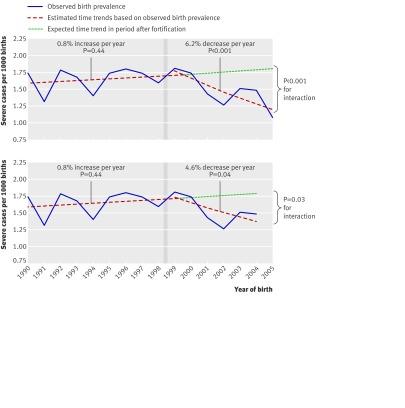
Among the 1, 324,440 births in Quebec in 1990-2005 there were 2083 infants born with severe congenital heart defects, corresponding to an average birth prevalence of 1.57/1000 births. Time trend analysis showed no change in the birth prevalence of severe birth defects in the nine years before fortification (rate ratio 1.01, 95% confidence interval 0.99 to 1.03), while in the seven years after fortification there was a significant 6% decrease per year (0.94, 0.90 to 0.97).
CONCLUSIONS
Public health measures to increase folic acid intake were followed by a decrease in the birth prevalence of severe congenital heart defects. These findings support the hypothesis that folic acid has a preventive effect on heart defects.
目的
调查1998年政府强制要求在面粉和面食产品中添加叶酸的政策实施后,严重先天性心脏缺陷的患病率是否有所降低。
设计
时间趋势分析。
地点
加拿大魁北克省。
参与者
在魁北克行政数据库中识别出的1990 - 2005年出生的患有严重先天性心脏缺陷(法洛四联症、心内膜垫缺损、单心室心脏、动脉干、或转位复合体)的婴儿。
方法
在两个时间段(强化前和强化后)进行数据分析。每年以魁北克每1000例出生婴儿(活产和死产)中患有严重先天性心脏缺陷的婴儿数量来衡量出生患病率。用泊松回归估计强化前到强化后出生患病率的变化。
结果
在1990 - 2005年魁北克的1324440例出生婴儿中,有2083例出生时患有严重先天性心脏缺陷,平均出生患病率为1.57/1000例出生。时间趋势分析显示,强化前的九年中,严重出生缺陷的出生患病率没有变化(率比1.01,95%置信区间0.99至1.03),而在强化后的七年中,每年显著下降6%(0.94,0.90至0.97)。
结论
增加叶酸摄入量的公共卫生措施实施后,严重先天性心脏缺陷的出生患病率有所下降。这些发现支持了叶酸对心脏缺陷有预防作用的假设。
 Zotero 插件