Fitzgerald Ryan H, Mills Joseph L, Joseph Warren, Armstrong David G
Southern Arizona Limb Salvage Alliance and College of Medicine, University of Arizona, Tucson, USA.
Eplasty. 2009;9:e15. Epub 2009 May 5.
People with diabetes are prone to develop lower-extremity ulcerations and infections, both of which serve as major risk factors for limb amputation. The development of lower-extremity complications of diabetes is associated with increased morbidity and mortality. Recently, there has been increasing interest in the development of interdisciplinary teams to manage the myriad factors that complicate the treatment of high-risk patients, particularly in the perihospitalization period.
This article presents 7 essential skills that necessarily allow the limb salvage team to appropriately manage the most common presenting comorbidities in patients with diabetes, including vasculopathy, infection, and deformity.
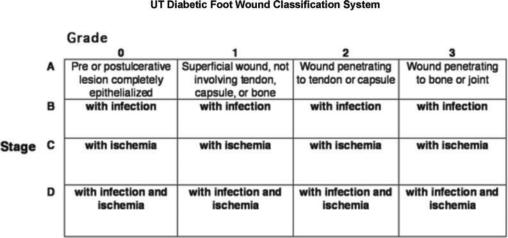
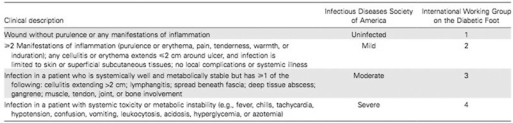
Seven essentials skills have been demonstrated to promote the greatest salvage outcomes, and these are the ability to (1) perform hemodynamic and anatomic vascular assessment with revascularization, as necessary; (2) perform neurologic workup; (3) perform site-appropriate culture technique; (4) perform wound assessment and staging/grading of infection and ischemia; (5) perform site-specific bedside and intraoperative incision and debridement; (6) initiate and modify culture-specific and patient-appropriate antibiotic therapy; and (7) perform appropriate postoperative monitoring to reduce risk of reulceration and infection.
Utilization of these 7 essential skills as the core basis for interdisciplinary limb salvage team models will provide clinicians guidance when establishing such teams. Interdisciplinary teams have been demonstrated to improve quality and efficiency of patient care, thus improving overall outcomes and reducing amputation rates.
糖尿病患者易发生下肢溃疡和感染,这两者均是肢体截肢的主要危险因素。糖尿病下肢并发症的发生与发病率和死亡率增加相关。最近,人们越来越关注跨学科团队的发展,以管理使高危患者治疗复杂化的众多因素,尤其是在住院期间。
本文介绍了7项基本技能,这些技能使肢体挽救团队能够妥善处理糖尿病患者最常见的合并症,包括血管病变、感染和畸形。
已证明7项基本技能可促进最佳挽救效果,这些技能包括:(1)必要时进行血流动力学和解剖学血管评估并进行血运重建;(2)进行神经学检查;(3)采用适合部位的培养技术;(4)进行伤口评估以及感染和缺血的分期/分级;(5)进行特定部位的床边和术中切开清创;(6)启动并调整针对培养结果和患者情况的抗生素治疗;(7)进行适当的术后监测以降低再溃疡和感染风险。
将这7项基本技能作为跨学科肢体挽救团队模式的核心基础加以运用,将为临床医生建立此类团队提供指导。已证明跨学科团队可提高患者护理的质量和效率,从而改善总体治疗效果并降低截肢率。