Garoushi Sufyan, Vallittu Pekka K, Lassila Lippo V J
Department of Prosthetic Dentistry & Biomaterials Science, Institute of Dentistry, University of Turku, Turku, Finland.
Open Dent J. 2009 Mar 18;3:36-41. doi: 10.2174/1874210600903010036.
The aim of this study was to determine the static load-bearing capacity of endodontically treated maxillary incisors restored with post-core complex made of experimental fiber composite resin (FC) and complete crown made of particulate filler composite (PFC). Further aim was to evaluate the effect of FC resin on the failure mode of the restoration.
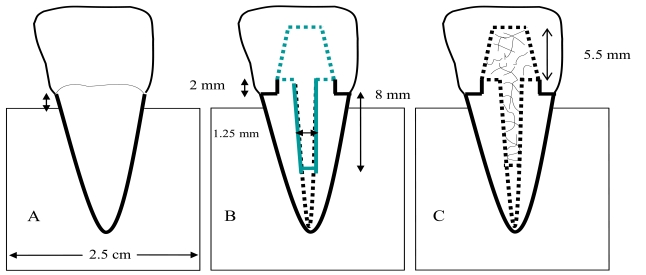
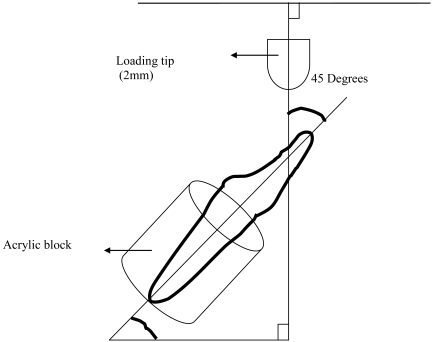
The experimental composite resin (FC) was prepared by mixing 22.5 wt% of short E-glass fibers (3 mm in length) and 22.5 wt% of semi-interpenetrating polymer network (IPN) resin with 55 wt% of silane treated silica fillers. Thirty extracted sound upper central incisors were used. Twenty teeth were prepared by cutting the clinical crown 2 mm above the cemento-enamel junction horizontally. Restorations were made by two techniques (n=10). Group A (control group) contained samples of sound incisor teeth. Group B had teeth restored using glass fiber post (everStick, Stick- Teck) and PFC (Filtek Z250, 3M-ESPE) to build up core and complete crown. In Group C, the teeth were restored with FC as post-core and complete crown of PFC. The root canals were prepared and posts were cemented with a dual cure resin cement. The restorations were polymerized with a hand-light curing unit. All restored teeth were stored in water at room temperature for 24 h before they were statically loaded with speed of 1.0 mm/min until fracture. Data were analyzed using ANOVA (p=0.05). Failure modes were visually examined.
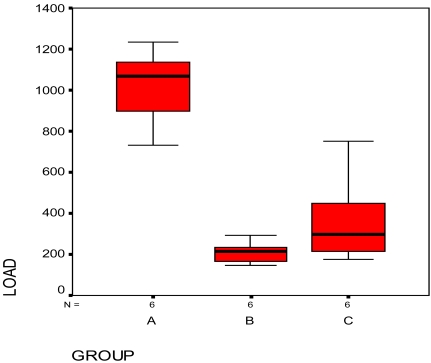
ANOVA revealed that restored incisors (Group B and C) had a statistically significantly lower load-bearing capacity (p<0.05) than the control group. Restorations made from FC post-core and PFC coverage (Group C) gave force value of 363 N (112 SD), which was higher than the value of Group B (211 N, 50 SD).
Within the limitations of this study, the teeth restored with experimental fiber composite post-core demonstrated higher load bearing capacity than those with fiber post and PFC core.
本研究旨在确定用实验性纤维复合树脂(FC)制成的桩核复合体及颗粒填料复合树脂(PFC)制成的全冠修复的经根管治疗的上颌切牙的静态承载能力。进一步的目的是评估FC树脂对修复体失败模式的影响。
通过将22.5 wt%的短E玻璃纤维(长度为3 mm)、22.5 wt%的半互穿聚合物网络(IPN)树脂与55 wt%的硅烷处理过的二氧化硅填料混合来制备实验性复合树脂(FC)。使用30颗拔除的健康上颌中切牙。通过在牙骨质-釉质界上方2 mm水平切割临床冠来制备20颗牙齿。采用两种技术进行修复(n = 10)。A组(对照组)包含健康切牙样本。B组使用玻璃纤维桩(everStick,Stick-Teck)和PFC(Filtek Z250,3M-ESPE)来构建核和全冠修复牙齿。C组用FC作为桩核并用PFC作为全冠修复牙齿。预备根管并用双固化树脂水门汀粘结桩。用手持式光固化装置使修复体聚合。所有修复后的牙齿在室温水中储存24小时,然后以1.0 mm/分钟的速度进行静态加载直至折断。使用方差分析(p = 0.05)分析数据。通过目视检查失败模式。
方差分析显示,修复后的切牙(B组和C组)的承载能力在统计学上显著低于对照组(p < 0.05)。由FC桩核和PFC覆盖层制成的修复体(C组)的力值为363 N(标准差112),高于B组的值(211 N,标准差50)。
在本研究的局限性内,用实验性纤维复合桩核修复的牙齿比用纤维桩和PFC核修复的牙齿表现出更高的承载能力。