Glover Lucy, Horn David
London School of Hygiene & Tropical Medicine, Keppel Street, London, WC1E 7HT, UK.
Mol Biochem Parasitol. 2009 Aug;166(2):194-7. doi: 10.1016/j.molbiopara.2009.03.010.
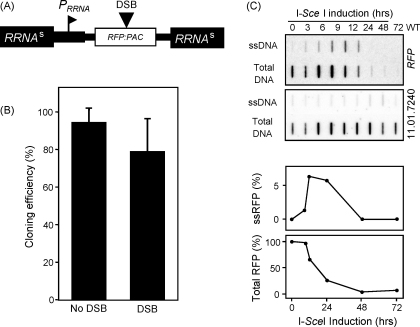
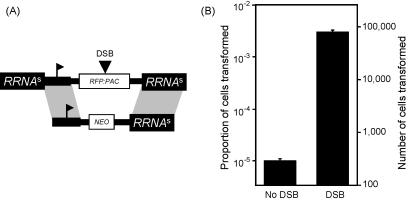
Genetic manipulation in African trypanosomes typically relies upon electroporation with chromosomal integration of DNA constructs by homologous recombination. Relatively little is known about chromosomal recombination and repair in these organisms however and low transformation efficiency and position effects can limit forward genetic approaches. In yeast and mammalian cells, site-specific DNA double-strand breaks (DSBs) stimulate targeted integration through homologous recombination-based repair where the exogenous DNA serves as the template. We have explored the effect of DSBs on targeted integration in bloodstream-form Trypanosoma brucei, focusing on the ribosomal RNA-spacer target commonly used to integrate recombinant constructs. DSB-repair within the ribosomal RNA tandem gene-repeats is likely dominated by single-strand annealing allowing approximately 80% of cells to survive the break. In the presence of exogenous DNA, transformation efficiency is increased approximately 250-fold by DSB-induction. In the example presented, more than 1% of cells that survive the procedure were transformed generating 80,000 transformants from a typical experiment.
在非洲锥虫中进行基因操作通常依赖于通过同源重组将DNA构建体整合到染色体的电穿孔法。然而,对于这些生物体中的染色体重组和修复,人们了解得相对较少,而且低转化效率和位置效应可能会限制正向遗传学方法。在酵母和哺乳动物细胞中,位点特异性DNA双链断裂(DSB)通过基于同源重组的修复刺激靶向整合,其中外源DNA作为模板。我们研究了DSB对布氏锥虫血流形式靶向整合的影响,重点关注常用于整合重组构建体的核糖体RNA间隔区靶点。核糖体RNA串联基因重复序列内的DSB修复可能主要由单链退火主导,约80%的细胞能在断裂后存活。在外源DNA存在的情况下,DSB诱导可使转化效率提高约250倍。在给出的例子中,超过1%的在该过程中存活的细胞被转化,从一个典型实验中产生了80000个转化体。