Girgis Hany S, Hottes Alison K, Tavazoie Saeed
Lewis-Sigler Institute for Integrative Genomics and Department of Molecular Biology, Princeton University, Princeton, New Jersey, USA.
PLoS One. 2009 May 20;4(5):e5629. doi: 10.1371/journal.pone.0005629.
Antibiotic exposure rapidly selects for more resistant bacterial strains, and both a drug's chemical structure and a bacterium's cellular network affect the types of mutations acquired.
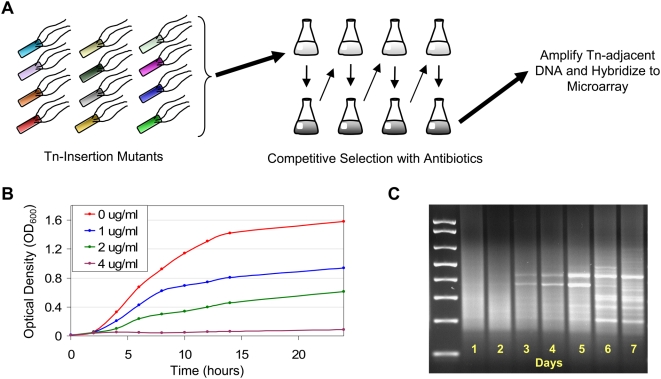
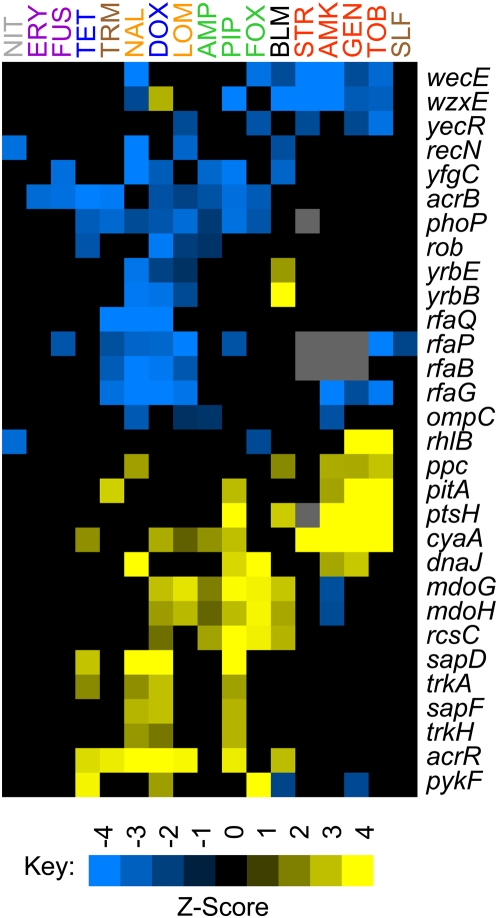
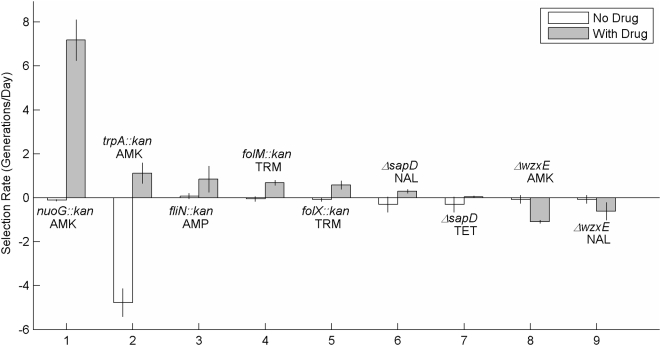
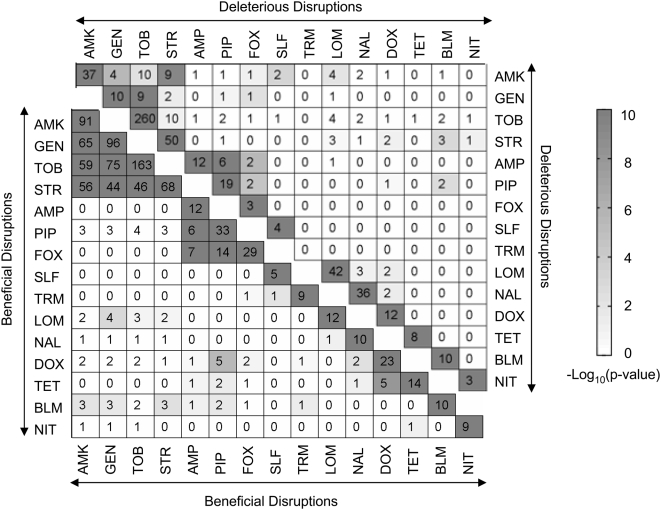
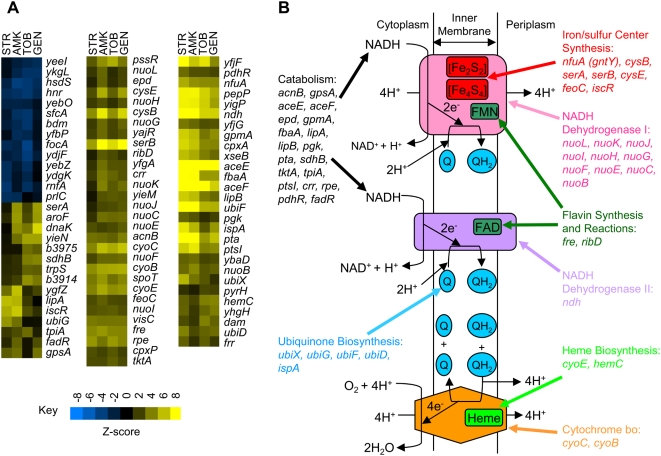
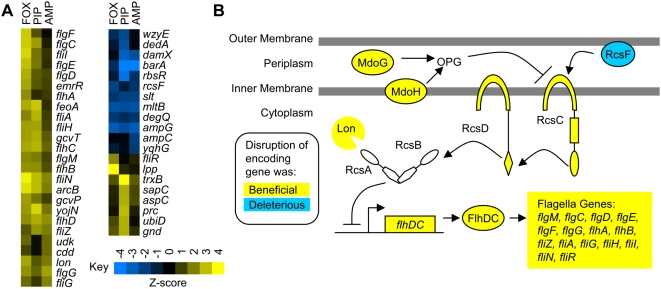
METHODOLOGY/PRINCIPAL FINDINGS: To better characterize the genetic determinants of antibiotic susceptibility, we exposed a transposon-mutagenized library of Escherichia coli to each of 17 antibiotics that encompass a wide range of drug classes and mechanisms of action. Propagating the library for multiple generations with drug concentrations that moderately inhibited the growth of the isogenic parental strain caused the abundance of strains with even minor fitness advantages or disadvantages to change measurably and reproducibly. Using a microarray-based genetic footprinting strategy, we then determined the quantitative contribution of each gene to E. coli's intrinsic antibiotic susceptibility. We found both loci whose removal increased general antibiotic tolerance as well as pathways whose down-regulation increased tolerance to specific drugs and drug classes. The beneficial mutations identified span multiple pathways, and we identified pairs of mutations that individually provide only minor decreases in antibiotic susceptibility but that combine to provide higher tolerance.
CONCLUSIONS/SIGNIFICANCE: Our results illustrate that a wide-range of mutations can modulate the activity of many cellular resistance processes and demonstrate that E. coli has a large mutational target size for increasing antibiotic tolerance. Furthermore, the work suggests that clinical levels of antibiotic resistance might develop through the sequential accumulation of chromosomal mutations of small individual effect.
抗生素暴露会迅速筛选出更具耐药性的细菌菌株,药物的化学结构和细菌的细胞网络都会影响所获得的突变类型。
方法/主要发现:为了更好地表征抗生素敏感性的遗传决定因素,我们将一个经转座子诱变的大肠杆菌文库暴露于17种抗生素中的每一种,这些抗生素涵盖了广泛的药物类别和作用机制。在药物浓度适度抑制同基因亲本菌株生长的条件下,将文库传代培养多代,导致即使具有微小适应性优势或劣势的菌株丰度也发生了可测量且可重复的变化。然后,我们使用基于微阵列的基因足迹策略,确定了每个基因对大肠杆菌固有抗生素敏感性的定量贡献。我们发现了一些基因座,其缺失会增加总体抗生素耐受性,以及一些途径,其下调会增加对特定药物和药物类别的耐受性。所鉴定的有益突变跨越多个途径,我们还鉴定出了一些突变对,它们单独作用时仅能轻微降低抗生素敏感性,但联合起来则能提供更高的耐受性。
结论/意义:我们的结果表明,广泛的突变可以调节许多细胞耐药过程的活性,并证明大肠杆菌具有较大的增加抗生素耐受性的突变靶点大小。此外,这项研究表明,临床水平的抗生素耐药性可能是通过具有微小个体效应的染色体突变的顺序积累而产生的。